
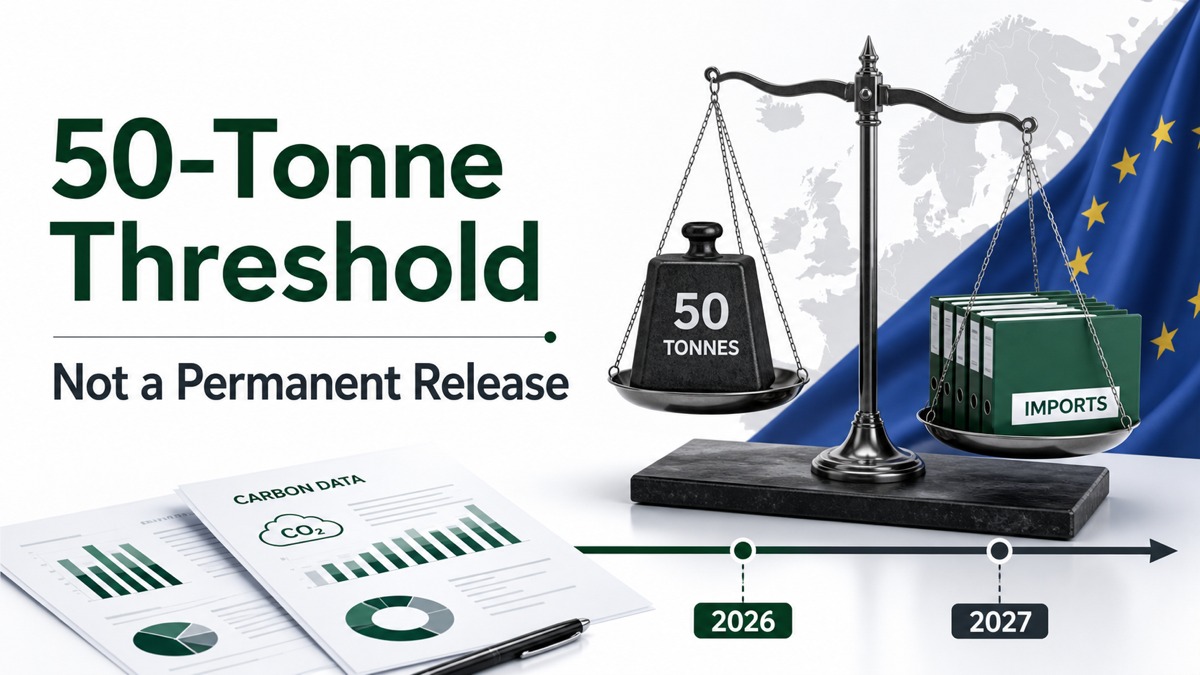
Short answer: The CBAM definitive regime applies from 1 January 2026. For most CBAM goods measured by mass, an EU importer or indirect customs representative importing more than the single 50-tonne mass threshold in a calendar year must address the authorised CBAM declarant requirements. This is not a rule that can be tested shipment by shipment, and it is not a permanent release from all record-keeping below 50 tonnes. Electricity, hydrogen and the exact CN code require separate checks against the current rules.
This reference is for manufacturers, exporters and brand owners supplying the EU. It focuses on who carries the filing responsibility, how to interpret the threshold, what data should be requested from the installation, and which cost or outcome claims should not be made without product-specific evidence.
1. What changes in 2026
The transitional period ran from 1 October 2023 to 31 December 2025 and centred on quarterly embedded-emissions reporting by the importer. The definitive regime applies from 1 January 2026. In-scope EU importers or their indirect customs representatives must deal with authorisation, embedded-emissions declarations and the surrender of CBAM certificates under the applicable framework. Certificate prices are linked to EU ETS allowance prices; the current Commission materials should be used for the applicable price and filing arrangements.
An exporter does not automatically become the party buying certificates. In practice, the exporter usually needs to confirm whether the product is in scope, provide installation and product data to the importer or declarant, and explain the data boundary, calculation method and supporting records.
2. How to read the 50-tonne threshold
The European Commission describes a single mass-based threshold: an importer or indirect customs representative importing more than 50 tonnes of CBAM goods in a calendar year needs to apply for authorised CBAM declarant status. Before relying on that number, complete these checks:
- Confirm the CN-code scope: “steel”, “aluminium”, “cement”, “fertilisers”, “electricity” and “hydrogen” are not substitutes for matching the actual goods to Annex I and the applicable CN code.
- Confirm the importer and annual aggregation: a shipment, supplier or SKU quantity cannot replace the importer-level annual assessment. The importer, customs representative and adviser should confirm the aggregation rule for the actual case.
- Check special treatment: electricity, hydrogen, outward processing and other fact patterns should not be forced into a blanket statement that “below 50 tonnes means everything is exempt”.
Below the threshold, the exporter should still retain contracts, invoices, CN-code evidence, quantities, installation details and the basis of the emissions calculation. The threshold is part of the declarant and reporting analysis; it is not a certificate that proves product compliance or removes the need to answer a scope question.
3. Data to request from the installation
| Data block | Useful records | Boundary to check |
|---|---|---|
| Goods and scope | CN code, product description, specification, quantity, origin and import period | Whether the actual code is in Annex I; an industry label is not enough |
| Installation | Facility identity and address, production route, output, energy and input records | Which facility, process stage and products are covered |
| Embedded emissions | Direct emissions, applicable indirect emissions, method, emission factors and allocation rules | Actual values, default values and other permitted methods must not be mixed |
| Evidence file | Meter readings, fuel and electricity records, output ledger, input records, calculations and version history | Period, units, product batch and installation must reconcile |
| Carbon price | If a deduction is claimed, payment or legal evidence and a calculation note | A carbon market in the producing country does not by itself prove a deductible payment |
4. Do not oversimplify actual and default values
CBAM distinguishes actual emissions from default values and sets rules for calculation, verification and declaration. The Commission also publishes definitive-period default values. Without the specific goods, installation, factors and permitted method, however, it is not safe to say that default values are always materially more expensive or that actual values are normally lower. Default values, benchmarks and implementing rules can be updated.
A safer supplier response identifies the facility, product and period covered, states the calculation method, lists missing data and lets the importer or authorised declarant confirm whether the file is usable. Where actual emissions are used, the data may need verification under the applicable rules. An ISO certificate alone does not prove that every CBAM data field has been accepted.
5. Six manual checks before sending the file
- Match each product specification and CN code to Annex I; do not summarise the entire range as “steel” or “aluminium”.
- Confirm the importer, indirect customs representative, annual aggregation and whether the single 50-tonne threshold is exceeded.
- Build one installation evidence pack with a traceable link between process, fuel, electricity, inputs, output and product allocation.
- Store actual values, default values, factors, calculation version and verification status in separate fields.
- If a deduction for a carbon price paid in the country of production is claimed, retain its legal basis, payment evidence, coverage and calculation.
- Have the importer or declarant review fields, units, period and submission format; do not present an internal estimate as an EU conclusion.
Scope note and sources
This is a supply-chain evidence reference, not a substitute for the importer, authorised CBAM declarant, customs authority or professional adviser assessing a specific CN code and current rule. Use the European Commission CBAM definitive-regime and guidance pages and the current text of Regulation (EU) 2023/956 as the source of record.


