
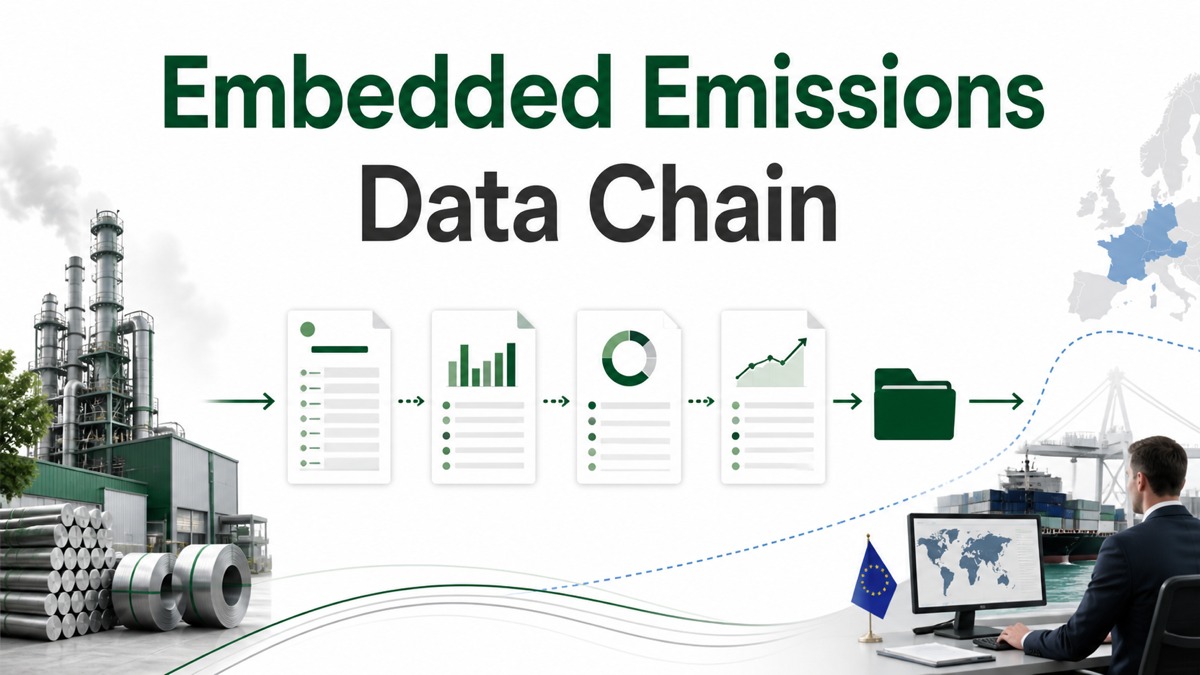
Under the CBAM definitive regime, the EU importer or indirect customs representative carries the declaration and related obligations. Suppliers, non-EU installation operators and supply-chain teams support that process by connecting the goods, installation, production period and emissions evidence. A supplier’s single emissions figure is not automatically ready for use in a CBAM declaration.
This page is a supplier-data request and review checklist. It does not determine whether a product is covered, which calculation method applies, or what a particular declaration will produce. Confirm the CN code, origin, production route, import arrangement and current official requirements for each case.
1. Confirm the goods and responsibility chain
Goods scope: Record the full goods description, applicable CN code, country of origin, quantity, unit and import date, then compare them with Annex I to Regulation (EU) 2023/956 and applicable later instruments. A product name or supplier model number cannot replace the CN-code assessment.
Installation: Build the record at installation level. Keep the installation name and address, operator, process route, goods or precursor relationship and data contact. Different installations may use different energy, process and production bases; merged figures need an explained allocation rather than an unexplained average.
Declarant role: The supplier or non-EU installation generally provides production and emissions information. Whether an EU importer or indirect customs representative must apply for authorised CBAM declarant status, and how the declaration is filed, must be confirmed by the responsible party under its import arrangement and the official system. A supplier data pack does not replace authorisation, declaration or certificate obligations.
2. Request a usable data pack
Ask for a chain linking the imported goods, installation, reporting period and calculation method—not just a final number in tonnes of CO2 equivalent.
Goods and output: goods description, CN-code mapping basis, installation, reporting period, output and unit, plus shipment, invoice or batch references.
Production process: process flow, system boundary, energy and material inputs, relevant precursors, measurement points, emission sources and data origins. State whether each figure is installation-level, process-level or product-level.
Emissions result: provide direct embedded emissions under the applicable method. Whether and how indirect emissions are included must be checked against the goods category and current CBAM methodology. Keep the total, product intensity, emission factors, energy sources and calculation sheet rather than only the final result.
Precursors and allocation: for complex goods, retain precursor origin, precursor emissions, input/output quantities, allocation rules and loss assumptions. Do not spread an organisation-wide annual emissions figure across products without a product-level basis.
Supporting files: collect meter records, energy bills, production records, emissions calculations, emission-factor sources, process notes, installation identifiers and any applicable operator emissions report or verification report. An ISO 14064, environmental or product-carbon-footprint file is material for review, but it does not automatically substitute for CBAM-method data.
3. Keep actual values, default values and verification separate
Article 7 of Regulation (EU) 2023/956 provides for embedded emissions to be determined using actual emissions or applicable default values. Actual emissions must follow Annex IV. Default values are not a free-form estimate made when a supplier is late; they follow the applicable official method and values.
Where actual emissions are used, Article 8 requires the authorised CBAM declarant to ensure that the total embedded emissions in the declaration are verified by an accredited verifier within the Article 18 framework. A third-country installation may provide information through the official verification process; an organisation-level audit report held by the supplier does not by itself show that CBAM actual emissions have been verified.
Avoid writing fixed conclusions such as “unverified data must always use a higher default value” or “steel and aluminium always use the same indirect-emissions treatment”. The goods category, applicable method, data quality and implementing instruments affect the assessment.
4. Six manual checks after receipt
- Match the CN code, goods description, import batch and quantity to purchasing, invoice and customs records.
- Confirm the installation, process route and reporting period covered by the emissions data.
- Recalculate output, energy inputs, emission factors, precursor inputs and product intensity, recording unit conversions.
- Check direct/indirect emissions, boundaries, allocation and precursor data against the applicable methodology.
- Separate actual, default and estimated values; retain the method version, source and supplier explanation.
- Cross-check operator reports, verification reports, installation contacts and declarant retention fields, then issue a written gap list.
5. Write the supplier request with clear boundaries
A supplier email or spreadsheet can request installation-level data for a stated period and list the method, units, source records and verification contact. It should not promise customs clearance, a fixed penalty rate, a fixed lead time or automatic platform acceptance; those outcomes are not determined by a supplier spreadsheet alone.
绿色方舟(深圳)认证有限公司 can help organise the links between goods, installations, emissions and evidence. The responsible party must still confirm scope, verification, authorised-declarant steps and declaration treatment against the official requirements and the actual record.
Sources and update note
Primary references: the European Commission CBAM definitive-regime page, the European Commission verification page and Regulation (EU) 2023/956, including Articles 6–8 and 18 and Annexes IV–VI. Rules and implementing material may change; recheck the official version before use.


