
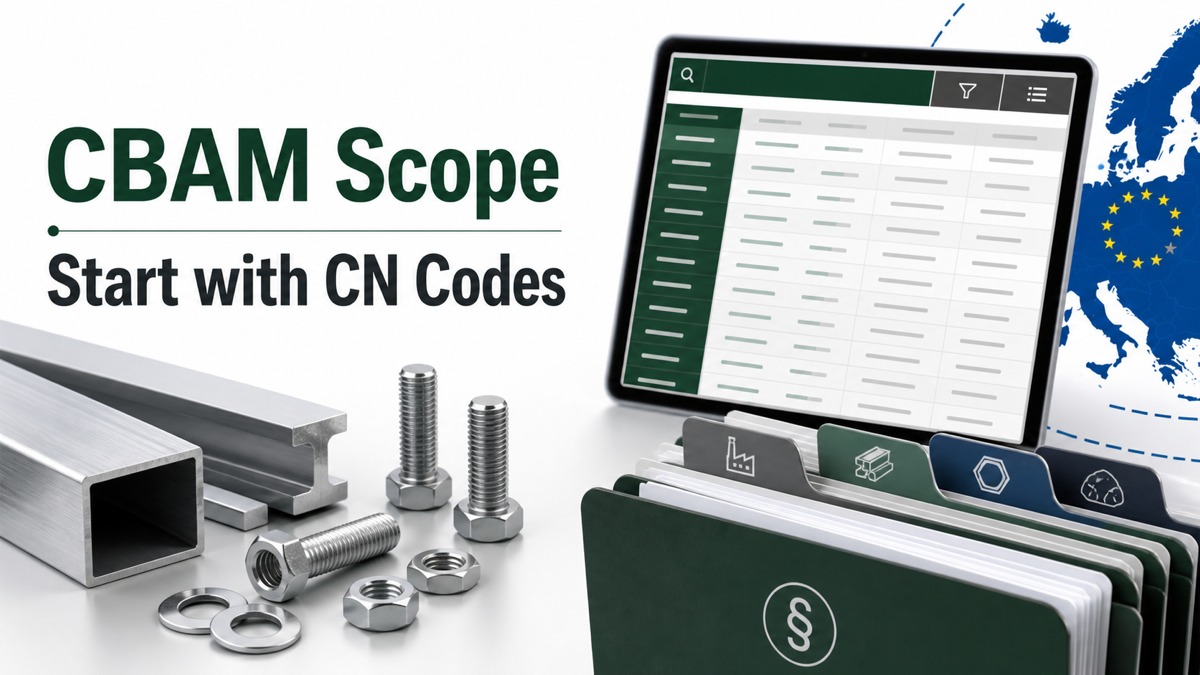
This reference is based on the European Commission’s CBAM definitive-period materials and Regulation (EU) 2023/956 available as of August 2026. It is a product-scope and evidence checklist, not a customs classification ruling. “In scope” here means that the goods and import route meet the relevant CBAM conditions; it does not mean that an importer has already completed authorisation, reporting, or certificate-related procedures.
1. What the scope test is actually testing
Article 2 of Regulation (EU) 2023/956 connects the scope to goods listed in Annex I and to specified situations, including goods originating in a third country and imported into the EU customs territory. Annex I identifies goods by Combined Nomenclature (CN) code and the associated greenhouse gas. The practical sequence is therefore: identify the goods, identify the declared code, identify the origin and import route, and then compare the result with Annex I. A product should not be classified from “contains steel”, “contains aluminium”, or a webpage title alone.
EU customs classification commonly uses an eight-digit CN code. An HS6 code can help with an initial search, but it is not the final scope conclusion: Annex I may cover a specific eight-digit subheading or attach a goods-description boundary. The importer or customs professional responsible for the declaration should confirm the code and retain the classification rationale.
2. Six sectors do not mean six complete chapters
The Commission’s current definitive-period page identifies six CBAM sectors: cement, iron and steel, aluminium, fertilisers, electricity, and hydrogen. The sector name is a navigation aid, not a statement that every product in a sector or an entire CN chapter is automatically covered. The final test remains the specific code, goods description, notes, and conditions in Annex I and the applicable official guidance.
| Sector | Scope-review focus | What the label does not prove |
|---|---|---|
| Iron and steel | Complete CN code, goods description, form, alloy features, and Annex I entry | That every steel-related product is covered |
| Aluminium | Code, form, product description, and the corresponding Annex I entry | That every aluminium finished product is covered |
| Cement | Specific goods entry, physical form, and import declaration | That a construction-related name is enough |
| Fertilisers | Specific fertiliser goods and the Annex I entry | That every nitrogen-containing input is covered |
| Electricity and hydrogen | Dedicated entry, origin, and import situation | That a sector name is a universal code |
3. Why 7323 cannot be decided from “tableware”
“Stainless-steel tableware” is a commercial description, not enough by itself for a CBAM scope decision. Whether 7323 corresponds to a relevant Annex I entry must be checked against the current Annex I, the complete eight-digit CN code, the goods as actually presented, and the classification rationale. It is not safe to say “it contains stainless steel, so CBAM definitely applies”, or to say “it is tableware, so it is definitely excluded” without checking the current text.
Two products with similar names may receive different codes because of form, processing, use, or the declared description. Different sales SKUs may also share a code. Keep the sales name, specification, material, processing state, photographs or drawings, packaging unit, and customs classification evidence in one record instead of relying on a product title or an old code list.
4. A four-step scope review
Step 1 — Identify the goods. Record the SKU, specification, material, form, use, quantity unit, and relevant technical images for the goods actually shipped. Do not replace the goods description with a broad catalogue category.
Step 2 — Confirm the eight-digit CN code. Obtain the current code from the party or customs professional responsible for the EU import declaration, and record the version, date, and classification rationale. HS6 is a search aid, not a substitute for the eight-digit review.
Step 3 — Compare with Annex I. Check the code, goods description, notes, and exclusions word for word. Also review the Commission’s definitive-regime and sector pages. If the code, description, and actual goods do not align, leave the scope conclusion open.
Step 4 — Separate responsibilities. A non-EU producer may provide installation and production-process emissions data. The EU importer or indirect customs representative handles the relevant import-side authorisation, declaration, and certificate procedures. Preparing a data package is not the same as completing the importer’s legal obligations.
5. The 50-tonne threshold is separate from product scope
The Commission’s definitive-regime page states that EU importers, or their indirect customs representatives, importing more than the single mass-based threshold of 50 tonnes of CBAM goods are required to apply for authorised CBAM declarant status. This threshold concerns a procedural question for the relevant importer; it does not bring non-Annex I goods into scope and does not replace the code-by-code review. Keep two separate conclusions: whether the goods are listed in Annex I, and whether the importer triggers the relevant procedure.
6. Evidence fields for a CN-code ledger
| Field | Minimum evidence |
|---|---|
| SKU and goods | SKU, specification, material, form, use, photographs, and technical drawing |
| Classification | Eight-digit CN code, classification opinion, applicable version, and review date |
| Scope comparison | Annex I entry, notes or exclusions, official link, and saved evidence location |
| Responsibility | EU importer, data provider, emissions-data request, and unresolved items |
For 绿色方舟(深圳)认证有限公司, a careful working boundary is to help organise the product–code–legal-entry–emissions evidence index and clearly mark classification, importer, or installation data that still needs confirmation. A single product name, an old spreadsheet, or one supplier statement should not be presented as a final CBAM conclusion.
Official sources
European Commission: CBAM definitive regime; European Commission: CBAM sectors; EUR-Lex: Regulation (EU) 2023/956. Official pages and legislation may be updated, so the applicable version should be checked again before an import filing.