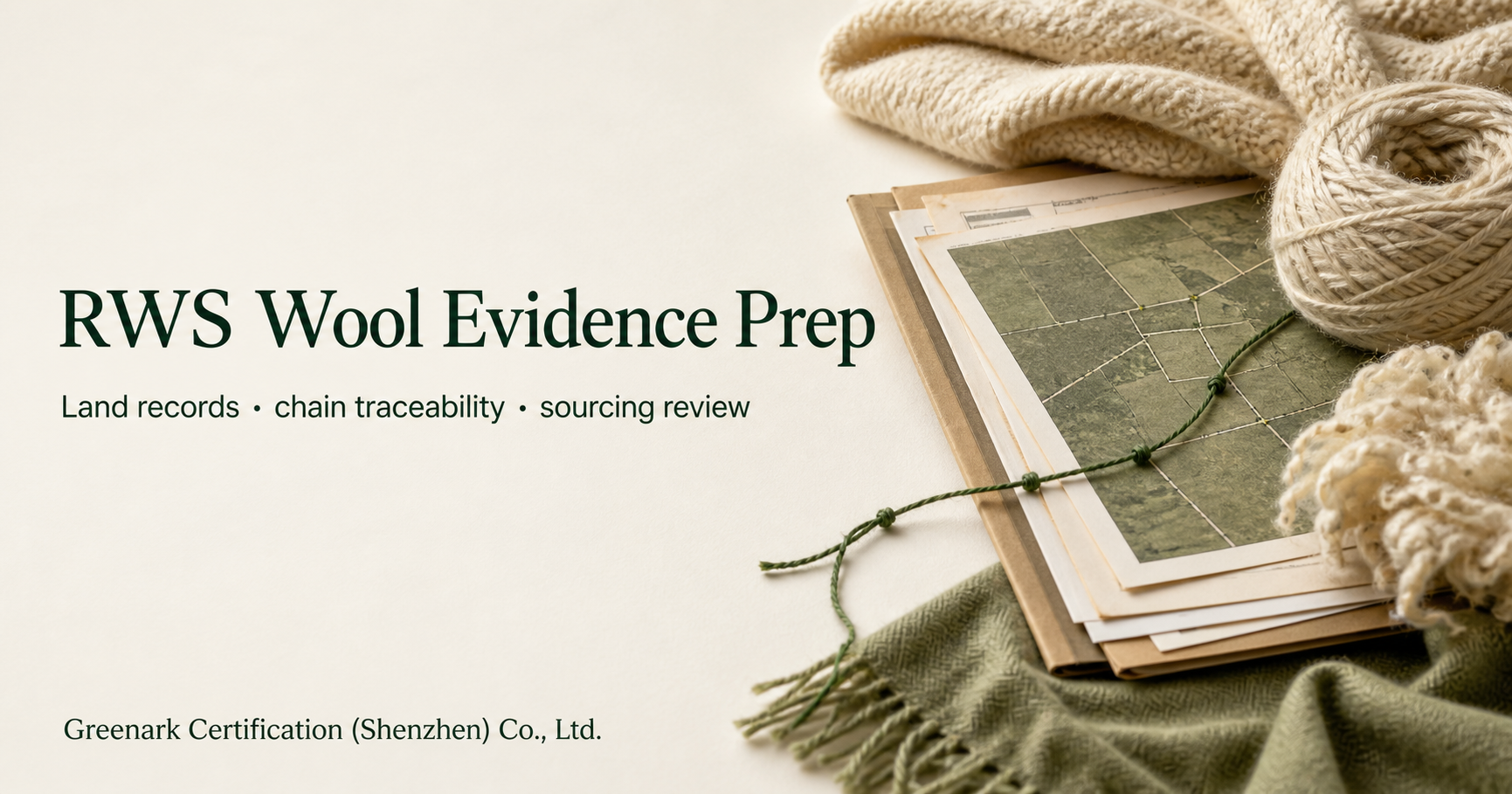
The Responsible Wool Standard (RWS) is a voluntary standard managed by Textile Exchange. It addresses sheep welfare, land management and chain-of-custody controls from the farm through the supply chain. It is not a universal customs-clearance certificate and does not replace product safety, labelling, import or consumer-law requirements in a target market.
For a brand, sourcing team or cross-border seller, the useful question is not simply whether a supplier has “a certificate”. The review must show what the Scope Certificate covers, whether the relevant shipment has Transaction Certificate evidence, and whether the proposed product or ecommerce claim follows the current standards-claims policy.
Keep the boundary clear: RWS evidence can support a defined responsible-wool claim. It cannot, by itself, prove that a product meets every law in a destination market or extend a supplier’s certificate to every SKU sold by a brand.
1. Confirm what RWS covers and what it does not
Textile Exchange describes RWS as a voluntary global standard intended to improve sheep welfare and the management of grazing land, while supporting traceability for responsible wool. Farms and supply-chain sites are audited by independent certification bodies against the applicable standard requirements. Textile Exchange also states that RWS is moving toward the Materials Matter Standard system.
Start by separating four objects: the farm or raw-material source, processing and trading sites, the shipment or lot, and the finished product with its external claim. The brand, supplier, importer and ecommerce operator may be different legal entities; a shared brand name is not proof that a certificate covers them all.
RWS should also be kept separate from product laws, textile-labelling rules, chemicals requirements, consumer-protection rules and platform policies. Record those checks in separate columns so that an RWS document is not presented as evidence for an unrelated legal obligation.
2. Use the Scope Certificate and Transaction Certificate for different questions
Scope Certificate (SC) answers: “What is this organisation qualified to produce or process under the standard?” Review the certificate holder, certification body, standard, sites, product categories, processing steps, status and organisational identifiers. Do not rely only on the first page or on a supplier’s verbal summary.
Transaction Certificate (TC) answers: “How is this particular certified-material transaction recorded?” It connects the seller, buyer, material or product description, quantity, date and relevant certification information. Textile Exchange’s RWS materials explain that certified material is tracked from the farm to the final product using transaction certificates under the Content Claim Standard (CCS).
An SC does not replace a TC for a shipment, and a TC cannot add a product category, process or legal entity that is outside the SC. If the organisation, site, material description or chain does not reconcile, pause the claim and ask the relevant certification body or trading partner to clarify the record.
3. Build an evidence index at SKU and lot level
For each SKU that may carry an RWS-related claim, create one traceable record with at least:
- SKU, style, version, fibre composition and the place of RWS wool in the product;
- Yarn, fabric, garment or other processing stages, with the organisation and site for each stage;
- Supplier SC number, certificate status, certification body, covered product categories and processes;
- Purchase orders, invoices, shipment records, lot or quantity data and the applicable TC;
- Proposed ecommerce, hangtag, packaging or catalogue language, artwork, logo and claim object;
- The relationship between the brand or seller, the certificate holder and the importer or page operator.
The purpose of this index is to let a reviewer move from the material source to the supply-chain site, transaction lot, finished product and published wording. It is an operating record, not a universal form prescribed for every business; adapt it to the current standard, claims policy, certification-body process and transaction model.
4. Review product and ecommerce claims as a separate control
“RWS wool is present somewhere in the supply chain” is not the same statement as “this finished product is eligible for an RWS product claim”. Textile Exchange’s Labeling & Standards Claims guidance states that product-related claims may appear on a product or off-product, including an ecommerce description, and must follow the current Standards Claims Policy and the relevant certification-body process.
Review the claim in this order:
- Define whether the claim concerns the raw material, yarn, fabric, garment or complete product; do not turn a partial-material record into a whole-product statement.
- Reconcile the composition, certificate scope, transaction evidence and any percentage or qualifier used in the wording.
- Check the current licence number or TE-ID, certification-body name and logo-use conditions against the controlled records.
- Save the final page, hangtag, packaging and artwork as versioned files, together with the required certification-body approval record.
- Reassess the claim when the product, supplier, material mix, certification status or publication language changes.
Do not use “RWS certified product” as a shortcut for an SKU whose scope, transaction and claim records have not been reconciled. The RWS mark should not be presented as a government safety mark or as a general mandatory-compliance mark for a destination market.
5. Record the 2026 transition without inventing a universal deadline
As checked on the date of this review, Textile Exchange’s RWS page says that the Materials Matter Standard criteria were released on December 12, 2025, that the system becomes effective on December 31, 2026, and that it becomes mandatory for Tier 4 audits from December 31, 2027. The same page tells certified and applicant organisations to follow transition updates. These are system-transition dates; they should not be rewritten as an automatic loss of every organisation’s current status on one day or as a substitute for a certification body’s project-specific instruction.
Claims and labels have a separate transition: Textile Exchange’s page states that all claims and labels must transition to Materials Matter by June 30, 2029, while the updated Standards Claims Policy is scheduled to become mandatory on September 27, 2026. Add controlled fields to the internal evidence register for the current standard, next audit standard, claims-policy version, transition-policy version and certification-body confirmation date. Recheck the latest certification-body communication and certificate status before publishing; do not rely on an older training deck.
6. Six manual checks and official references
- Does the product contain the wool material being claimed, and is the claim object clearly defined?
- Can the farm, processing site, trading organisation and final business-to-business seller be located in the evidence chain?
- Do the SC holder, sites, product categories, processes and status cover the SKU under review?
- Do the lot, quantity, date and TC reconcile with purchasing and shipment records?
- Do the ecommerce page, hangtag, packaging and artwork follow the current Standards Claims Policy and required certification-body review?
- Have textile labelling, product safety, import and platform requirements been checked separately from the RWS evidence?
Start with Textile Exchange’s Responsible Wool Standard page, Labeling & Standards Claims, Certificate Authentication, Find a Certified Company and the current standards and policy documents. When the official documents change, use the latest English version and the instructions from the relevant certification body.
Boundary note: This page describes an RWS evidence and claim-review method. It does not guarantee certification status, platform acceptance, customs clearance, sales performance or any other outcome for a particular product. The controlling evidence is the current certificate, transaction record, claims policy, destination-market requirements and certification-body advice.