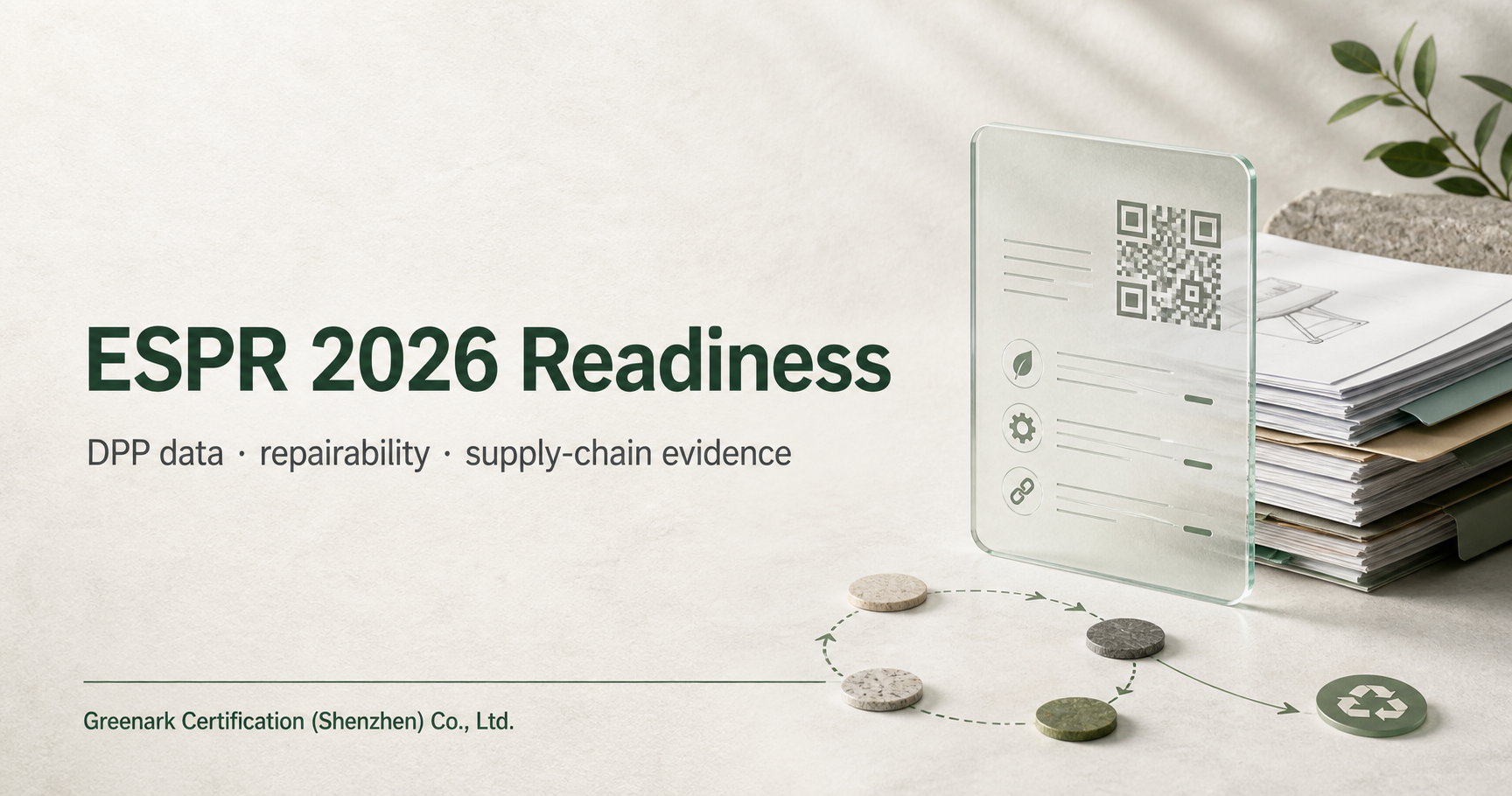
The EU Ecodesign for Sustainable Products Regulation (ESPR, Regulation (EU) 2024/1781) creates a framework for product sustainability requirements and Digital Product Passports (DPPs). It is not a universal certificate for every product. For a cross-border business, the practical task is to build product-level data and evidence that can be traced to a model, material, production site, or supply-chain record.
1. What ESPR and the DPP actually do
ESPR is the framework. It covers physical goods placed on the EU market or put into service, including components and intermediate products, while excluding categories such as food, medicines, living plants and animals, and products of human origin. It provides the legal basis for later product-specific ecodesign requirements, information requirements and DPP requirements. The applicable delegated act and other EU legislation still determine the concrete duties for a product group.
The DPP is an information and access mechanism. The European Commission describes it as a digital container for information about products, components and materials. Depending on the product group, the information may concern safety, origin, materials, repairability, environmental performance, reuse and recycling. The required data, data carrier, DPP level and access rights depend on the applicable product-specific rules.
The first preparation step is therefore not to upload every certificate into one platform. Confirm whether a specific measure applies, identify the economic operator placing the product on the market, decide which identifier must remain stable, map public and role-based data access, and separate internal technical files from DPP data.
2. Turn DPP preparation into a traceable data ledger
Article 9 and Annex III of the ESPR point to the types of information that may be relevant, but the final mandatory fields are defined by the applicable product-specific delegated act. A business can begin with a “candidate field–evidence–owner” ledger without presenting this preparation list as a single mandatory checklist for every category:
- Product identity: model, version, batch or item level, global trade identifiers where relevant, and links between a product and its components.
- Materials and composition: BOM, materials or chemical composition, substances of concern, recycled content or origin data, with the basis for each measurement, calculation or supplier declaration.
- Environmental and circularity data: durability, repair, upgrade, disassembly, reuse and recycling information where the applicable rule requires it.
- Compliance and technical files: applicable conformity information, technical-document indexes, test or calculation methods, and controlled versions of labels and user instructions.
- Supply-chain evidence: suppliers, production sites, purchase batches, delivery records, data owners and the date on which each data point was last reviewed.
DPP data must be accurate, complete and up to date. A data carrier may be placed on the product, packaging or accompanying documentation, but its exact form and location are product-specific. A web page, QR code or service-provider system does not replace the applicable legal requirements.
3. Registration, data carriers and access rights are different controls
Article 10 requires a DPP to be connected through a data carrier to a persistent unique product identifier. The data carrier must be placed as specified by the applicable act, and DPP data should use open, interoperable and, where appropriate, machine-readable structures. Article 9 also requires product-specific rules to address the data set, carrier, position, DPP level, access for distance selling, and the information available to different actors.
The Article 13 registry stores the unique identifiers and other registration data required by the applicable legislation. The EU has published implementing arrangements for the DPP registry in 2026. A unique registration identifier generated by the registry is not, by itself, proof that a product complies with the ESPR or any other EU law. Keep the registration record, complete DPP data, technical file and conformity assessment evidence as separate but linked records.
For distance selling, map the carrier location, language versions, visible fields, restricted fields and role-based access for the product page, packaging and accompanying documents. Do not infer a universal QR-code, label or importer-data rule from platform practice; confirm it in the product-specific act and the applicable Member State requirements.
4. How to read the 2026 timeline
As of August 2026, the ESPR has applied since 18 July 2024, and the first ESPR and Energy Labelling Working Plan was adopted in April 2025. The plan prioritises iron and steel, aluminium, textiles with a focus on apparel, furniture, tyres, mattresses and a number of energy-related products. “Priority” describes the Commission’s programme of work; it does not mean that every product group has the same DPP duty today.
The Commission’s DPP page presents an indicative product-group timeline, subject to publication requirements. It lists work on iron and steel around 2026, textiles, aluminium and tyres around 2027, and later work for furniture and mattresses. The binding date, transition period, fields and data carrier must be taken from the final delegated or implementing act and its published version. An indicative year is not a universal deadline for every seller.
Businesses can start data mapping and evidence indexing now, but should not promise that one upload covers every market or that completing a DPP guarantees customs clearance, platform approval or a product outcome. DPP requirements may interact with product safety, chemicals, packaging, energy labelling, textile labelling, customs and platform rules; each source and responsible party still needs to be checked separately.
5. A practical evidence ledger for cross-border products
For each model, create one master record covering: product identifier and version; applicable product group and legal-source version; economic operator placing the product on the market; data carrier and DPP level; materials, BOM and substances of concern; repair, disassembly, reuse and recycling information; test, measurement or calculation method; suppliers and sites; original-file path, version and update date; data owner and reviewer; and access boundaries for consumers, professional users, repairers, recyclers and authorities.
For a supplier-provided value, retain more than a PDF. Record the supplier entity, linked SKU or batch, data definition, product scope, change date and re-verification trigger. For a company-calculated environmental or circularity metric, retain inputs, assumptions, method version and review trail. If a field is not yet required by a product-specific rule, label it as a preparation field rather than a mandatory field.
6. Six manual checks before publication
- Confirm that the product is covered by a published product-specific rule. Until then, do not turn a framework requirement into a fixed field set or deadline.
- Check that the product identifier, model, batch or item level, BOM, technical file and supplier evidence point to one another.
- Give every data point a source, definition, version, update date and owner; mark missing information instead of filling it with assumptions.
- Check the carrier, location, language, visible fields and role-based access against the applicable rule, including the distance-selling page.
- Keep registry data, complete DPP data, technical files, labels, instructions and conformity evidence as separate linked records; do not treat the registration identifier as a conformity certificate.
- Define which product, material or supplier changes trigger a data review, and preserve the superseded version and review trail.
References: EUR-Lex: Regulation (EU) 2024/1781; European Commission: Implementing ESPR; European Commission: Digital Product Passport; EUR-Lex: DPP Registry implementing rules.