Checked on 21 August 2026. This reference is based on the European Commission’s CBAM definitive-regime materials, Regulation (EU) 2023/956 and related implementing rules. It explains the evidence boundary between importers, indirect customs representatives, exporters and production installations. It is not legal, customs or competent-authority advice and does not promise an approval, declaration, clearance or market outcome.
Start with the division of responsibility
The CBAM definitive regime applies from 1 January 2026 to selected goods in the cement, iron and steel, aluminium, fertilisers, electricity and hydrogen sectors. Scope cannot be decided from a label such as “steel accessory” or “aluminium product”. Check the complete CN code, origin, goods description and the specific entry and notes in Annex I to Regulation (EU) 2023/956.
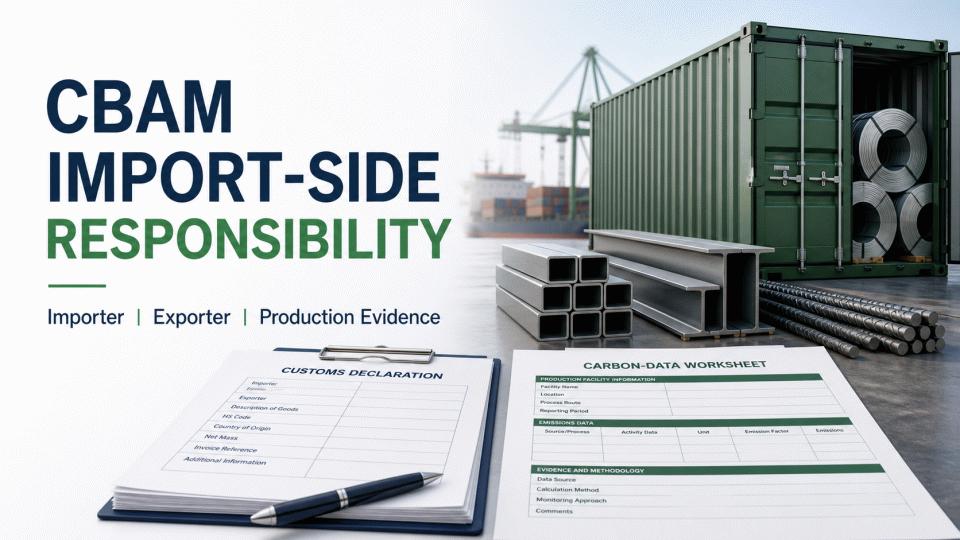
The importer, or an indirect customs representative where the rules allow that arrangement, handles the authorisation, declaration and certificate-related obligations. A non-EU production installation is generally not the purchaser of CBAM certificates, but its production, quantity and embedded-emissions data may support the importer’s declaration of actual emissions. These are different roles: supplier data does not replace the importer’s legal duties, while importer responsibility does not eliminate the installation’s need to retain production records.
Importer or indirect customs representative: check the threshold and status
The Commission currently states that an importer, or its indirect customs representative where applicable, importing more than the single 50-tonne mass threshold of CBAM goods must apply for authorised CBAM declarant status. The calculation, any exemption and the representative’s role must be checked against the current regulation and competent-authority instructions. Do not turn the threshold into a per-product or per-shipment rule without checking the legal calculation.
An authorised declarant uses the CBAM Registry to report the quantity and embedded emissions of the preceding year and to meet the related certificate-surrender and carbon-price evidence obligations. Regulation (EU) 2023/956 sets 31 May as the ordinary annual deadline and refers to 2027 for the first declaration covering 2026. Current Commission implementation material identifies 30 September 2027 as the first submission date for 2026 imports; confirm the active Registry and competent-authority instructions before relying on a calendar date.
Exporter and production installation: build a traceable data chain
The information requested from a production installation depends on the goods, process, calculation method and applicable CBAM template. At minimum, create a link between the following records:
- the operator, installation name, address and an identifier for the production location;
- the goods description, complete CN code, origin, production or shipment period and exported quantity;
- the production process, inputs and relevant precursors, without combining facilities or products that have different emissions profiles;
- direct emissions and, where applicable, indirect emissions, together with the method, activity data, factors and support files;
- where a carbon-price deduction is claimed, records showing the payer, the link to the goods or emissions and the amount actually paid.
Actual and default values are not simply “good data” versus “bad data”. Importers may use Commission default values where the applicable rules permit. If actual values are used, the installation must provide data under the CBAM methodology, and embedded emissions in the definitive declaration must be verified by an accredited verifier. A default value is not automatically higher than an actual value; any cost or data-quality conclusion requires the specific goods, process and applicable value basis.
Six manual checks for one evidence ledger
- Scope: retain the CN code, goods description, origin and Annex I reference; do not replace classification with a material name.
- Roles: identify the importer, indirect customs representative, exporter, installation and declarant. Do not describe the supplier as the certificate purchaser.
- Installation: use a separate identifier for each production location and trace goods, output, process and emissions records to it.
- Method: record whether actual or default values were used, along with the calculation version, reporting period and factor sources.
- Verification: when actual values are used, check that the data, report and verifier roles fit the definitive-regime rules. An internal review is not automatically regulatory verification.
- Wording: cross-check invoices, packing lists, production records, emissions calculations, verification reports and customer-facing claims. Pause a claim when the model, quantity or period does not match.
Boundary note and official sources
CBAM covers the goods and responsibility actions defined by the legislation. Product safety, chemicals, packaging, timber, food contact and platform requirements must be assessed separately; they should not be merged into a generic certification checklist. 绿色方舟(深圳)认证有限公司 can help organise the links between products, installations, data and files, while scope, authorisation, verification and declaration decisions remain subject to the European Commission, Member State authorities, customs and the applicable law.