
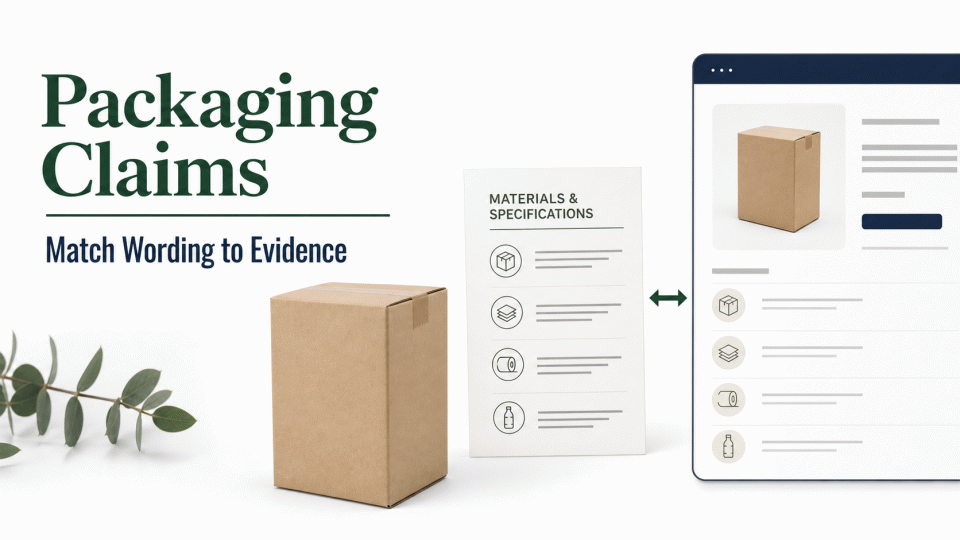
This reference is for exporters, brand owners, importers, packaging buyers and e-commerce teams. The objective is not to make packaging sound “greener”. It is to connect every label, symbol and listing statement to a defined component, market, technical file and responsible economic operator.
Scope first: the Packaging and Packaging Waste Regulation (Regulation (EU) 2025/40, PPWR) entered into force on 11 February 2025 and generally applies from 12 August 2026. Individual provisions may have separate dates, implementing acts or transitional arrangements. Do not turn the general application date into an immediate deadline for every label requirement, and do not treat one Member State’s EPR or sorting rule as an EU-wide rule.
1. Separate three kinds of information
- Legally required information: material, identification and sorting information, plus requirements for particular packaging formats such as reuse, compostability or deposit-return markings. Check the exact PPWR provision, implementing act and packaging scope.
- Voluntary environmental claims: “recyclable”, “recycled content”, “low carbon” and “eco-friendly” need different evidence. A material test does not automatically support a claim about the whole pack or its life cycle.
- Market or platform information: EPR registrations, producer-responsibility schemes, marketplace fields and display rules may vary by country, scheme, category and platform. Record the country, scheme, SKU and registrant together.
Do not collapse these into a sentence saying “PPWR requires all packaging to…”. If an item comes from national law, a platform rule or a voluntary claim framework, identify its source and scope.
2. PPWR labelling timeline: do not present future rules as current duties
Article 12 of PPWR sets the timing for harmonised labels by reference to implementing acts: the relevant date is 12 August 2028 or 24 months after the relevant implementing acts, whichever is later. The harmonised label is intended to help consumers identify material composition and sort packaging. Article 12 also allows a QR code or another standardised, open digital data carrier to provide information such as the destination of separate components. That is not the same as saying every pack must already carry a QR code containing a full product passport.
For packaging covered by an extended producer-responsibility scheme, Article 12(9) provides a route and timing for scheme identification through a QR code or other standardised, open digital technology. This is distinct from a national EPR registration number or a marketplace upload field. Recycled-plastic-content targets sit in Article 7 and related technical rules; they should not be described as a universal Article 11 label duty.
Use this internal timeline, then re-check the live legal text before release:
- Now: identify components, materials, weights, suppliers and sales countries; retain specifications, artwork, test or certification files and calculations.
- After the relevant PPWR provisions apply: assess the exact packaging format, provision and transition rule; a generic label graphic is not a conformity assessment.
- During the harmonised-label and digital-carrier implementation stage: confirm the implementing act, pictograms, data fields, accessibility and transition period before freezing artwork and SKU copy.
3. Evidence boundaries for environmental claims
“Recyclable”, “compostable” and “recycled content” require different evidence. One material report cannot prove all three.
- Recyclable: assess the Article 6 design, material, collection, sorting and recycling conditions and retain the applicable technical documentation, standards or conformity evidence. State the component, material, market and conditions; do not turn theoretical recyclability into “100% recyclable packaging”.
- Compostable: distinguish industrial composting, home composting and other treatment settings. The sample, thickness, additives, inks and final pack structure in the evidence must match the SKU. Without scenario-specific evidence, describe only the tested material or scope.
- Recycled content: record the plastic component, denominator, feedstock route, mass-balance or physical-traceability method, batch or transaction evidence and validity period. State whether caps, labels, adhesives and liners are included.
- Eco, green and low carbon: broad wording can imply overall environmental superiority. Directive (EU) 2024/825 requires Member States to transpose by 27 March 2026 and apply the relevant measures from 27 September 2026. Even before that date, unsupported environmental claims should not be treated as safe. Prefer a description that names the component, attribute, method and comparison basis.
4. Turn evidence into listing copy
A listing is not a substitute for the evidence file. Each claim should map to:
- the SKU, packaging version and component;
- the sales country or region and the applicable rule or scheme;
- the exact claim, language version and display location;
- document ID, issuer, sample or batch, validity and covered scope;
- calculation method, assumptions, exclusions and reviewer; and
- the economic operator, importer or other responsible entity.
Instead of “100% eco-friendly packaging”, use a component-level statement only where the file supports it: “The PP bottle body contains X% post-consumer recycled plastic; the denominator is bottle-body mass and excludes the cap, label and carton; batch …; evidence file …”. If the file covers the bottle body only, do not expand the wording to the complete pack.
5. Do not copy national rules into an EU-wide template
France, Germany, Italy and other Member States may have additional EPR, sorting, deposit-return or language requirements. Triman, VerpackG-related duties and Italian sorting information cannot be determined from a single “EU label template”. Before release, complete one row per sales country: authority or scheme, responsible entity, packaging category, reporting period, label or listing requirement, source link and review date. Until that row is complete, do not write a country-specific conclusion as an EU-wide one.
6. Six manual checks before release
- Component: does the claim cover the bottle, cap, label, liner, carton or another defined part?
- Denominator: is the percentage based on mass, count or another basis, and what is excluded?
- Sample and batch: do the test sample, formulation, construction and production batch match the current SKU?
- Scenario: which facility, country and treatment condition supports the recyclable, compostable or reuse conclusion?
- Language: do Chinese, English and local-market versions preserve the same scope, including “may” and “where applicable” boundaries?
- Responsibility: can the listing, EPR record, technical file and importer or placing-on-market entity be reconciled?
7. Suggested evidence-pack structure
For each SKU, keep a versioned folder containing the packaging breakdown, material and weight data, supplier statements, test or certification files, batch or transaction documents, recycled-content calculations, sales-country matrix, label artwork, listing copy, approval record and change log. If evidence is incomplete, use a neutral factual description such as “PP bottle-body material: …”. Do not substitute “fully recyclable”, “overall eco-friendly” or “zero carbon”.
This reference is based on Regulation (EU) 2025/40, the European Commission packaging-waste page and Directive (EU) 2024/825. Product scope, Member State transposition, implementing acts and platform requirements still require a current item-by-item check. 绿色方舟(深圳)认证有限公司 does not promise a product outcome, platform result or regulatory decision that has not been verified.


