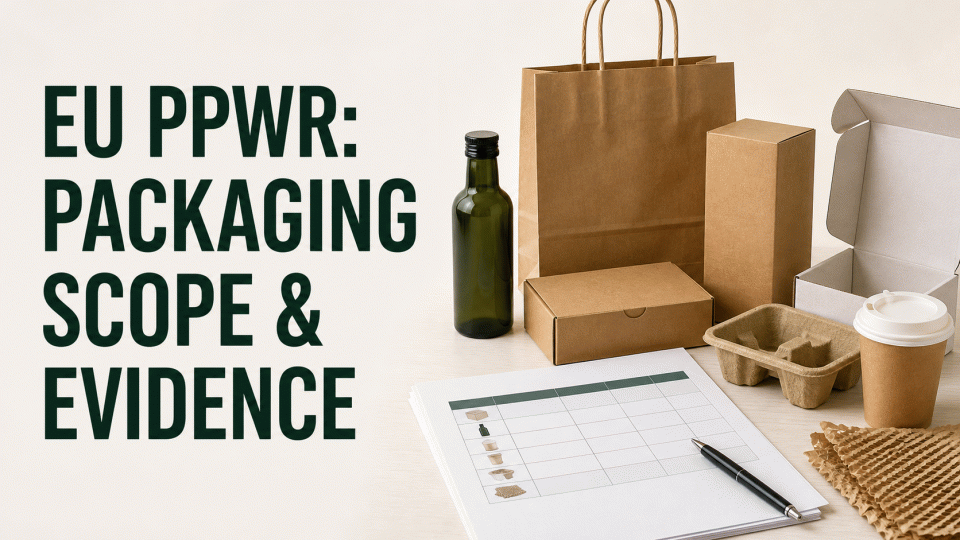
The EU Packaging and Packaging Waste Regulation, Regulation (EU) 2025/40, is not a universal “certificate” for every product. It is a set of rules covering packaging and packaging waste across the life cycle, including scope, design, materials, labelling, reuse, recycling and waste management. Cross-border sellers, brand owners, relevant import actors and suppliers should identify each packaging unit and responsibility boundary before deciding which records are needed.
1. What the PPWR covers
Regulation (EU) 2025/40 entered into force on 11 February 2025 and generally applies from 12 August 2026. The European Commission describes it as a framework covering the packaging life cycle. The applicable obligation still needs to be checked against the Regulation, its annexes and relevant later measures.
Article 2 applies the Regulation to all packaging, regardless of material, and to packaging waste from industry, manufacturing, retail, distribution, offices, services and households. Article 3 defines packaging by function: an item used by an economic operator to contain, protect, handle, deliver or present products to another economic operator or an end user, distinguishable by packaging format, material and design.
Do not classify an item by product name alone or treat every transport component in the same way. For each SKU, separate product, sales and transport or delivery packaging where relevant, record the function and material of each unit, and document the destination and supply-chain context.
2. Requirements to map by packaging type
The PPWR contains several kinds of requirements. A general product report should not be treated as a substitute for an article-by-article review:
- Packaging minimisation: review whether weight, volume, empty space and components are necessary, subject to the specific applicable provisions.
- Recyclability: map design, materials, collection, sorting and recycling considerations. The relevant grades and dates must be checked against the Regulation, its annexes and related measures.
- Recycled content and reuse: some requirements are phased by material and packaging type; a target for one plastic packaging category should not be applied to every package.
- Labelling and information: check labels, data carriers and consumer information against the relevant provisions rather than treating a green graphic as evidence.
- Producer responsibility and packaging waste: registration, reporting and fee arrangements may depend on Member State systems and should not be presented as one uniform EU process.
Product safety, food-contact, dangerous-goods transport, chemicals and other product rules may also apply, but they have separate conditions. The existence of a product test report does not by itself demonstrate that all PPWR requirements for the packaging have been met.
3. Build a packaging evidence register by SKU
Use a record that connects each packaging unit to each requirement, document and responsible party:
- Packaging identity: unit name, function, product SKU, sales or delivery context, target Member State and material.
- Material and structure: components, weight or dimensions, material specification, coatings or additives, supplier version and change history.
- Design and recycling: the design basis for recyclability, separation, collection, sorting or reuse; where an external standard is used, record its name, version and scope.
- Labels and online wording: retain packaging artwork, instructions, data-carrier content and environmental claims, with the evidence supporting the exact scope of each claim.
- Roles and flow: keep the factual basis for the roles of brand owner, manufacturer, relevant importer, supplier and Member State arrangements. “The platform asked for it” is not a substitute for a legal responsibility analysis.
There is no universal “24-month validity” rule for every document. Check the issuing body, covered packaging or product, material version, method, date, signatures and scope. Whether an update is needed depends on regulatory changes, changes to packaging or supply chain, and the conditions of the document itself.
4. Keep environmental wording within the evidence
When packaging uses words, graphics or colour cues such as “green”, “eco-friendly”, “sustainable” or “recyclable”, identify which packaging, material or attribute the statement describes and retain the supporting evidence. Directive (EU) 2024/825 addresses consumer-protection concerns around generic environmental claims, claims about an entire product that concern only one aspect, and certain claims based on greenhouse-gas offsetting. This does not mean every environmental statement is automatically prohibited, but unsupported or misleading wording should be avoided.
A safer approach is to state the scope precisely, for example, “material information for this paper outer package is recorded under document …”, rather than saying that the entire product is sustainable. Product pages, packaging artwork and supplier records should use the same SKU, material and quantity version.
5. Six checks before a listing or shipment change
- List every packaging unit for each SKU and state its function.
- Match material, components, weight, dimensions and supplier version to the physical packaging and records.
- Map the applicable PPWR provisions and annexes by packaging type, including open questions.
- Link recyclability, recycled-content, reuse and labelling statements to specific evidence.
- Separate EU-wide requirements from Member State producer-responsibility and waste-management processes.
- Review product pages, packaging artwork and sales materials for claims that exceed the evidence.
PPWR preparation is not a one-document exercise. Recheck the register when packaging structure, material, supplier, product range or target market changes. 绿色方舟(深圳)认证有限公司 can help organise a checklist around the specific packaging and target market, while the final assessment should remain grounded in the Regulation, official guidance and the company’s actual records.
Sources: Regulation (EU) 2025/40 (EUR-Lex); European Commission: Packaging waste; Directive (EU) 2024/825 (EUR-Lex).