Review date: 22 August 2026. This reference is based on Regulation (EU) 2025/40 (the PPWR), Articles 2 and 3 and Annex I. It is for packaging-scope and evidence preparation only; it is not a legal opinion and does not promise certification, market access or platform outcomes.
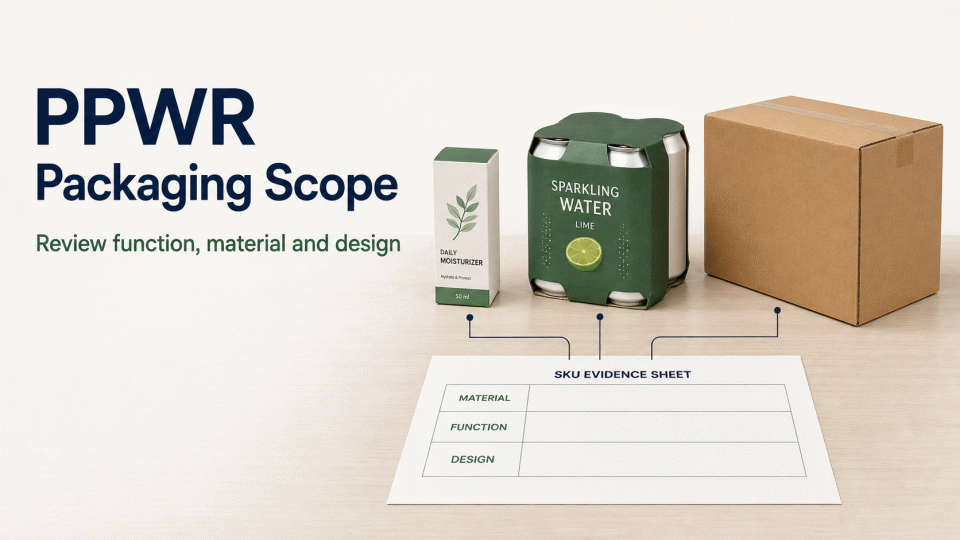
The starting point is not the product category. It is whether an item is intended to contain, protect, handle, deliver or present products to another economic operator or an end user, and can be differentiated by packaging format based on its function, material and design. Article 2 applies the PPWR to all packaging, regardless of material, and to packaging waste from industry, manufacturing, retail, distribution, offices, services and households. The market-placement facts and responsible economic operator still need to be mapped for the specific supply chain.
Start with the packaging function
Sales packaging: packaging used with a sales unit to contain, protect, handle, deliver or present the product. A pouch, box or blister may fall into this category, but the conclusion must follow the actual function and design.
Grouped packaging: packaging that combines several sales units. Whether it is retained or discarded before or after the point of sale is part of the fact pattern; the label “secondary packaging” is not a substitute for analysis.
Transport packaging: packaging used to handle or transport products. Cross-border sellers should map the order flow, warehouse or fulfilment route and responsible parties together. A carton, cushioning material or sealing material should not be automatically included or excluded merely because an FBA or courier step is involved.
Use Article 3 and Annex I for the boundary
Article 3 covers items that are not an integral part of the product and are intended to contain, support or preserve it, together with components and ancillary elements integrated into packaging. An ancillary element attached directly to a product can also be packaging when it performs a packaging function and is intended to be used, consumed or disposed of with the product. Labels attached to packaging and plastic sleeves may therefore need review. Separately sold clothes hangers and tool boxes are examples that should not be classified by appearance alone. Annex I provides an indicative list, to be read with the actual function, material and design.
Permeable tea, coffee or other beverage bags, and certain non-permeable single-serve beverage systems intended for use in a machine, are expressly addressed in the Article 3 definition. They should not be described generically as an unresolved issue. Conversely, an item sold empty or an integral component intended for the product’s long-term use may require a different conclusion under the Annex I examples and the specific design.
Build a SKU packaging-scope register
For each SKU, record at least: the packaging component and a photo, material and key structure, function (sales, grouped, transport or attached element), relationship to the product, whether it is used or discarded with the product, sales and transport context, the economic operator placing it on the EU market, supplier or design changes, and the source for the conclusion. Keep the product, packaging, transport service and platform requirements in separate fields.
After scope is mapped, review the PPWR requirements that may apply to the identified packaging, such as recyclability, material composition, labelling or data carriers, minimisation, reuse and extended producer responsibility. A scope conclusion is not by itself proof that all applicable obligations have been met.
Sources and service boundary
Primary sources: EUR-Lex, Regulation (EU) 2025/40, Articles 2 and 3 and Annex I; and the European Commission Packaging waste page. 绿色方舟(深圳)认证有限公司 can assist with organising SKU-level packaging components, material information and source files. The responsible operator, national arrangements and product-specific conclusion still require confirmation against the actual supply chain and current official information.