
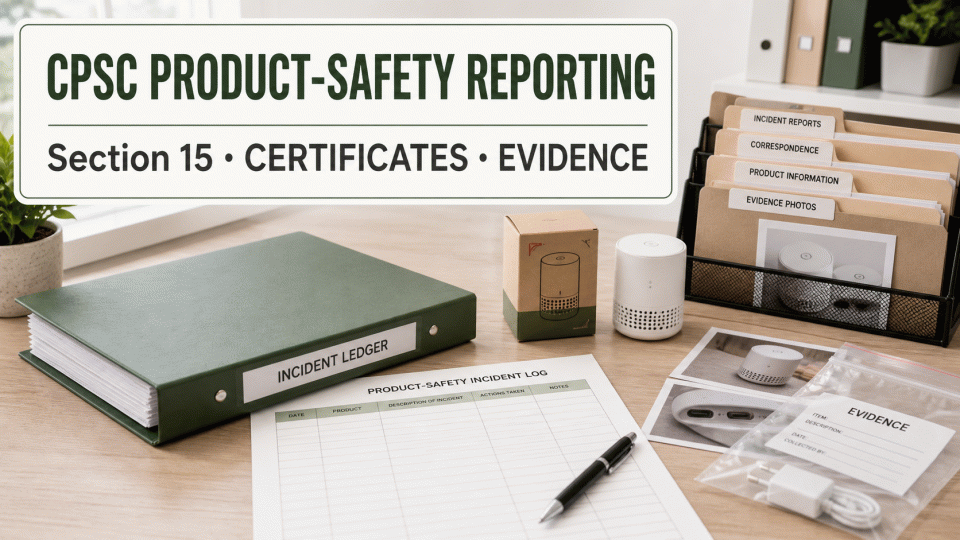
Who this is for: Manufacturers, importers, distributors, retailers, and cross-border e-commerce teams selling consumer products in the United States and organizing safety complaints, suspected defects, CPC/GCC records, testing files, or corrective-action evidence.
Key point: An internal process should not be built around an unverified penalty headline. First preserve what was received, when it was received, and which product and lot it concerns. Then assign a qualified person to assess whether the information meets the CPSC Section 15 reporting standard. CPSC guidance also makes clear that a report does not automatically mean a recall, while an unfinished root-cause investigation is not a reason to ignore reportable information.
Scope note: This is a product-safety recordkeeping reference, not legal advice. The reporting analysis depends on the product, the firm’s role, the facts known, and the applicable rules. Escalate the decision to the designated product-safety lead and, where needed, U.S. counsel.
“24 hours” is not a universal deadline for every customer-service complaint. It describes the immediate reporting obligation after a firm obtains information that reasonably supports a Section 15 conclusion.
1. Separate routine complaints from Section 15 information
CPSC Section 15 guidance focuses on whether the information reasonably supports a conclusion that a product violates an applicable consumer-product safety rule, contains a defect that could create a substantial risk of injury, or presents an unreasonable risk of serious injury or death. Manufacturers, importers, distributors, and retailers may have reporting responsibilities.
| Information type | First response | Do not infer automatically |
|---|---|---|
| Routine function or appearance complaint | Record the order, model, lot, time, images, and original communication; check for a pattern. | A refund or negative review alone does not establish a Section 15 trigger, but it should not be deleted. |
| Suspected rule noncompliance | Lock the affected SKU and lot; preserve testing, certificates, labels, packaging, and sales records; escalate promptly. | One report or certificate cannot automatically cover a different model, material, factory, or lot. |
| Injury, fire, choking, or serious-risk information | Preserve the original description and evidence, record when it was received, and assess reporting while the investigation continues. | Do not wait for a platform notice or a fully proven root cause before escalation. |
CPSC states that a company generally must report within 24 hours after obtaining reportable information. Its guidance also says “when in doubt, report,” but that does not turn every complaint into a mechanical filing. A Section 15 report does not itself decide that a recall is required; CPSC and the firm evaluate the facts and appropriate response.
2. Build an Incident Log that connects time, product, and evidence
An incident log is not a collection of rewritten conclusions. It preserves what the firm knew and when. For each entry, retain the original attachment or link and capture at least:
- Time and source: receipt time, channel, original message, images or video, and order or service reference.
- Product identity: brand, SKU/model, ASIN where relevant, serial or lot, production date, factory, and supplier.
- Event description: use conditions, observed issue, injury or medical treatment, and whether the product remains in use.
- Initial triage: routine complaint, suspected noncompliance, suspected serious hazard, or legal review; record the reviewer and time.
- Linked files: test reports, CPC/GCC, label and manual versions, change history, shipment quantity, inventory, and sales scope.
- Action trail: whether CPSC was contacted, time and reference number, inventory controls, customer communication, and approved follow-up.
Use version control: Do not keep only the “latest” report. When materials, critical components, factories, labels, software, or intended use change, link the before-and-after versions, affected lots, and reassessment basis in one product file. This reduces the risk of applying an old certificate or another model’s test result to the current product.
3. CPC, GCC, and testing files: the certificate does not transfer responsibility
Children’s products generally require a Children’s Product Certificate (CPC) issued by the manufacturer or importer based on applicable testing by a CPSC-accepted third-party laboratory. General-use products subject to applicable CPSC safety rules generally require a General Certificate of Conformity (GCC) issued by the manufacturer or importer based on testing or a reasonable testing program. Their scope, issuing responsibility, and testing basis must not be mixed.
- CPC: Confirm that the product is a children’s product, map each applicable children’s product safety rule, and match the report, model/lot, and issuing party.
- GCC: Confirm that the general-use product is subject to an applicable consumer-product safety rule, ban, or standard. CPSC’s FAQ explains that general-use products do not automatically require a CPSC-accepted laboratory; the GCC must be based on applicable testing or a reasonable testing program.
- Both: The certificate, test evidence, product identity, and actual goods must correspond, and the certificate must be furnished as required. A laboratory report is not the same thing as a laboratory-issued CPC or GCC.
- Imported certificate data: CPSC’s current certificates guidance lists July 8, 2026 for domestically manufactured products and general imports, and January 8, 2027 for products entered from a foreign-trade zone. Confirm the product type, manufacturing or importer role, and latest official instructions instead of applying one old workflow to every shipment.
At minimum, index certificates, test reports, sample images, packaging and warnings, tracking information, shipment lots, supplier changes, and product-page claims together. Check exact standards and limits against the rule or official CPSC requirement for the product; do not copy them from another category.
4. A practical four-step response when a safety incident appears
- Preserve immediately: Keep the original information and receipt time. Do not overwrite it with “misuse,” “isolated case,” or “resolved” before the facts are assessed.
- Define the scope: Identify model, lot, factory, inventory, units sold, and channels; preserve pages and files and isolate inventory where appropriate.
- Escalate the decision: Have the designated product-safety lead assess Section 15, applicable rules, and reporting route. The investigation may continue, but it should not become an indefinite delay.
- Close the loop: Retain the reporting or non-reporting rationale, submission time, regulatory communication, inventory action, customer communication, and later verification. If a recall or corrective action is needed, maintain a separately approved plan.
Preserve page claims too: Include listing titles, bullets, images, packaging, and manuals in the product file. Avoid “CPSC approved,” “guaranteed safe,” “will not be recalled,” or other claims beyond the evidence. Do not present a CPC/GCC, a third-party certification, and a platform badge as the same conclusion.
5. Pre-publication checklist and official sources
- Can each complaint be traced to a SKU, model, lot, and original evidence?
- Is the firm’s role—manufacturer, importer, distributor, or retailer—identified?
- Have CPC, GCC, and their testing bases been checked separately?
- Is the time when reportable information was first received recorded, with a named reviewer?
- Are testing, certificates, labels, packaging, manuals, page claims, and product changes in one version chain?
- Are platform requirements separated from CPSC legal conclusions?
Official references: CPSC Duty to Report, CPC FAQ, GCC FAQ, Certificates and eFiling, and Online Initial Section 15(b) Report.
This reference is based on public CPSC materials. Confirm the reporting duty, applicable standards, certificate content, and corrective action against the product facts and the latest official requirements.


