
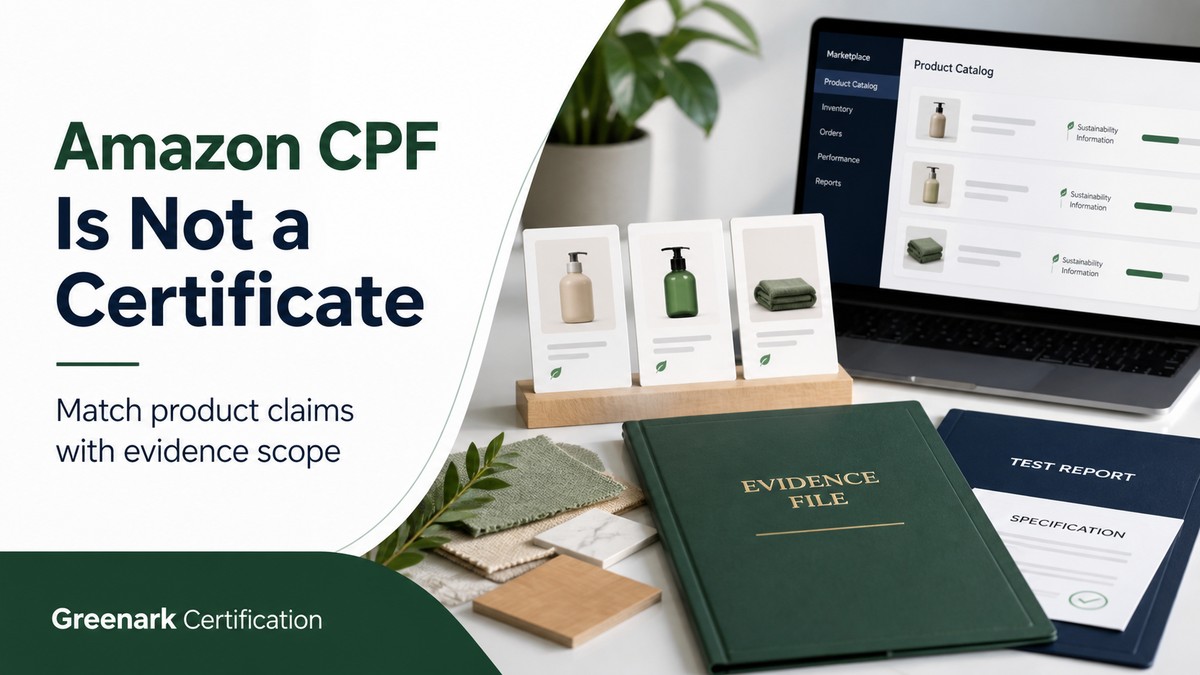
Climate Pledge Friendly (CPF) is an Amazon program and label used to highlight sustainability features for products. It is not one universal certificate issued by Amazon, and it does not replace every legal, testing, labeling, or import obligation in a target market. Amazon describes CPF as working with third-party certifications and also offering Amazon-created certification paths. Its advertising guidance states that the CPF label qualifies a single product, not a brand as a whole.
The practical question is therefore not whether a seller has a “CPF certificate.” The question is whether a specific product fits a currently accepted path, what the supporting document actually covers, and whether each product-page claim stays within that evidence scope.
1. Separate CPF, certification, and legal obligations
CPF is an Amazon product-display framework. A third-party certification is governed by its own certifier, standard, or program owner. Legal obligations come from the laws and authorities applicable to the target market. These layers may concern the same ASIN, but they do not make the same decision. A CPF label should not be presented as proof that a product has completed every EU, US, Japanese, or other market requirement.
- Program layer: check Amazon’s current CPF descriptions, accepted paths, and product-eligibility process.
- Evidence layer: check the issuer, standard or program name, certificate number, holder, product scope, status, dates, and version. The exact fields depend on the issuer and the current Amazon process.
- Legal layer: separately assess sale, import, labeling, chemicals, packaging, recycling, and other obligations. CPF is not a regulatory passport.
2. Build the evidence line around one product
Amazon’s CPF guidance connects the label to product eligibility. The internal register should therefore use an identifiable product as its unit, rather than a brand slogan or a factory name. At minimum, record:
- Product identity: ASIN, SKU, model, variation, packaging version, and the name used in the supporting record.
- Path: the current third-party certification, program, or Amazon-recognized path. Do not combine different standards under the label “CPF certification.”
- Scope match: materials, formulation, components, manufacturing site, brand or certificate holder, and product variations covered by the record.
- Status and source: issuer, public lookup or submission record, certificate number, status, effective dates, and version.
- Listing claim: the icon, wording, comparison, or environmental attribute used on the detail page and the evidence supporting it.
A supplier document can be a starting point, but its cover page alone does not prove coverage for a seller, brand, ASIN, or variation. If the holder, model, scope, or status cannot be matched, confirm it with the issuer or Amazon’s current process before making the claim.
3. Align certificates and claims field by field
Use a “claim—evidence—scope—status” register instead of simply collecting PDFs:
| Listing or internal claim | Evidence to check | Boundary to confirm |
|---|---|---|
| The product has a stated environmental attribute | Relevant certification or program record and issuer | Which product, material, or component has the attribute |
| The product may display a CPF-related label | Current accepted path, product eligibility, and Amazon submission route | Single product or variation; not the whole brand |
| The product uses a stated material or source | Scope certificate, transaction or supply-chain record, or other applicable evidence | Content, processing, batch, and finished-product claim |
| The product meets a target-market requirement | Applicable regulation, test, or technical file | CPF does not replace import, labeling, chemical, or packaging duties |
The register is not a shortcut to an approval conclusion. Its purpose is traceability: each public statement should lead back to a specific record. Recheck the current requirements when Amazon, a certifier, or a program owner changes its process.
4. Common ways listing language exceeds the evidence
- Do not turn “CPF is not one certificate” into “any green certificate guarantees a CPF label.” Only a currently accepted path and product qualification can support that statement.
- Do not describe certification evidence as guaranteed customs clearance, guaranteed approval, automatic delisting protection, or a fixed review time. CPF, market surveillance, import decisions, and Amazon case review are different decisions.
- Do not extend a material, packaging, or supplier certificate to every product, the whole storefront, or the brand. State the product, model, variation, and claim scope.
- Do not use one regulation or test report for every country. Requirements depend on the market, product category, and claim.
5. A practical review checklist
- Lock the ASIN, SKU, model, and variation, and save the current version of the product-page wording.
- Start with Amazon’s current CPF information and accepted paths; do not treat a third-party certificate name as Amazon’s universal certification name.
- Check the certificate number, holder, product scope, status, and version with the issuer or public database. Mark unverifiable items for review.
- Compare materials, components, manufacturing sites, and supply-chain records with the finished product.
- Keep CPF eligibility, third-party certification, and target-market law in separate fields with separate sources.
- Review the detail page line by line before publication. Avoid environmental, sustainability, risk-free, or outcome claims that exceed the evidence.
Sources and limits
This page summarizes Amazon’s official descriptions of CPF, its relationship with third-party certifications, the product-level scope of the label, and creative-claim boundaries. Amazon’s accepted paths, submission process, and marketplace policies may change. The current Amazon page, Seller Central workflow, and the applicable certifier or program owner’s current documents control. This page is not legal advice, a test conclusion, or a certification decision.
绿色方舟(深圳)认证有限公司 can review product evidence and listing language against a defined product, market, and claim scope. No certification result, platform display, customs outcome, or processing time is guaranteed.


