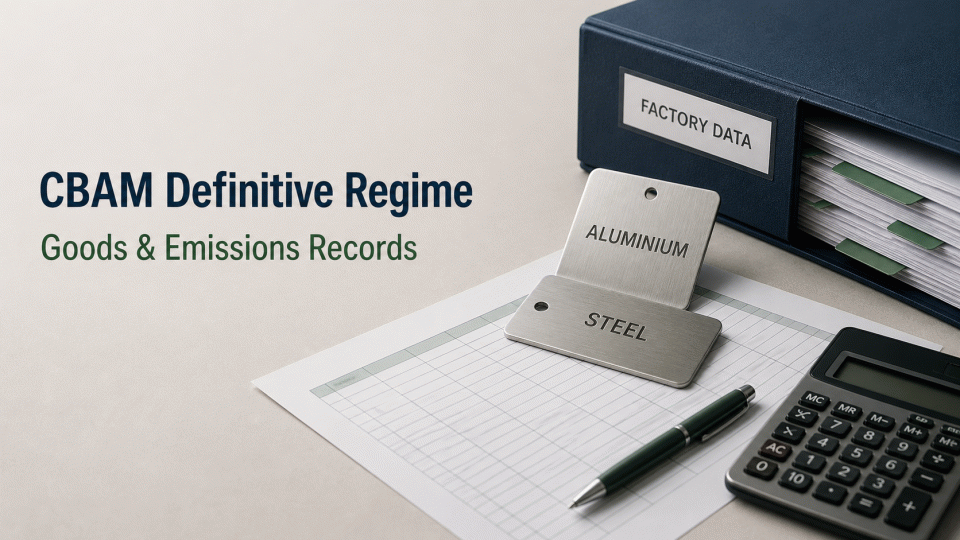
The Carbon Border Adjustment Mechanism (CBAM) entered its definitive regime on 1 January 2026. For manufacturers and exporters outside the EU, the practical task is not to obtain a generic “compliance certificate”. It is to prepare traceable records that an EU importer or indirect customs representative can use: goods, CN code, quantity, production installation, embedded emissions and supporting evidence. This page is a preparation reference, not a determination of an importer’s legal obligations.
1. Confirm the CBAM scope first
CBAM currently covers selected goods in the cement, iron and steel, aluminium, fertilisers, electricity and hydrogen sectors. Scope cannot be decided from a broad product name such as “metal” or “chemical”. Check the CN code against Annex I and review any applicable exclusions.
The definitive regime uses a single mass-based threshold. EU importers or their indirect customs representatives importing more than 50 tonnes of CBAM goods are required to apply for authorised CBAM declarant status under the applicable rules. The importer or representative must confirm the threshold, declarant role and customs records; an exporter should not state from its own shipment volume that a customer definitely is, or is not, required to declare.
2. Connect the goods, installation and emissions
Create a record chain for each relevant goods type instead of applying a supplier’s general statement to every SKU:
Goods record: product description, specification or grade, CN code, country of origin, importer, customs period, quantity and unit. Electricity and other goods use different reporting units, so follow the applicable CBAM rules.
Installation record: installation name and address, operator, production route, system boundary, relevant precursors or inputs, and the link between those records and the goods or shipment period.
Emissions record: direct and applicable indirect embedded emissions, calculation method, activity data, emission factors, precursor sources and calculation version. Actual emissions must be calculated under the CBAM methodology and, where applicable, verified by an independent accredited verifier. If actual data are unavailable, record the Commission default values used and the basis for their use.
3. What an exporter can prepare
A manufacturer or exporter can prepare a data pack tied to the relevant installation and goods, including:
(1) Goods and customs records: specifications, quantity and measurement notes, sales contract, invoice, shipping documents, batch or production period;
(2) Installation and process records: installation identity, production route, inputs and precursor sources, activity data and emissions calculation workpapers;
(3) Emissions support: calculation sheet, methodology version, emission-factor sources, quality-control records and, where relevant, verification report or verifier information;
(4) Carbon-price information: the payer, period, amount and evidence for any carbon price paid in the country of origin. The importer must determine whether the evidence supports a deduction under the applicable rules.
Each figure should be traceable from the installation record to a type of imported goods. FSC, GRS, ISO certificates, general laboratory reports or Amazon CPF page materials do not replace CBAM embedded-emissions data. Other regulations and customer programmes need separate evidence folders.
4. Annual declaration and internal ledger
An authorised CBAM declarant submits the preceding calendar year’s CBAM declaration through the CBAM Registry. Under the current rules, the first declaration covers 2026 imports and is submitted in 2027, by 30 September 2027; the declarant also surrenders the corresponding CBAM certificates as required. Certificate prices, free-allocation adjustments and deductions for carbon prices paid in the country of origin are declarant-level matters. Do not turn them into a fixed amount or guaranteed result in an exporter’s data pack.
At minimum, retain the version, owner, reporting period, goods/CN code, installation, quantity, emissions method, data source, verification status, carbon-price file, transfer record with the importer and reason for each change. Recheck the mapping when the installation, process, raw material, measurement basis or CN code changes.
5. Boundaries and official sources
CBAM reporting is not the same system as product safety, packaging, deforestation, recycling responsibility, platform green labels or customer audits. This page makes no promise of automatic customs clearance, platform listing, certification, exemption, penalty outcome, processing time or declaration result. Check the applicable regulation, Commission guidance, CBAM Registry and the competent authority in the importing Member State.
Official sources: European Commission CBAM definitive regime; CBAM Registry and reporting; CBAM verification; EUR-Lex: current text of Regulation (EU) 2023/956.
绿色方舟(深圳)认证有限公司 can help organise and review the evidence boundary, while the importer, authorised declarant and competent authorities remain responsible for the applicable declaration and legal decisions.