
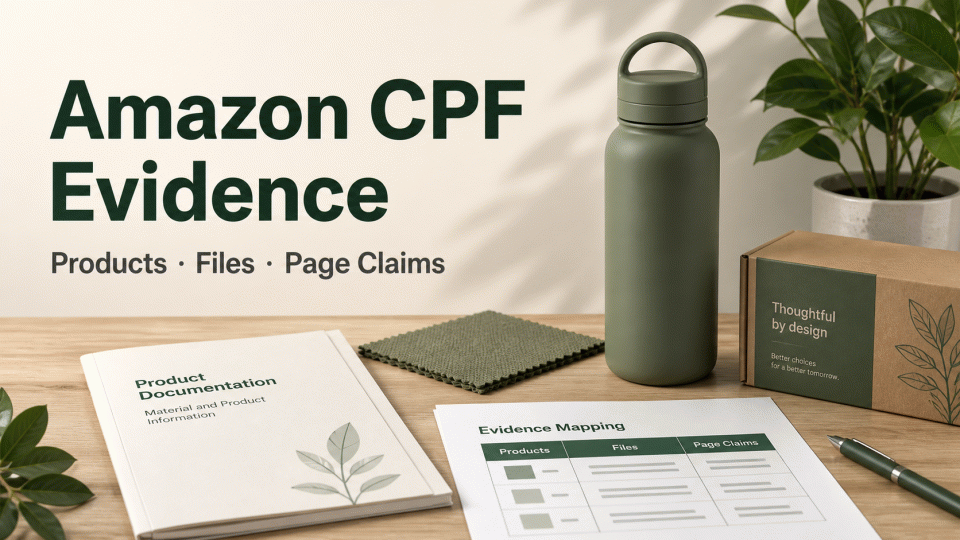
Amazon Climate Pledge Friendly (CPF) is a product-facing Amazon program and label used for products associated with qualifying sustainability programs or certifications. It is not a universal certificate that replaces product safety, customs, packaging, chemical, recycling or other legal requirements. The practical task is to match the exact product, the applicable program, the supporting files and the wording shown to consumers. This article does not promise CPF placement, certification, platform display or sales results.
1. Separate four objects
First, define the product: model, variation, packaging component, material and production batch. Second, define the evidence: what a certification, verification, environmental attribute statement or program file actually covers. Third, define the platform context: the current Amazon account, marketplace and CPF submission or display path. Fourth, define the page claim: the wording in the title, bullets, detail page, images, packaging or advertising. A supplier, factory or brand holding one certificate does not automatically cover every SKU, and it does not guarantee CPF display for a product.
2. Build a product-to-evidence map
Create one record for each SKU with the ASIN or internal SKU, model and variation, brand and declaring entity, manufacturer or supplier, target marketplace, proposed CPF route, program or certification name, file identifier, covered scope, file version or date, exact page claim and open gaps. If a file covers only a material, model or manufacturing site, record that limit in the map. Do not turn a narrow file into a claim about the whole brand or product family.
Reconcile product names, models, brands, certificate holders, manufacturing sites and key attributes across the specification, packaging artwork, purchase record and certification or test files. Where names differ, explain the relationship and preserve the version trail. A supplier marketing page is not a substitute for evidence that applies to the current SKU.
3. Keep CPF separate from legal obligations
CPF review and product safety, chemical restrictions, packaging responsibility, recycling registration, wireless or electrical rules, import declarations and consumer-protection requirements are separate questions. A sustainability-program file does not prove compliance with another legal regime; completing a legal test does not automatically prove that a product meets CPF program conditions. Build separate evidence paths by marketplace, product category and actual claim, and check the current Amazon account and marketplace guidance before submission.
4. Make environmental claims specific and supportable
Broad terms such as “sustainable,” “green,” “eco-friendly” or “no impact” can imply an overall environmental benefit. Prefer a specific attribute that the records support, and state whether it applies to the product, a component, packaging or a supply-chain step. Percentages, life-cycle conclusions, carbon-neutral, recyclable, compostable and comparative claims must match the applicable standard, calculation boundary, material scope and geographic conditions.
A third-party certification or seal does not remove the need to review express and implied claims. Before using a name, mark, certification description or program graphic, verify the permission, licence code, scope and final artwork. Without verified authorisation, do not draw an official organisation or certification mark into an article or product image.
5. Manual pre-submission checklist
□ Product model, variation, packaging and page claim correspond; □ the relationship between the evidence holder and declaring entity is clear; □ the evidence scope has not been expanded; □ file version, date and marketplace are recorded; □ page wording stays within the supported attribute; □ the CPF route has been checked against current category, account and marketplace guidance; □ trademark and certification wording has an authorisation basis; □ safety, customs, packaging and other legal records are archived separately; □ the final page, files and mapping version are retained after submission.
6. Boundaries and maintenance
Recheck the evidence when the material, formula, supplier, manufacturing site, packaging or environmental wording changes. Platform pages, certification programs and regulatory requirements can change, so fixed claims about lead times, report ages, automatic delisting, detention or fines should not be applied across products. GreenArk (Shenzhen) Certification Co., Ltd. may help organise files, map claims to evidence and identify gaps, but it does not replace a certification body, Amazon or a regulator’s decision.
Source direction: Amazon Climate Pledge Friendly public program materials and current account or marketplace guidance; the U.S. Federal Trade Commission’s Guides for the Use of Environmental Marketing Claims (16 CFR Part 260) and its environmental-claims summary. This article is a document-review reference, not a CPF, certification, platform or regulatory decision.


