For: brand owners, importers and cross-border teams responsible for EU packaging design, sourcing, supplier files or product-page wording.
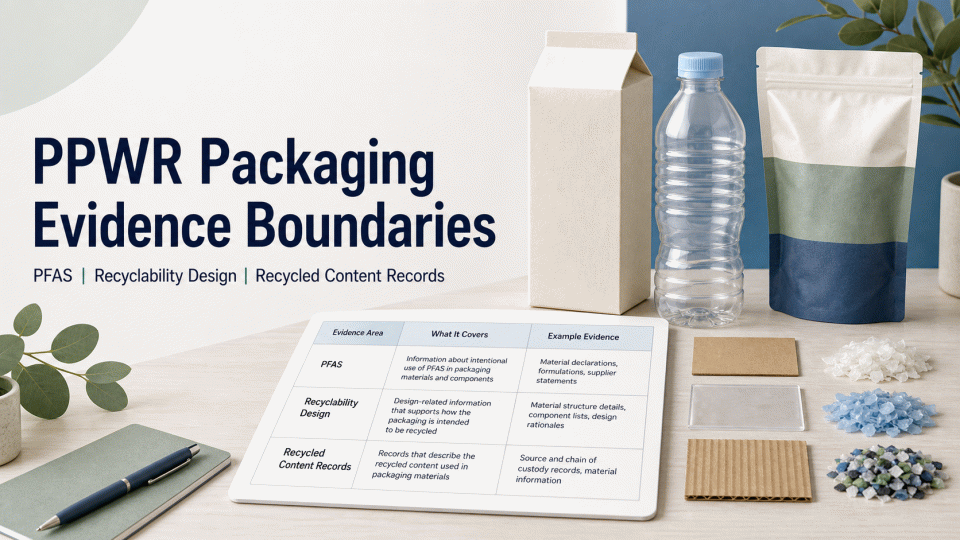
Summary: PPWR (Regulation (EU) 2025/40) addresses substances of concern, recyclability and recycled-content records within a broader technical-documentation framework. These topics are related, but one certificate cannot replace the others. This reference page maps evidence to packaging components and explains what to record for PFAS checks, recyclability design, recycled content and product-page claims, while keeping use, material, contact scenario and target-market boundaries visible.
This is a documentation reference. It does not confirm that any product complies with PPWR and does not replace applicable chemical, food-contact, waste or extended producer responsibility requirements. Final conclusions should be based on the regulation, test method, supplier records and target-market rules that apply to the specific packaging.
1. Separate the three questions
| Question | What to review | Typical evidence | What it does not prove by itself |
|---|---|---|---|
| Are substances of concern or specific restrictions relevant? | Each packaging material and component, including coatings, inks, adhesives, seals and liners | Material declarations, supplier statements, targeted test reports and food-contact records where relevant | An outer-carton report does not automatically cover every component; “not detected” depends on method, limit and sample scope |
| Does the design and local system support recycling? | Material structure, component combination, separation, collection and sorting conditions | Packaging BOM, drawings, design assessment and target-market recycling information | A material name or recycling mark alone does not mean that packaging is recyclable in every location |
| Where does recycled content come from and how is it calculated? | Plastic part, resin, recycled-content source, batches and plant/year accounting boundary | Supplier batch records, mass-balance records, traceability files and third-party certificates where applicable | GRS, RCS, ISCC PLUS or another document does not automatically substantiate a different material or claim |
2. PFAS review: confirm scope before method
Article 5 of PPWR sets a framework for substances of concern in packaging and establishes PFAS thresholds for food-contact packaging from 12 August 2026. The text distinguishes individual PFAS, the sum of PFAS and a total-PFAS approach that includes polymeric PFAS. A generic “80 ppb total PFAS” statement should therefore not be treated as a universal limit for every packaging type and test method.
A useful file should identify the component, food-contact status, direct or indirect contact scenario, material and coating, sample batch, analytes, method and detection limit, result units, report date and supplier responsibility. Grease-resistant paper, laminating adhesives, plastic additives, moulded pulp and sealing components should not be combined merely because they appear in the same outer package.
3. Recyclability: design evidence is not a performance guarantee
Article 6 uses design for material recycling and the ability to be separately collected, sorted and recycled at scale as core directions. For each SKU, retain the packaging BOM, component materials and weights, composite structure, joining, labels, coatings and the collection and sorting conditions relevant to the target market. If a recyclability assessment is used, record its method, material scope, assumptions and conclusion boundary.
Page wording should identify the component and conditions, for example: “The carton body uses … material, and the file records … design information.” Do not turn a single material, a recycling mark or one laboratory assessment into “100% recyclable,” “recyclable across the EU” or “PPWR certified.” Recyclability claims need to remain connected to local collection, separation and recycling conditions.
4. Recycled-content records: align material, accounting and batches
Article 7 sets recycled-content requirements for plastic packaging and provides for calculation methods and technical documentation. Records should identify the plastic part rather than treating the whole package as one unit, the resin type, the post-consumer recycled-content definition, the accounting boundary, plant and year or batch scope, supplier chain, and any food-contact or other applicable exception.
GRS, RCS, ISCC PLUS, mass-balance records and an internal material ledger serve different purposes. A certificate name cannot replace its scope, validity, transaction or batch records, or the link to the actual packaging component. Nor can a certificate alone establish the recycled-content percentage or page wording for a particular SKU.
5. Suggested fields for a packaging evidence register
| Field group | Suggested records |
|---|---|
| Identity | SKU, component ID, material, supplier, plant, batch, drawing or revision |
| PFAS / chemicals | Food-contact status, applicable rule, analytes, method, detection limit, result, report and source |
| Recycling design | Component weight, layers, joining, label/ink/adhesive, assessment method and target-market conditions |
| Recycled content | Resin, recycled-content type, percentage basis, accounting period, supplier traceability and certificate/transaction record |
| Page wording | Claim text, component, evidence ID, market, limitation, reviewer and review date |
6. Five checks before publishing
- Start with the packaging BOM and list every component; do not replace component scope with “the package.”
- Mark food-contact status, material structure and target market separately before selecting tests and records.
- Link every page claim to an evidence ID; where evidence is incomplete, narrow the claim rather than adding a result.
- Recheck regulation version, effective date, threshold basis and exceptions; do not present a future method or target date as a current conclusion.
- Keep revision, batch, supplier and review records, then obtain owner approval before changing the page.
Sources and boundaries
Primary source: Regulation (EU) 2025/40, especially Articles 5, 6 and 7 and the annexes. Applicability must still be checked against the product use, components, target market and other EU rules. 绿色方舟(深圳)认证有限公司 can support evidence organisation and review; this page does not replace the regulation, a competent authority or a laboratory conclusion.