
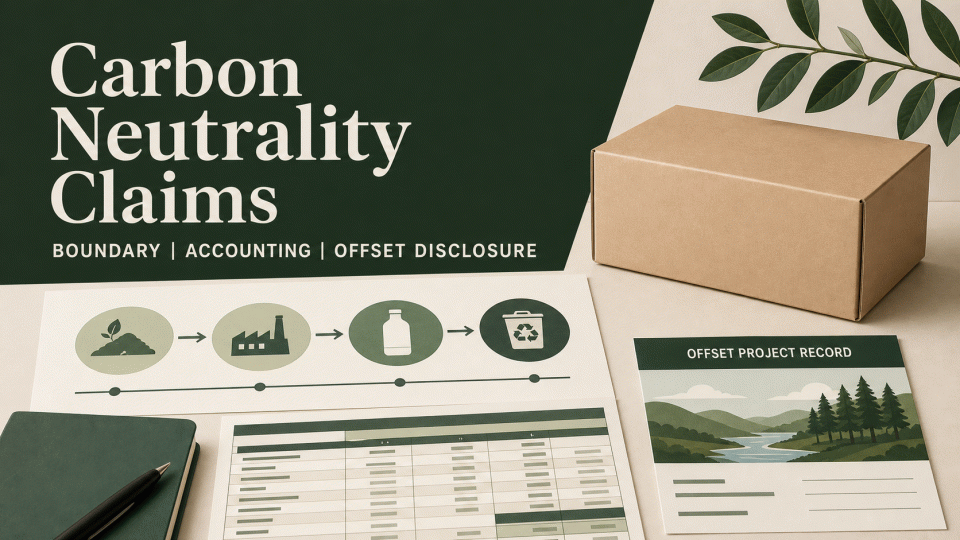
“Carbon neutral,” “climate neutral,” and “low-carbon” are not stand-alone proofs that can be separated from a product boundary and an accounting method. Before publishing a claim, record the claimant, the product or service scope, the emissions calculation, data sources, reduction measures, and any offset project as distinct evidence items. The wording on the page should lead back to those records.
1. Define what the claim is about
Start by identifying the object of the claim: one product, a product family, business operations, or an event. For a product claim, record the model, formulation or material version, production site, accounting period, functional unit, and life-cycle boundary. An organisation-level inventory does not automatically establish the footprint of a particular SKU, and a supplier’s material data does not automatically cover the finished product’s full life cycle.
ISO 14067 sets principles, requirements, and guidance for quantifying and reporting a product carbon footprint consistently with life-cycle assessment. It can support full or partial footprint studies, but a product footprint is not an offset project and does not by itself determine how a claim may be communicated. The GHG Protocol Product Standard is likewise a framework for understanding life-cycle emissions and reduction opportunities. The evidence register should state the method, version, functional unit, allocation rules, boundary, and data-quality limitations.
2. Turn the calculation into traceable fields
- Product identity: SKU, version, BOM, packaging composition, production site, and accounting period.
- Boundary and method: whether raw materials, manufacturing, use, transport, and end-of-life are included; the functional unit, emission-factor sources, allocation method, and assumptions.
- Activity data: purchased quantities, energy, transport, production losses, use-phase parameters, and end-of-life data, with units, periods, sources, and estimates identified.
- Review trail: calculation files, version history, internal review, and the exact scope of any third-party verification or assurance.
If the available evidence covers only a cradle-to-gate footprint, describe it as partial and state which stages are outside the boundary. Do not turn a factory average into the measured value for every SKU, or treat the name of a certificate as the footprint, boundary, or conclusion.
3. Separate reductions, removals, and offsets
Product redesign, material changes, energy changes, and transport improvements are reduction measures within the product or supply chain. An offset is a separate project record. At minimum, record the project name or identifier, project type, accounting period, quantity and unit, registry or issuance information, ownership and retirement evidence, methodology, verification documents, and the link to the claim. Do not describe a product as having no emissions merely because credits were purchased.
The FTC Green Guides state that carbon-offset claims need competent and reliable scientific evidence, including appropriate accounting that avoids double counting or selling the same reduction more than once. They also caution against advertising an offset when the underlying activity is already required by law. The applicable advertising and consumer-protection rules still need to be checked for each target market.
4. Keep page wording within the evidence
Titles, selling points, graphics, labels, and footnotes can all communicate an environmental claim. Make the scope visible: what was calculated, what was excluded, where the data came from, whether an offset sits inside or outside the product value chain, and which version and period the statement covers. Avoid unqualified phrases such as “zero carbon,” “no climate impact,” or “completely eco-friendly.” If a technical term is used, pair it with its boundary, method, and evidence path.
Directive (EU) 2024/825 addresses the risk of presenting an external offset as if the product itself were climate neutral or carbon neutral, and distinguishes actual life-cycle impacts from offsets outside the product value chain. It also restricts generic environmental claims when the specific qualification is not clear and prominent. This is not a single worldwide rule; record the target market, sales interface, and applicable date separately.
5. Five checks before publication
- Do the claimant, product model, version, and period match the accounting files?
- Can the boundary, functional unit, emission factors, and allocation assumptions be traced to the calculation?
- Are reductions, the product footprint, removals, and offsets kept distinct?
- Are the quantity, ownership, retirement, and double-counting controls for offsets documented?
- Do the page, image, label, and footnotes stay within the evidence and pass a target-market review?
绿色方舟(深圳)认证有限公司 recommends keeping each claim as a versioned evidence package: claim wording, product identity, boundary and method, source data, calculations, review trail, and offset records. Reassess the package when the materials, production site, method, accounting period, or claim changes.


