
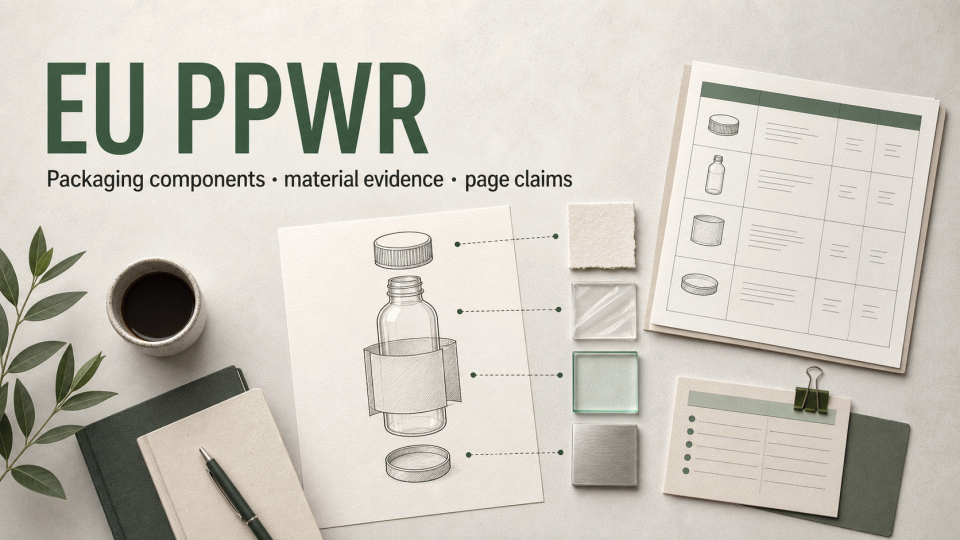
This reference page uses Regulation (EU) 2025/40, the Packaging and Packaging Waste Regulation (PPWR), as its legal background. It organizes packaging components, material information, technical records, and page wording. The applicable scope and duties still need to be checked against the product, packaging format, target market, and the official text in force at the time.
Boundary note: a complete evidence file is not a certification, market-access decision, or platform decision. This page does not predict approval, delisting, detention, penalties, or other outcomes and is not legal advice.
1. Define the evidence object
Start with one product and one target market. Separate sales packaging, grouped packaging, and transport packaging, then record each component’s function, material or material combination, dimensions/weight, supplier, and version. A brand or factory alone is not a sufficient evidence unit, and product-specific rules should not be silently folded into a PPWR conclusion.
Use a four-column map: “packaging component—material—evidence—page wording.” Each row should retain its source version, owner, and open questions.
2. Packaging and material records
- Structure drawings, component photographs, or sample records showing how adjacent materials are separated.
- Known material, coating, adhesive, and composition information, supported by supplier specifications or declarations.
- Component weight, dimensions, quantity, unit, measurement date, and applicable version.
- For recycled content, recyclability, reuse, or other environmental wording, keep the calculation method, data source, and conditions separately.
- Where testing or technical assessment is needed, record the object, method, laboratory or assessor, report number, and coverage. Do not substitute a file that does not match the entity, material, or model.
3. Technical file and responsibility chain
List the product owner, packaging designer, material suppliers, and relevant EU-market roles separately, with the role basis and document version. Purchase orders, invoices, specifications, test reports, design changes, and supplier declarations should resolve to the component they support rather than sit in an unindexed folder.
For every environmental claim, keep a “claim text—object—boundary—evidence—conditions—page location” record. If a file covers one material, batch, model, or market, do not expand it into a conclusion about an entire brand or product range.
4. Page and customer-facing wording
Write only what the evidence supports: for example, a packaging component’s material information, design feature, or collection instruction, with the relevant conditions, region, and version. Avoid broad wording such as “fully compliant,” “guaranteed approval,” or “zero risk” when the file cannot prove that conclusion.
PPWR may sit alongside product-safety, chemicals, extended-producer-responsibility, or platform requirements. That overlap does not make one document a substitute for another scheme. Keep separate requirements in a separate review list and link each to its relevant official source.
5. Five checks before publication
- Do the component records cover sales, grouped, and transport packaging actually used?
- Can materials, weights, versions, and suppliers be mapped to each component?
- Do the entity, object, scope, and date of each report or declaration match?
- Does the wording retain conditions and avoid presenting preparation work as a certification result?
- Has the current official text of Regulation (EU) 2025/40 and any relevant member-state requirement been recorded?
Official source: EUR-Lex: Regulation (EU) 2025/40. 绿色方舟(深圳)认证有限公司 can help map evidence boundaries by product and market; this page does not make an outcome promise or restore a contact footer.


