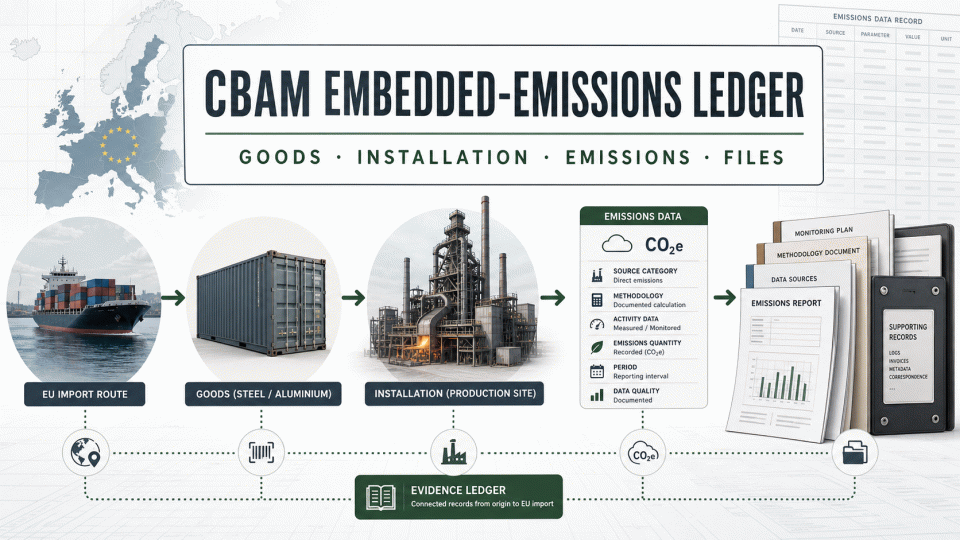
CBAM preparation starts with matching the covered goods, import roles, production installations, embedded emissions and reporting evidence. This page is a records framework, not a substitute for checking the current legislation, commodity code and import arrangement.
1. Confirm the goods and responsible roles
For the first ledger, record the import date, country of origin, eight-digit CN code, goods description, quantity and unit. Compare the record with Annex I of the CBAM Regulation. The European Commission describes 2026 as the start of the definitive regime; any mass threshold or exception must be checked against the current rules rather than inferred from a broad product category.
Map the EU importer, indirect customs representative, non-EU installation and supplier. Legal names, installation names, addresses, countries and internal product IDs should point to one another across orders, customs records, production records and emissions files.
2. Record embedded emissions at installation level
Do not treat a company-wide carbon inventory as the embedded-emissions value for a shipment. Record the installation, production route and period, including material and energy inputs, output, system boundary, direct emissions, relevant indirect emissions and the allocation method.
When actual values are used, the installation should calculate them under the applicable method and provide sufficient underlying data. When an allowed default value is used, keep the rule version and scope that support the choice. Actual values, default values and calculation methods should never be mixed in one record without an explanation.
3. Map goods, installations, emissions and files
Give each product version a unique record ID and link four groups of information: goods and CN code; installation and production period; the emissions worksheet and unit; and orders, invoices, transport records and producer communications. If the factory, process, inputs or commodity code changes, create a new version and retain the earlier record.
A reported emissions figure should trace back to calculation sheets, energy records, output records and allocation notes. Where verification is required, it concerns the installation and embedded-emissions data; it is not a blanket certification of every product or the entire supply chain.
4. Separate reporting steps from file versions
The CBAM Registry, authorisation, import records, emissions data and later declarations are distinct operational steps. Record the owner, source, calculation method, submitted version, reviewer and revision date. “Supplier file received” should not be recorded as “declaration completed.”
European Commission materials state that the first annual declaration for 2026 imports is due in a later reporting cycle; the applicable date, certificate and verification requirements should be checked against the current legislation and system notices. This page does not replace an importer’s legal, customs or tax assessment.
5. Manual review before submission
Check each record: the CN code matches the goods description; the importer matches the authorisation and customs record; quantity, unit and period reconcile to production and import records; the emissions figure has a calculation basis; actual or default values are identified; the figure is linked to the correct installation and product version; and prior versions, revisions and supplier responses are retained.
绿色方舟(深圳)认证有限公司 can help organise evidence structures and mappings, but it does not replace the statutory roles of the EU importer, indirect customs representative, installation operator or competent authority. Before publication or filing, re-check the current EUR-Lex text, the CBAM Registry and the applicable goods rules.