
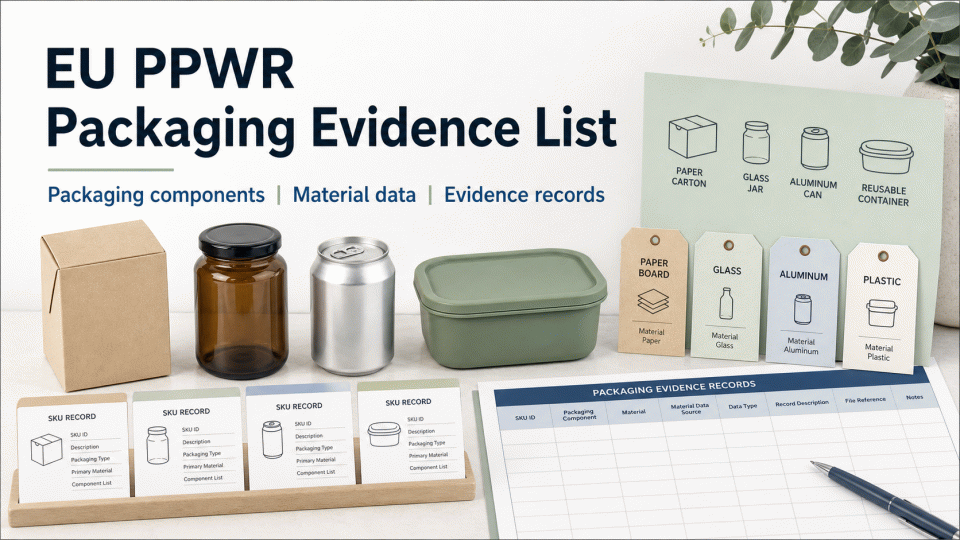
PPWR is not a standalone certificate that can be detached from the product and market context. A useful starting point is to break each SKU into sales packaging, transport packaging and individual components, then record materials, weights, labels, supplier sources and supporting files against Regulation (EU) 2025/40.
1. Define the record object and market boundary
At minimum, record the SKU, sales market, packaging function, packaging level and relevant economic operator. Do not turn a product rule, a Member State producer-responsibility arrangement, a platform preference or a private customer standard into a PPWR conclusion. An outer carton, insert, cap, label, tape and transport protection may be separate components and should be listed separately.
Regulation (EU) 2025/40 covers packaging and packaging waste placed on the EU market and addresses packaging design, composition, reusability or recoverability, and waste management. Whether a particular SKU, component or operator is in scope still requires a product-specific reading of the regulation, its annexes, the facts and the applicable dates.
2. Build a material record for every component
Useful fields include component name, packaging level, primary material, composite structure, unit weight, dimensions, product-contact relationship, separability, supplier or manufacturing location, version and change date. For paper, plastics, glass, metals, wood or composite materials, keep a source that leads back to a specification, BOM, purchasing record or supplier statement.
A material label is not a substitute for evidence, and a supplier’s general marketing wording is not automatically an SKU-level fact. If a claim concerns recycled content, reuse, recyclability or food contact, record the claim subject, method, applicable version and evidence owner.
3. Review labels, instructions and packaging information separately
Keep the final packaging artwork, labels, instructions, sorting or collection information and language versions, and link them to the component register by version. Every material, recycling, reuse or environmental statement shown on packaging or a product page should point to a specific file. If it cannot be supported, mark it for review instead of replacing it with a broad term such as “green” or “sustainable.”
PPWR information and labelling requirements may depend on later implementation details, packaging type and market arrangements. Where the applicable provision is not confirmed, record the source and open question rather than inventing a universal format, deadline or threshold.
4. Link each claim to evidence and version
For each outward-facing statement, link the wording to the applicable SKU and component, the evidence file and page, the issuing or supplying party, and the reviewer and review date. Keep file names, versions, languages and source links traceable. A change to packaging, supplier, material formulation or market should trigger a new review.
绿色方舟(深圳)认证有限公司 should separate “available,” “to be supplemented” and “not determinable from the current file set.” A checklist is a record-management aid, not a compliance result and not a substitute for a product- and market-specific legal assessment.
5. Complete a manual review before submission
Check each item before submission or publication: the SKU and packaging version match; component, material and weight have sources; artwork, labels and instructions are final; the legal entity and market are aligned; PPWR provisions, annexes and dates come from official sources; and unresolved points are clearly marked. Only then decide whether further testing, supplier evidence or specialist legal input is needed.
Sources: European Commission, Packaging and Packaging Waste Regulation; Regulation (EU) 2025/40, EUR-Lex. This page is a record-keeping reference and does not provide a product-specific compliance conclusion.


