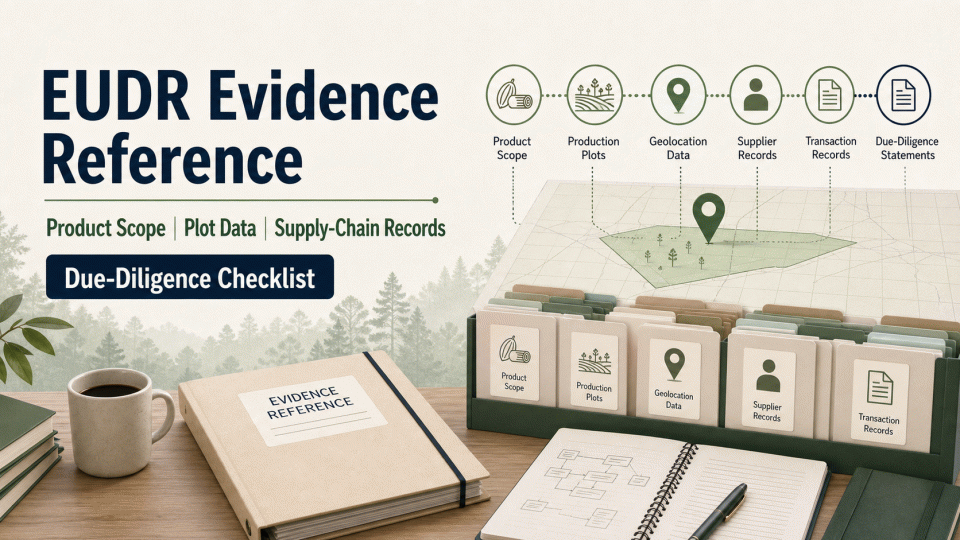
EUDR preparation starts with checking whether a product falls within the relevant commodities and products listed in Annex I. The evidence map should then connect the product, production plot, supplier, transaction records and due-diligence statement information. This page is a reference checklist, not a determination of applicability or outcome for a particular product.
1. Build a product-scope register
For each SKU or batch, record the product and material description, model or batch reference, quantity or weight, intended EU market, relevant commodity category, HS code and the corresponding Annex I entry. For composite products, identify the covered commodity or material instead of treating the whole company, all SKUs or one supplier certificate as the applicable unit.
Useful fields: SKU or batch, product and material description, commodity category, HS code, supplier, country of production, production date or period, document number, linked plot and record version.
2. Capture production-plot information
For covered commodities, the register should connect the production plot to the commodity, batch or supply-chain record. Depending on the applicable case, retain the production country, production date or period, and the supplier’s plot list, map, coordinates or polygon data. Check the required precision and format against the regulation, Annexes, official system and applicable guidance; a country name is not a substitute for plot information.
3. Link legality and supply-chain evidence
Organise due-diligence evidence around three activities: collecting the required information, assessing risk against the relevant factors, and taking risk-mitigation measures where needed. Depending on the transaction, records may include supplier and producer identity, purchase contracts, invoices, transport or batch records, documents relating to the applicable law of the country of production, plot-to-product mapping, and the rationale for risk assessment or mitigation.
An invoice, packing list, transport record or supplier statement proves only the relevant fact; it does not automatically replace plot information, a legality assessment or a due-diligence statement. Legal names, product descriptions, quantities, batches, dates and geographic scope should reconcile across records, with explanations and correction history retained for discrepancies.
4. Record statements and page wording
Where a due-diligence statement is submitted or referenced, record its reference number, submitting party, covered product or batch, linked suppliers and plots, and the document versions that support it. Downstream reference numbers or declaration identifiers should remain traceable to the transaction record. A website may say that product, plot and supply-chain records are being organised against EUDR requirements; it should not turn preparation into a statement of approval, completed review, universal SKU coverage or a guaranteed result.
5. Record current timing information carefully
The European Commission’s current EUDR page lists 30 December 2026 for large and medium operators, 30 June 2027 for most micro and small operators, and 30 December 2026 for micro and small operators already covered by the EU Timber Regulation. Page copy and internal schedules should show the verification date and follow the consolidated and amending legislation plus the latest Commission implementation information; do not present one date as applying identically to every operator, product or transaction.
6. Five manual checks before publication
① Is the SKU and Annex I scope supported? ② Do commodity, product, batch and plot records correspond? ③ Are location, production timing, legality and transaction records free of unexplained breaks? ④ Are risk assessment, mitigation and statement references versioned? ⑤ Does the page distinguish preparation, legal requirements and actual findings without expanding into a generic certification or outcome promise?
Sources: the consolidated text of Regulation (EU) 2023/1115; European Commission, Regulation on Deforestation-free Products; and related official implementation and guidance pages. Applicability should be checked against the product, transaction role and latest official information.