The EU Ecodesign for Sustainable Products Regulation (ESPR, Regulation (EU) 2024/1781) creates a disclosure framework for discarded unsold consumer products. Article 25 also restricts the destruction of apparel, clothing accessories and footwear listed in Annex VII. This article focuses on scope, record fields and evidence boundaries; an internal ledger is not, by itself, proof of market access or a regulatory outcome.
1. Separate the product scope from the company-size rules
ESPR is a framework regulation for more sustainable products. For unsold apparel, clothing accessories and footwear, start by confirming whether the item falls within the relevant Annex VII categories, the company size, who controls or disposes of the stock, and whether sales and supply-chain records can be traced to a product batch.
- Article 25 applies the destruction prohibition to large enterprises from 19 July 2026 and to medium-sized enterprises from 19 July 2030. The paragraph does not apply to micro and small enterprises. Company size and operating arrangements still need to be checked against the applicable rules and authority requirements.
- An operator that is outside the prohibition must not receive unsold products for destruction in order to circumvent the rule. “Unsold” alone is not enough to decide whether a particular disposal route is available.
- Disclosure under Article 24 and the destruction prohibition under Article 25 are related but distinct. Disclosure records cover information such as the products discarded, quantities, reasons and destinations; a destruction exception also requires the relevant facts and supporting proof.
2. Build the inventory route ledger at SKU and batch level
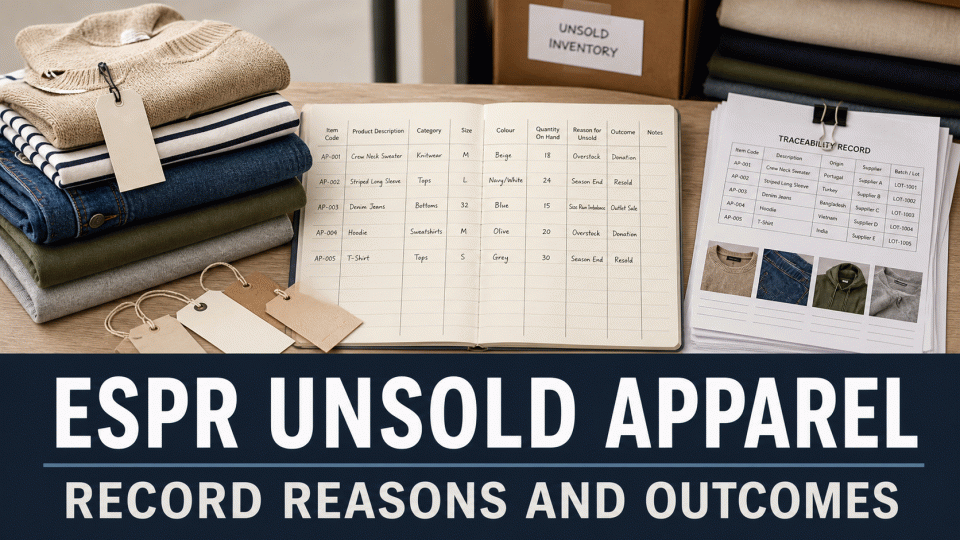
Do not use only the brand, factory or one total-stock figure as the record unit. A workable register should identify the SKU, style or model, material composition, size or colour, batch and storage location, while preserving the source and date of each status change.
- Product identity: SKU, style or model, product category, fibre or material composition, size and colour, batch or production lot, supplier and production location.
- Inventory status: received quantity, closing quantity, returns, damaged units, whether the goods were offered for sale, and whether they moved to donation, resale, repair, refurbishment or remanufacturing. A donation is not itself “discarding” for Article 24, but its acceptance and handover records should still be retained.
- Route evidence: sales or resale records, donation acceptance records, repair or refurbishment work orders, remanufacturing handover records, logistics documents, recycling or waste-treatment records, and the related internal approval reference.
- Reason statement: keep seasonal stock, quality or safety issues, damage, intellectual-property disputes, donation refusal and unsuitability for reuse as separate factual categories rather than replacing them with “other”.
3. Create a factual evidence chain before destruction or disposal
Destruction should not be treated as the default stock-clearance route. For an item planned for destruction or already discarded, retain its product identity, quantity, reason, treatment route and receiving-party information. If an applicable derogation is relied on, retain documents or test results that support that specific fact. A generic supplier statement or a certificate that does not cover the SKU is not a substitute.
The purpose of the record is not to prove that the business has obtained a universal “compliant” result. It is to show which batch was handled, what fact led to the decision, who approved it, how it was treated, who received it and which document supported the decision. For safety issues, damage, intellectual-property concerns, donation refusal or inability to prepare the item for reuse, retain the relevant inspection, test, notice, response, photograph or handover evidence.
4. Keep product files, transaction records and page wording distinct
Product specifications, fibre composition, labels and lot records identify the goods. Purchase orders, invoices, warehouse records and logistics documents explain quantity and movement. Inventory ledgers and treatment records explain the destination. Website wording about “sustainable”, “circular” or “reusable” claims should be checked separately against the supporting evidence and scope; one generic certificate should not be used to infer a broad claim.
For the Article 24 disclosure, the Commission has adopted Commission Implementing Regulation (EU) 2026/2, which sets details, format, product-category boundaries and verification arrangements; for disclosed discarded products, the supporting delivery, reception and treatment evidence generally must also be kept for five years under that implementing regulation. For Article 25(5) derogations, Commission Delegated Regulation (EU) 2026/296 now sets out further applicable situations. Other product information requirements may still be specified by later product measures. A field that lacks a corresponding EU measure or direct source support should not be presented as a single confirmed mandatory checklist. Platform rules, buyer requirements and additional Member State measures should be labelled separately by source and audience rather than merged into the legal duties in Articles 24 and 25.
5. Five manual checks before publication
- Confirm the product category, SKU, batch and company size so that different products are not merged into one record.
- Reconcile quantity, reason, destination and receiving party, with a source document for each material field.
- If destruction or disposal is involved, check the facts and proof for the specific derogation instead of using a general assurance.
- Check the format, timing and retention arrangements for required disclosures or authority requests against the current official version.
- Read the title, summary and body manually and remove wording that turns a ledger, test or internal process into an approval, exemption, market-access or fixed-result claim.
Sources and boundaries
This reference page is based on the European Commission explanation of the unsold apparel and footwear destruction restrictions and EUR-Lex texts for Regulation (EU) 2024/1781, Commission Implementing Regulation (EU) 2026/2 and Commission Delegated Regulation (EU) 2026/296, with particular attention to Articles 24 and 25 and Annex VII. Application can depend on company size, product scope, Member State implementation and later EU measures. Use the applicable official text and authority requirements for a specific case.
European Commission: unsold clothes and shoes destruction restrictions EUR-Lex: Regulation (EU) 2024/1781 EUR-Lex: Commission Implementing Regulation (EU) 2026/2 EUR-Lex: Commission Delegated Regulation (EU) 2026/296