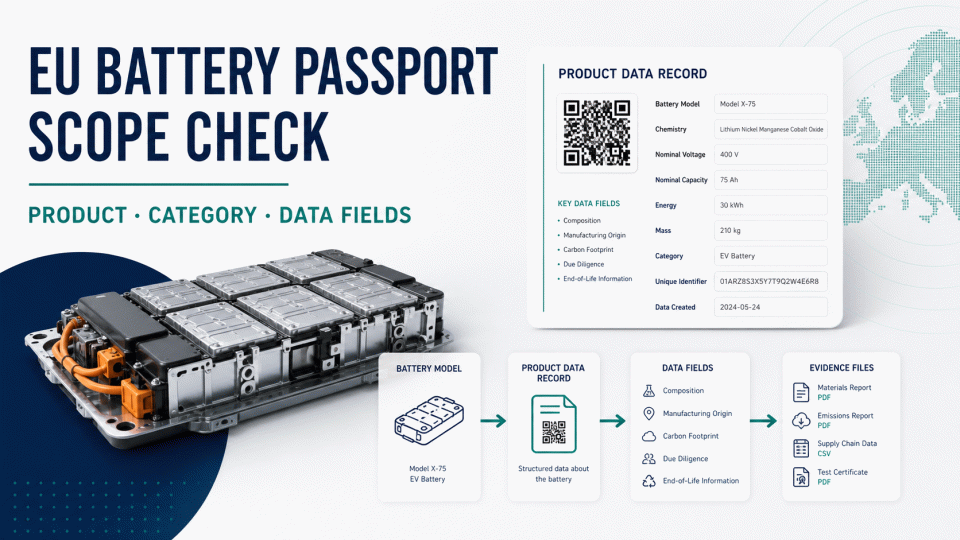
A battery passport is not a standalone certificate that can be separated from the product and the responsible economic operator. This page is a practical record map for linking a battery model, its regulatory category, required data fields and traceable evidence. It does not replace a product-specific legal assessment.
1. Check whether the battery is in scope
Article 77 of Regulation (EU) 2023/1542 provides that, from 18 February 2027, each light means of transport (LMT) battery, each industrial battery with a capacity greater than 2 kWh, and each electric vehicle battery placed on the market or put into service must have an electronic record called a battery passport. The scope file should record the use, category, capacity, market-placement or putting-into-service fact, model and manufacturing plant.
Portable batteries, starter-lighting-ignition (SLI) batteries and other categories should not be classified by analogy alone. Keep the technical specification and the legal basis for the category decision. A platform page, customs code or generic supplier spreadsheet is not a substitute for the regulatory scope analysis.
2. Use the battery model as the core record unit
Use “battery model—manufacturing plant—version or batch” as the working key. Link at least the model name and unique identifier, manufacturer and responsible economic operator, manufacturing location and date, capacity and key technical parameters, chemistry, composition and material information, carbon-footprint data, due-diligence records, and information relevant to dismantling, remanufacturing, repurposing and recycling. Do not merge different models, plants or technical versions without supporting evidence.
Article 77 also requires the QR code and unique identifier to follow the specified ISO/IEC standards or equivalent standards. Keep the identifier-generation rule, data version, access permissions and change log, and make sure the model name is consistent across the product, technical file and page.
3. Map each field to an evidence file
Product and manufacturing: retain specifications, BOMs, model/plant lists, production dates and version records to show what the battery is and who made it, where and when.
Materials and performance: retain chemistry, key-material, capacity, performance and durability data, together with applicable test or calculation records. The report entity, model, sample and method must trace back to the battery; another product’s report cannot fill the gap.
Carbon footprint and supply chain: record the boundary, functional unit, data sources, calculation version, manufacturing plant and review trail. Where due diligence is relevant, keep supplier, material-source, risk-assessment and mitigation records that match the actual chain. Mark unsupported or unreviewable data as pending instead of presenting it as complete.
Circularity and end-of-life: prepare the required information on safe dismantling, composition, repair, remanufacturing, second-life use and recycling, while separating fields by access role. Not all data is public; access permissions and legitimate-interest boundaries should be documented.
4. Separate responsibility, access and page wording
Identify the manufacturer, importer, authorised representative or other economic operator in the actual transaction chain before assigning data-maintenance actions. A data service provider may store or process information, but it does not replace the economic operator with the regulatory responsibility and should not use restricted data for unrelated purposes.
A website may accurately say that a battery model and evidence register is being prepared. It should not turn a checklist into “battery passport obtained”, “EU approved” or a guarantee of market access. If scope confirmation is incomplete, use wording such as “pending confirmation” and “to be checked against the specific model”.
5. Five manual checks before publication
1) Is the category and capacity supported? 2) Do the model, plant, version and page name match? 3) Does every field point to a located file or calculation record? 4) Are access permissions, QR/unique-identifier controls and change records clear? 5) Do the Chinese and English pages state the same facts without approval, fixed-deadline or market-outcome promises?
Source and boundary
This reference is based on Regulation (EU) 2023/1542 on batteries and waste batteries, with emphasis on Article 77 and Annex XIII. Before use, check the current EUR-Lex text, relevant implementing or delegated acts, and the product’s own records. 绿色方舟(深圳)认证有限公司 can help structure evidence files, but this page is not a promise about a product’s scope decision or regulatory outcome.