
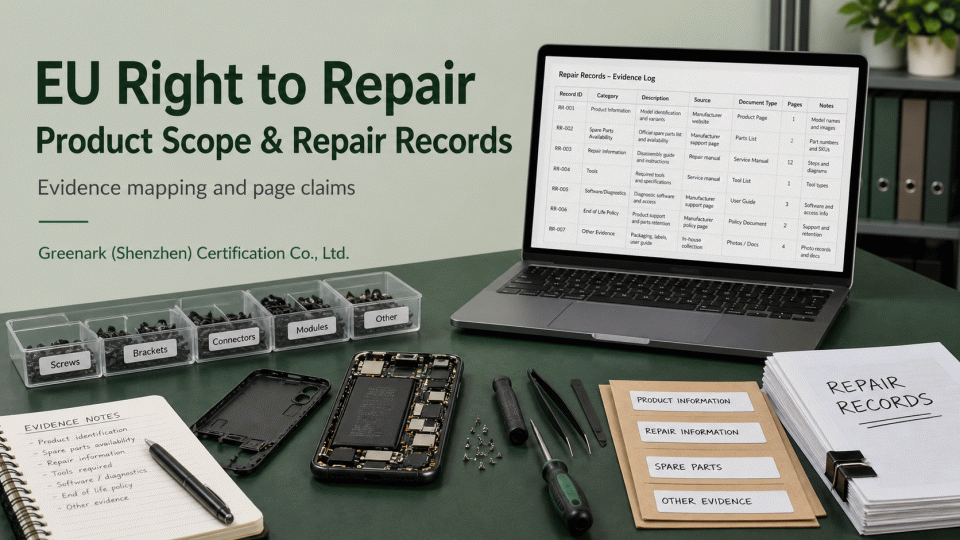
The EU right-to-repair framework is not a universal certificate for every product. It sets rules around consumer repair choices, manufacturer repair obligations, repair information, and product reparability. A business should first identify the product-specific EU law and the relevant entry in Annex II of Directive (EU) 2024/1799, then map its repair and spare-parts evidence.
1. Confirm the product scope first
Record the product definition, consumer-sales context, timing of the defect, manufacturer, and import or distribution roles. The Directive primarily addresses repair of consumer-purchased goods when a defect occurs or becomes apparent outside the seller’s liability under the applicable sale-of-goods rules. Its definition of goods excludes water, gas, and electricity.
Then map the exact product to the legal acts listed in Annex II. The list can evolve as EU product legislation introduces new reparability requirements. Your register should therefore retain the model, applicable act and version, relevant provision, reparability requirement, spare-parts scope, and repair-information requirement instead of treating “EU right to repair” as one generic category.
2. Repair obligations and consumer information
Within the applicable scope, Member States must ensure that manufacturers repair covered goods at the consumer’s request. A manufacturer is not required to repair when repair is impossible and may subcontract the repair. The repair must be provided within a reasonable time and free of charge or at a reasonable price, subject to the transposing Member State rules and product-specific legislation.
Where the relevant obligation applies, manufacturers, authorised representatives, importers, or distributors must make repair-service information available in a clear, comprehensible, and easily accessible way. Manufacturers that make spare parts and tools available should not price them in a way that deters repair. They should not refuse repair solely because another repairer or person previously repaired the product; intellectual-property, product-safety, and product-specific requirements still need separate review.
A repairer may provide the European Repair Information Form. It is supplied on a durable medium before the consumer is bound by the repair contract and covers the repairer, service, price, arrangements, and timing. The conditions generally remain unchanged for 30 calendar days after the form is provided. If diagnosis is needed, the repairer should explain the need for and cost of that service in advance.
3. Suggested evidence register
Product and parties: brand, model, variant, serial or batch logic; legal names and roles of the manufacturer, authorised representative, importer, distributor, and repairer; sales channel and target Member State.
Regulatory mapping: the Annex II legal act, provision, and version; applicable reparability requirements; disassembly, spare-parts, tools, software, and repair-information requirements; and any fields that depend on national transposition or product-specific rules.
Repair service: service channel and responsible party; available spare parts, tools, and technical information; diagnostic method and cost notice; price or indicative typical-repair price information; repair conditions and timing; and durable-medium records provided to consumers.
Evidence links: connect each page claim to the legal provision, product file, spare-parts catalogue, repair procedure, webpage version, and internal owner. Use “verified,” “to confirm,” or “not applicable” states with a review date. A generic supplier certificate cannot replace a product-specific repair-obligation analysis.
4. Page and customer-communication boundaries
A page may describe the repair service, spare-parts availability, request route, and cited legal provisions that actually apply to the product. It should not present “EU right to repair” as a universal certification, customs document, platform approval, or guarantee of a commercial outcome. Avoid claims such as “every product must be repaired,” a universal fixed repair deadline, “automatic EU compliance,” or a guaranteed absence of listing or market action unless specific evidence supports the statement.
For each model, check that the legal scope matches, party roles are consistent, repair and spare-parts information is real and available, page language reflects the target market, and webpage or durable-medium records are traceable. If discussing national implementation, penalties, or consumer remedies, cite the applicable Member State rules and obtain a separate legal review rather than using one universal percentage or consequence.
5. Five checks before publication
1) The model matches the Annex II legal act. 2) Manufacturer, import-chain, and repairer roles are not mixed. 3) Spare-parts, tools, repair-service, and diagnostic-cost statements have supporting records. 4) The page does not turn a repair right into a certification or outcome promise. 5) Chinese and English pages match the real service scope and retain the source and version record.


