Who this is for: Manufacturers, brands, importers, distributors and marketplace sellers supplying consumer products to the UK. This article covers evidence handling after a listing removal, import rejection or product-safety notification; it is not legal or regulatory advice for a particular product, market or responsible business.
Bottom line: A marketplace listing removal, an official product safety report, an import rejection and a product recall can describe different facts or measures. Preserve the original notice and timestamp, then connect product identifiers, batches, stock, test or complaint evidence, owners and corrective action in one traceable timeline. Do not describe one listing removal as a recall or extend one batch finding to all inventory without evidence.
1. Confirm the market and the source
“The UK market” is not enough to establish the applicable framework or authority. GOV.UK guidance distinguishes the Great Britain framework from the arrangements applying in Northern Ireland. When a notice arrives, record the territory, the business that placed the product on the market, the sender, any case number, the date and the requested action. Keep official notices, marketplace tickets, customer complaints and supplier messages as separate original records.
2. Separate four different statuses
- Marketplace listing removal: a marketplace measure affecting an offer or listing; it is not automatically an official recall.
- Product safety report: in OPSS public information, a report about a specific product found in the UK where corrective measures other than a recall may be ordered or undertaken.
- Product recall: an action for a specific product sold in the UK that may require consumers to obtain a repair, replacement or refund.
- Product safety alert: a warning about risks in a product category or sector that requests immediate steps; it is not the same record as a single listing action.
These distinctions follow OPSS public explanations and its published reports. In the internal register, preserve the source page, original wording and supporting evidence. Do not replace neutral source language with stronger labels such as “illegal,” “recalled” or “non-compliant” unless the evidence and authority record support that wording.
3. Build a product, batch and channel evidence chain
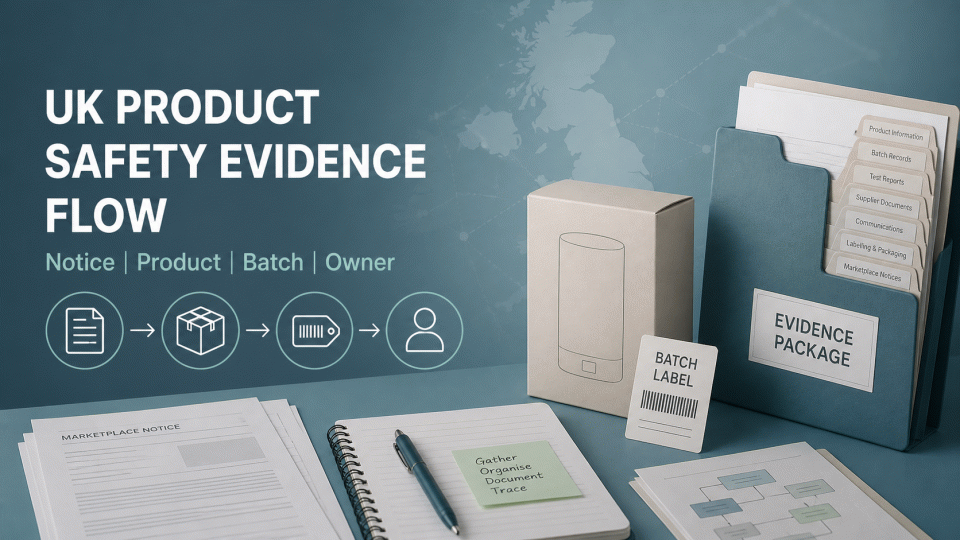
For each incident, record at least the brand, model or SKU, barcode where relevant, listing version or screenshot, manufacturer/importer/seller, supplier, batch and stock location, sales channel and territory, notice or complaint source, test reports and images, the basis for the risk assessment, any listing, isolation, repair, replacement or notification action, the owner, review date and closure basis. The OPSS Product Safety Database guidance also identifies importer details, product batch numbers, test reports and corrective actions as important notification information. A complete record is not the same as proof that a product is safe or compliant.
4. Use a controlled response sequence
- Preserve the marketplace ticket, official notice, page screenshot, current listing version and receipt time before overwriting anything.
- Define the affected scope by model, version, batch, stock location and territory; a supplier’s “same product” statement does not replace identifier and batch matching.
- Keep product facts, test or complaint facts, applicable guidance and marketplace actions in separate fields. If a notification to an authority may be required, follow the relevant official guidance rather than treating a blog or marketplace prompt as the formal procedure.
- Have operations, warehouse, quality, compliance and the project owner confirm the listing, stock, evidence, source boundary and receipts. At closure, retain the corrective action, version change and open items.
5. Match the wording to the evidence boundary
One complaint, one test report or one listing record supports only the product and time range it actually covers. Until batch tracing, risk assessment or authority communication is complete, do not write that all stock is affected, that the marketplace will restore the listing or that regulatory requirements have been satisfied. Recheck the guidance and facts separately for Great Britain, Northern Ireland, product category and responsible business.
6. A practical owner-flow checklist
Source and receipt time | Product brand/model/SKU | Batch and stock location | UK territory and sales channel | Manufacturer/importer/seller | Reports, images, tests and complaints | Risk-assessment basis | Listing and stock action | Consumer or authority notification record | Owner | Review date | Closure basis.
Scope note: This is an evidence-organisation framework based on public materials. GOV.UK, OPSS, local market-surveillance authorities and marketplaces determine the applicable process and measure according to the product, territory, risk and case facts. This article does not promise delisting reversal, a regulatory conclusion, sales, certification or a platform outcome.
Official sources: GOV.UK Product Recalls and Alerts; OPSS Product safety advice for businesses; Business notifications of unsafe and noncompliant products; How to use the Product Safety Database; General product safety regulations: Great Britain. Recheck source status and scope before handling a specific case.