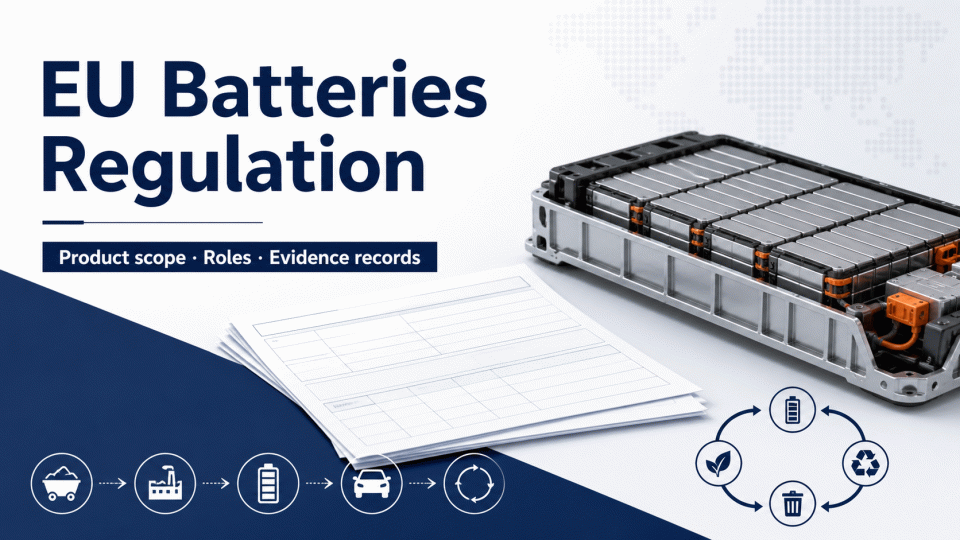
Preparing for the EU Batteries Regulation does not begin with finding a generic certificate. Regulation (EU) 2023/1542 covers batteries and waste batteries across their life cycle, while the practical duties depend on the battery category, intended use, market role, and the Member States where the product is made available. This page is a documentation framework, not a conclusion that any SKU complies.
1. Define the regulatory object before using a template
Start with a product register. Record whether the battery is sold separately or incorporated into equipment, a light means of transport, or an electric vehicle; whether it is portable, industrial, automotive, or another category; and who manufactures, imports, distributes, or places it on the market under a private label. Cells or modules supplied for end use may need to be treated according to the closest battery category, so the commercial product name is not enough.
- Product identity: model, capacity, chemistry, ratings, rechargeability, installation method, and differences between versions.
- Market route: the first Member State of supply, sales countries, importer and distributor details, and any private-label arrangement.
- Economic-operator role: separate the manufacturer, importer, distributor, producer-responsibility organisation, and other roles. A supplier file is not automatically evidence of every duty of the seller or importer.
The output should be a SKU–category–role–Member State–evidence map. If the product boundary or role is unresolved, record it as an open question rather than presenting an assumed scope as settled.
2. Convert applicable requirements into traceable records
Product and technical file
Keep specifications, BOM or material information, chemistry and critical-component records, design-change history, instructions for use and maintenance, and relevant safety or risk records for each model. Every file should point to a model and version. A generic supplier document is only a lead until its scope, legal entity, and revision are matched.
Conformity and labelling file
Index the conformity-assessment route, applicable technical requirements, declarations, and label artwork. Warnings, capacity information, recycling marks, packaging, instructions, and product-page statements should describe the same product version and reflect the target Member State language requirements. Do not turn one test report, laboratory name, or mark into a claim that it proves every obligation.
Supply-chain and producer-responsibility file
Record the manufacturer, importer, and distribution chain by product and market, together with producer-responsibility registrations or organisation records where applicable, and records of quantities placed on the market and waste-battery arrangements. Contracts, invoices, transport documents, and internal ledgers help explain the chain; they do not replace technical or regulatory documents.
Life-cycle and change-control file
The Regulation addresses different subjects, including materials, carbon footprint, recycled content, removability, durability, collection, recycling, and digital information. Their details and timing are not identical for every battery category. Link each applicable item to the Regulation, a delegated or implementing act, or official guidance, and state why it is applicable, pending, or not applicable. Avoid applying one fixed validity period to every record.
3. Keep product-page wording within the evidence boundary
Product pages should describe verified product facts and document status. For example, it may be accurate to say that the technical file, label version, and operator records have been indexed for a model. It is not safe to write “EU compliant,” “approved,” or “will not be detained” merely because a supplier has made a statement. If a compliance claim is used, define its object, scope, basis, and date. If the review is open, say so and list the missing evidence.
- Model, images, capacity, and chemistry on the page must match the controlled technical version.
- External claims should point to a document name, revision, issuing entity, and coverage.
- Separate legal requirements from marketplace-document requirements; a platform review is not a legal conclusion.
- Reassess the map after a model, cell, factory, label, or market-role change.
4. Common mistakes and a human review checklist
- Assigning every battery to one category without checking use, installation, and market role.
- Treating a CE mark, test report, or supplier certificate as a substitute for all obligations.
- Presenting producer-responsibility registration, label language, or collection arrangements as automatically portable across Member States.
- Keeping only a final PDF and losing the model, revision, change, and page-publication trail.
Before release, ask: What type of battery is this? Who places it on which Member State market? Which record supports each claim? Which model and revision does the record cover? Do the label, manual, packaging, and page agree? Questions that cannot be answered should remain REVIEW items, not be filled with a conclusion.
Sources and scope note
This reference uses the official EUR-Lex text of Regulation (EU) 2023/1542 and the European Commission Batteries topic page. The Regulation, later amendments, delegated or implementing acts, and Member State requirements can change; check the applicable version before placing a product on the market. 绿色方舟(深圳)认证有限公司 can help organise a product-to-evidence map, but this page is not a compliance-result promise for a particular product.
EUR-Lex: Regulation (EU) 2023/1542 · European Commission: Batteries