
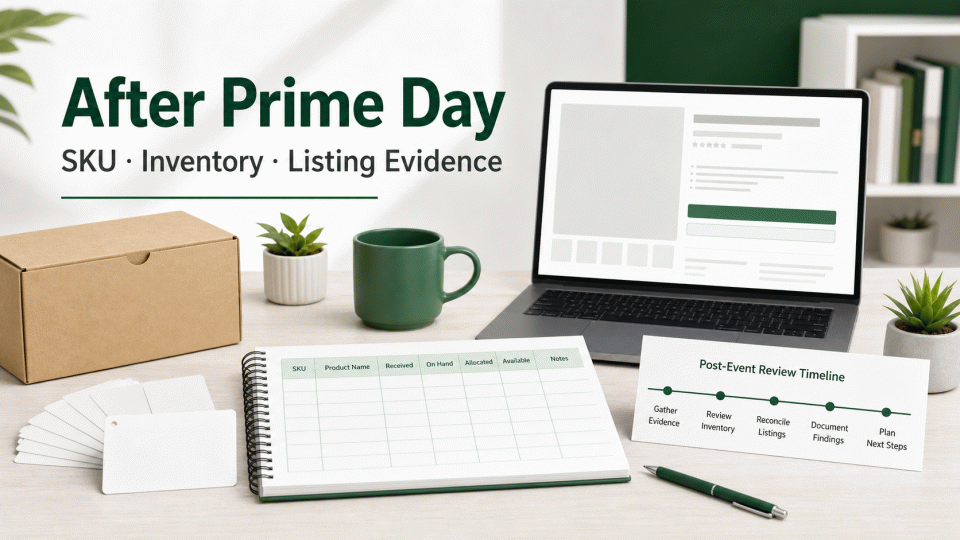
A useful Prime Day post-event review goes beyond sales totals. Reconcile the SKUs actually promoted, promotion settings, inventory movements, listing versions, returns, and customer feedback in one evidence table. The goal is to separate documented facts from assumptions made during the event.
1. Fix the review scope: SKU, marketplace, and event version
Save the ASIN, SKU, marketplace, variation, event or promotion name, and review window. Do not combine different marketplaces, variations, or promotion types into one conclusion. If the title, main image, bullets, or A+ Content changed, record the listing version and change time.
A practical index is: product identifier | marketplace | event or promotion type | listing version | inventory point | promotion record | issue and evidence location. If a SKU, variation, or marketplace cannot be matched, mark it for reconciliation instead of turning it into a performance conclusion.
2. Recheck promotion records: settings, eligibility, and presentation
Keep the submission record, promotion type, discount or offer settings, start and end times, marketplace, and the status shown in Seller Central. Amazon’s official materials note that product and seller quality requirements vary by promotion type, so one event’s setup should not be treated as proof that the next event will have the same requirements.
Use separate fields for “submitted in the account,” “shown on the event page,” and “order recorded.” They describe an account record, customer-visible presentation, and transaction fact respectively. When a price, offer, or display looks wrong, retain the screenshot, timestamp, and SKU.
3. Put inventory and fulfillment evidence on the timeline
Record sellable inventory, inbound or transfer status, reserved units, delivery commitments, and returns before, during, and after the event. Low inventory may affect availability, but a sales change alone does not establish the cause; connect inventory reports, inbound records, orders, and support records.
At minimum, preserve the timestamp, marketplace, SKU, inventory value or status, report source, downloaded filename, and owner. Keep FBA, external warehouse, third-party fulfillment, and merchant-fulfilled records distinct so that unrelated fulfillment figures are not combined.
4. Reconcile the listing, customer feedback, and service signals
Save the title, bullets, images, A+ Content, price presentation, and key attributes used during the event and at review time. Link page changes to return reasons, customer questions, reviews, and support cases without treating one comment as a complete picture of customer experience.
For environmental, performance, material, origin, or certification claims, check the product scope and supporting files again. Confirm the certificate holder, model, scope, version, and current status; a supplier file should not automatically be treated as complete evidence for the current SKU.
5. Write conclusions that remain traceable
Write each conclusion as “what was observed — which record supports it — what remains uncertain — who will check next.” For example: “A stockout record appears for one SKU in one marketplace during the event, based on the inventory report and order timeline. This alone does not establish the cause of all sales changes. Next, reconcile replenishment and delivery records.”
Archive the review in four groups: event and promotion, SKU and listing, inventory and fulfillment, customer feedback and follow-up. Any documentation or compliance guidance provided by 绿色方舟(深圳)认证有限公司 should remain bounded by the product, marketplace, and available evidence; it does not replace current Amazon or regulator requirements.
Sources and verification entry points
Amazon’s Prime Day readiness playbook describes preparation dimensions including dates, promotions, inventory, shipments, and stock maintenance. Amazon’s seller-facing Prime Day guide also recommends reviewing listings, inventory, and storefront content. After the event, use the specific marketplace and promotion records shown in Seller Central as the controlling source.
Amazon Seller Central: Prime Day readiness playbook
Sell on Amazon: Prepare for Prime Day


