
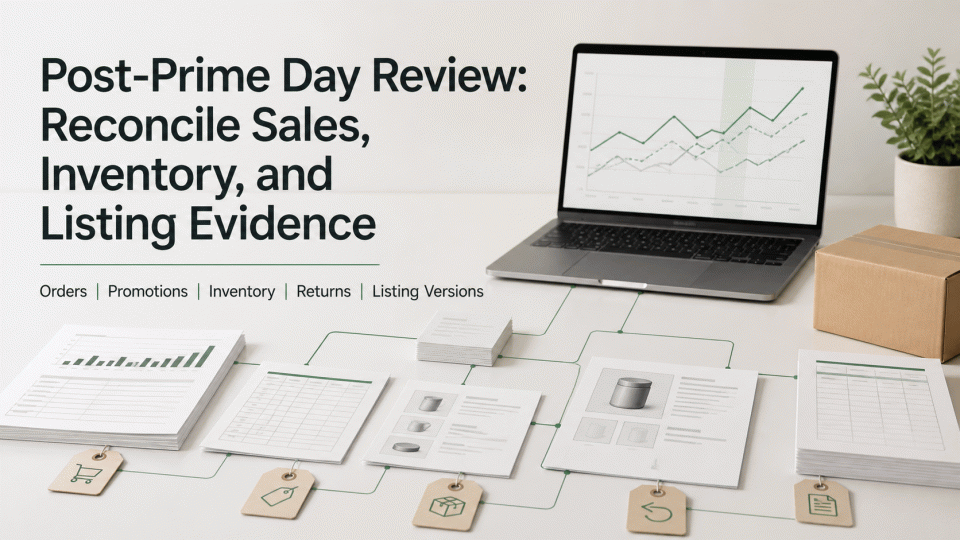
A post-event review is most useful when it separates what happened from why it happened. Preserve the original records first, compare the event window with clearly defined reference windows, and keep observed facts, possible explanations, and follow-up actions in separate fields.
1. Lock the review scope
Create a review key containing marketplace, ASIN, SKU, parent-child relationship, sales channel, event name, and the event start and end times. Define the comparison windows separately. Keep the report timezone and download timestamp, especially when sites or reports use different time conventions.
Use the current Seller Central account view and Amazon help materials for event eligibility, promotion types, inventory preparation, and tool availability. These can vary by marketplace, category, and account. This page is a review framework; it does not determine eligibility for any SKU.
2. Align five evidence tables
Orders and traffic: Record SKU, marketplace, date, orders, units, sales amount, sessions, page views, unit session percentage, and the report filename and download time. Do not mix order value, post-refund value, and settlement value under one label.
Promotions: Record promotion type, included SKUs, displayed price, reference-price basis, status, advertising activity, coupons, and actual active time. Whether discounts stack and how attribution is calculated should come from the relevant platform record.
Inventory and fulfillment: Record sellable, inbound, unfulfillable, and transferred units, receiving status, stockout periods, delivery promise, and fulfillment exceptions. A lower inventory balance is not by itself proof of stronger demand.
Returns and customer feedback: Group returns, reasons, ratings, review themes, support cases, and product batches by SKU. A reported issue is not automatically a confirmed product defect; keep investigation evidence separate.
Listing versions: Preserve the titles, bullets, A+ content, main images, variation relationship, price, promotion display, and edit times before and during the event. A version change is a fact, not proof that it caused a conversion change.
3. Separate observation, evidence, and explanation
Start with an observation such as “orders were higher in the event window.” Then list the supporting records: order report, promotion configuration, inventory movement, advertising record, and listing version. Only then list possible explanations such as price, traffic mix, availability, or competition. A time sequence alone does not establish causation when several variables changed together.
Add a status to each conclusion: checked when source records and definitions agree, to validate when the signal lacks a comparison, and discarded when the records conflict or cannot be traced. This prevents an old assumption from becoming a new “fact.”
4. Common misreads and evidence fixes
“Sales rose, so the listing edit worked” requires a check of price, advertising, traffic, and availability. “Inventory fell, so demand rose” requires checks for returns, removals, damage, and transfers. “Returns increased, so the product is defective” requires grouping by reason, batch, and variation. “Conversion fell after the event, so the event harmed the page” requires checks of traffic source, price, Featured Offer status, review changes, and stockouts.
When reports disagree, preserve the originals instead of manually forcing the numbers to match. Document field definitions, time basis, refund treatment, advertising attribution, missing items, owner, and retrieval path. Product-safety, labelling, or customer-complaint questions need a separate product- and market-specific review; a sales table is not a substitute for technical or regulatory analysis.
5. Turn findings into the next action list
For each action, name the object, evidence basis, owner, review point, and completion evidence. Examples include reconciling an SKU inventory difference, saving the final promotion configuration, reviewing a return cluster, or testing one clearly stated hypothesis. Avoid writing “increase conversion” or “reduce returns” as a guaranteed outcome; define the measure and the condition for reassessment instead.
If 绿色方舟(深圳)认证有限公司 helps organize the records, the working set should still come from client-authorized reports, page captures, promotion records, inventory data, and return records, with source, version, and gaps noted. Documentation support cannot invent data or decide platform eligibility, approval, or enforcement outcomes.
Source and limits
For Prime Day scheduling, promotion tools, inventory preparation, and account requirements, consult the Amazon Seller Central Prime Day readiness playbook and the account-specific pages shown after sign-in. This article turns those tools and seller records into a review method; the applicable marketplace record remains the basis for any eligibility, fee, metric-definition, attribution, or follow-up decision.


