For: Brands, importers, distributors, e-commerce sellers, and packaging teams placing packaged products on the EU market.
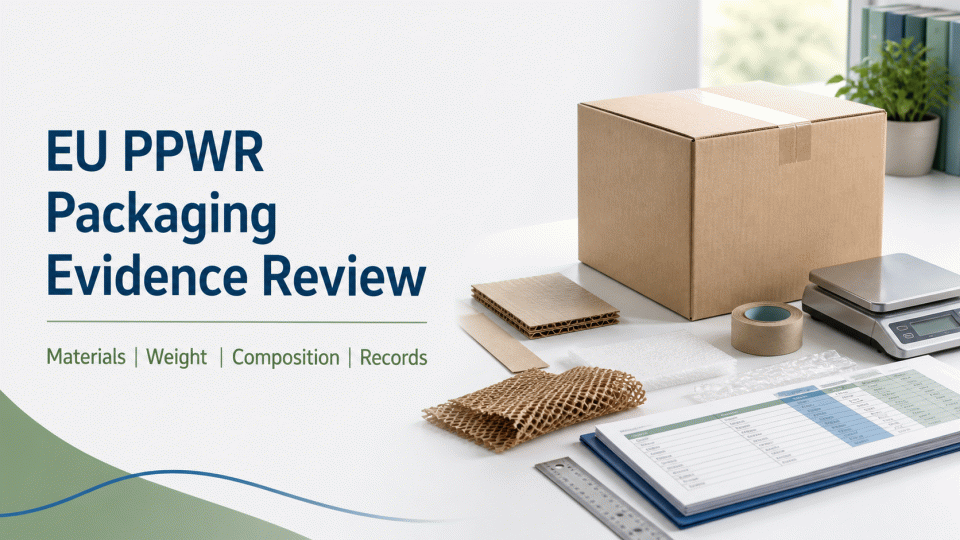
Summary: The Packaging and Packaging Waste Regulation, Regulation (EU) 2025/40, covers packaging across its life cycle. It generally applies from 12 August 2026, while particular duties take effect in stages under the Regulation and later measures. This page helps teams connect packaging composition, weight, supplier evidence, and market records. It does not turn a file check into a finding that a product is compliant.
1. Start with the business scope
The European Commission describes PPWR as a framework covering packaging design, composition, reusability or recoverability, and waste management. It covers packaging of different materials and origins, but that does not mean every business or format has the same duty on the same date. Map the product, packaging, and destination market before assigning responsibility.
- List every layer supplied with or used to transport the product: sales packaging, grouped packaging, transport packaging, cushioning, closures, labels, and inserts.
- Record each layer’s material composition, net mass, dimensions, supplier, version, and target market. Do not replace a material record with a broad label such as “paper box” or “plastic bag.”
- Identify who places the product or packaging on the market in each Member State. Keep EU-level PPWR requirements separate from national producer-responsibility registration, reporting, and collection arrangements.
2. Build a packaging evidence record
| Record area | Useful fields | Review question |
|---|---|---|
| Composition | Part, function, material or multilayer structure, joining method, supplier code | Can each part be linked to a physical inspection or technical document? |
| Quantity and mass | Unit mass, unit, method, tolerance, version date | Are product mass, packaging mass, and shipping-carton mass kept separate? |
| Supplier evidence | Specification, declaration, test or recycled-content record, batch/model | Does the document cover the current packaging version and batch? |
| Market and page | SKU, destination, packaging version, page claim, change log | Does the customer-facing wording stay within the evidence scope? |
3. Review the rule themes separately
PPWR addresses packaging-waste prevention, design and recyclability, recycled plastic, reuse and refill, labelling and information, producer responsibility, and restrictions affecting certain single-use plastics and substances of concern in food-contact packaging. The Commission notes that many requirements will apply progressively. The object, exception, threshold, and date should be checked in the Regulation, its annexes, and subsequent measures.
- Design and empty space: retain the rationale for dimensions, cushioning, fragility, and transport. Do not turn one internal ratio into a universal legal conclusion.
- Materials and recycled content: record polymer type, intended use, recycled-content methodology, batch, and supply-chain evidence. A supplier marketing statement or unrelated certificate is not a substitute for a PPWR review.
- Reuse, refill, and single-use formats: identify the packaging function and use scenario before checking the relevant provision and date. A national collection arrangement should not be presented as one EU-wide process.
- Labelling and information: confirm EU and national information requirements before final artwork. Page wording such as “recyclable” or “recycled content” should match the record’s object and evidence.
- Producer responsibility and reporting: maintain separate records for EU rules, national registration/reporting, fees, and collection systems. Amounts, schedules, and responsibility should not be copied from a template or old case.
4. A single-SKU review sequence
- Set the scope: lock the SKU, destination markets, packaging version, and placing-on-the-market actor; retain current photos and version identifiers.
- Break down the packaging: register material, function, mass, dimensions, joining method, and supplier for each layer. Keep shipping cartons separate from sales packaging.
- Link the evidence: connect specifications, measurements, declarations, batch records, and change logs to the same packaging version.
- Check the rules: mark design, material, reuse, labelling, responsibility, and national reporting as “checked,” “partly checked,” or “to confirm,” with the source and review date.
- Review the page: remove “compliant,” “guaranteed approval,” and “zero risk” wording without item-specific support. Qualify environmental or material claims by object, scope, and evidence.
- Control changes: reassess when material, supplier, tooling, dimensions, artwork, or destination changes. Do not carry forward a conclusion from an earlier version.
5. Sources and limits
This page is based on the European Commission’s public packaging-waste and PPWR material and the text of Regulation (EU) 2025/40. Dates, exceptions, technical details, and Member State implementation may develop through formal instruments. Use the Commission packaging-waste page, the Regulation, its annexes, and current implementation guidance as the source of truth. 绿色方舟(深圳)认证有限公司 can help map products, packaging, and evidence, but this page does not guarantee a result for any product, market, or filing.