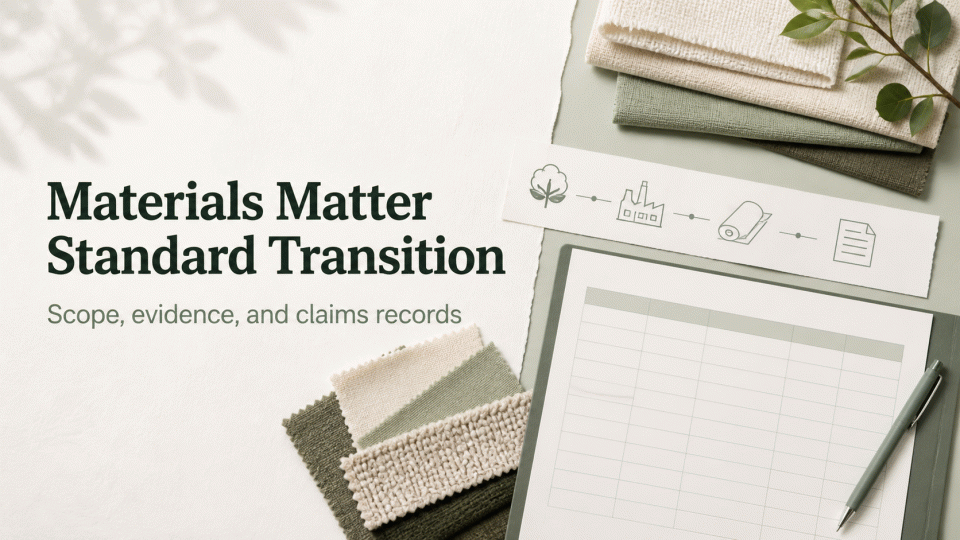
Materials Matter is not a universal certificate that replaces market law, platform requirements, or buyer audits. It is Textile Exchange’s evolving standard system for raw-material production and primary processing. For brands, supply-chain sites, and textile sourcing teams, the practical task during the transition is to separate scope, upstream evidence, transaction records, and product claims, then align the next steps with current official guidance and the relevant certification body.
1. What Materials Matter covers—and what it does not
Textile Exchange describes the first edition of Materials Matter as covering raw-material production and primary processing. Its initial scope includes wool, alpaca, and mohair within the Responsible Animal Fiber framework, together with recycled materials currently covered by the Global Recycled Standard (GRS) and Recycled Claim Standard (RCS). Organic Cotton Standard is expected to follow a gradual pathway, while other materials and standards should not be treated as included merely because their names appear in a supplier file.
Traceability does not disappear when the new standard is introduced. Textile Exchange explains that the Content Claim Standard (CCS) continues to support chain of custody and product claims. The scope of a raw-material or primary-processing audit should therefore be documented separately from the evidence needed for spinning, weaving, dyeing, garment production, and brand communications.
Keep three questions separate: the standard scope identifies the organizations, materials, and activities covered; CCS, Scope Certificates, and Transaction Certificates help document movement and claim-related evidence; destination-market law, buyer specifications, and platform policies impose their own requirements. They may interact, but none automatically substitutes for another.
2. Put the transition dates into a version log
At the time of this review, Textile Exchange’s official Materials Matter pages identify these milestones:
- December 12, 2025: the final Materials Matter Standard and Claims and Labeling Policy were published.
- December 31, 2026: the Standard becomes effective; eligible organizations may begin auditing to Materials Matter, while transition arrangements may allow current standards to continue.
- December 31, 2027: the Standard becomes mandatory for Tier 4 audits; the official FAQ also states that from 2028 onward all Tier 4 audits must be conducted to Materials Matter.
- June 30, 2029: claims and labels must complete the mandatory transition to Materials Matter.
For each date, record the source title, publication date, access date, applicable organizational tier, and any instruction from the certification body. Do not collapse “effective,” “mandatory for Tier 4 audits,” and “claims and labels” into one date. These milestones also do not establish a platform upload deadline or guarantee acceptance of a product.
3. Build a traceable evidence matrix
Use an index that connects organization/site, material, lot, product, and claim. A supplier folder full of undated PDFs is not enough. Each record should answer:
- Organization and site: Do the legal entity, site, certified activity, and scope match the party and activity in the transaction?
- Material and product: Can the material description, composition or category, product/SKU, lot, and purchase records be matched? Do not assume every SKU is covered just because the supplier or brand is the same.
- Chain records: Can Scope Certificates, Transaction Certificates, invoices, purchase orders, and transport or storage records be traced to the same material lot? Keep CCS records under the applicable version.
- Claims and labels: What exact wording appears on the product page, label, packaging, and customer material? Can each phrase be traced to the relevant policy, certificate scope, and approval process?
- Version and exceptions: Are document versions, dates, changes, gaps, and owners recorded? Mark unclear scans, name mismatches, and out-of-scope evidence as pending review instead of treating them as satisfied requirements.
For recycled inputs, Textile Exchange also provides guidance on the Reclaimed Materials Declaration Form (RMDF). Whether it is required, who completes it, and how it is submitted must be checked against the current standard, transition policy, and certification-body instructions. It should not be presented as a universal form for every textile product.
4. Keep claims synchronized with evidence
The Materials Matter Claims and Labeling Policy provides a separate framework for claims and labels. During the transition, customer-facing copy should identify the relevant current standard, material scope, and evidence object. Phrases such as “eco-friendly fabric,” “fully compliant supply chain,” or “globally certified” are too broad when they cannot be tied to a defined scope.
A practical review has four passes: highlight every statement about material origin, production, certification, or standards; map each statement to a standard, certificate scope, product, or lot; check whether certification-body review or claim approval is required; and confirm that the Chinese, English, packaging, and sales versions use the same approved wording. Delete unsupported or out-of-scope result language, replace it with a factual description, or mark it for verification.
5. Six checks to run now
- Record the current versions of the Materials Matter Standard, transition policy, and Claims and Labeling Policy from Textile Exchange.
- Identify the organization’s tier and whether the work concerns raw-material production/primary processing or downstream supply-chain and brand claims.
- Map certificate entity, site, material, product, lot, and transaction evidence one-to-one.
- Log existing GRS, RCS, or other standards separately from the Materials Matter transition; retain the original evidence and do not announce a completed transition prematurely.
- Review every claim on product pages, labels, packaging, and customer quotations; remove wording that cannot be traced or exceeds the evidence scope.
- Assign owners to gaps, version changes, and questions for the certification body, then recheck official sources before the next audit or shipment.
Sources and limits
The factual basis for this page is Textile Exchange’s Materials Matter Standard, Materials Matter Standards Transition, Materials Matter transition FAQ, and Labeling & Standards Claims. This page does not replace destination-market legal advice, certification-body audit decisions, or current platform rules.