
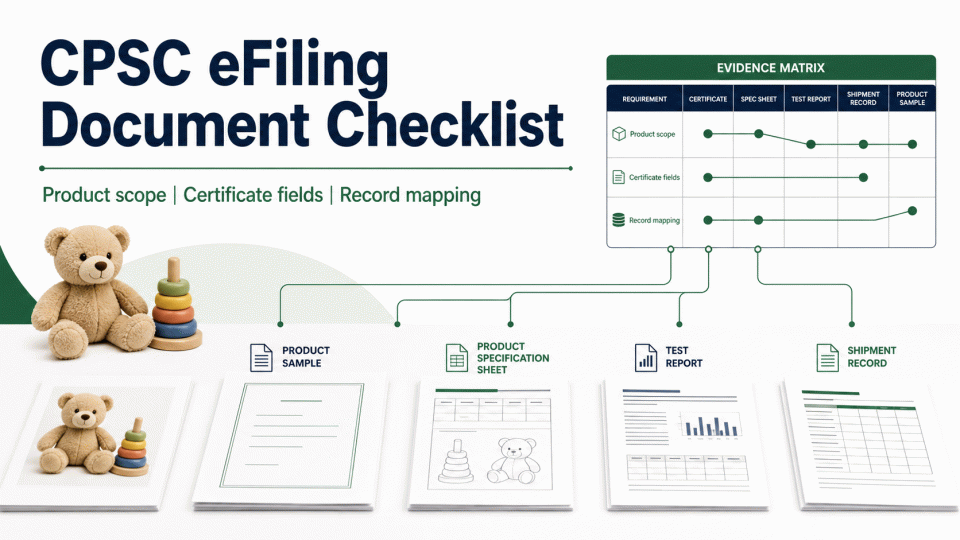
CPSC eFiling and a Children’s Product Certificate (CPC) are not generic product certificates. Before preparing records, confirm whether the product is a children’s product, identify the CPSC-enforced safety rules that apply, and establish whether the domestic manufacturer or importer is responsible. Then map the product, testing, certificate, and import records item by item.
1. Define the product and responsible firm
A children’s product is generally a consumer product designed or intended primarily for children 12 years old or younger and subject to children’s product safety rules. The classification cannot be determined from a listing title alone; design, packaging, marketing, foreseeable use, and applicable rules all matter. A non-children’s product subject to a CPSC rule may instead require a General Certificate of Conformity (GCC). Do not merge GCC and CPC workflows.
For an imported product, the importer generally issues the CPC; a U.S. manufacturer issues the CPC for a product manufactured domestically. A supplier may provide test reports or component records, but it does not replace the responsible firm’s certification responsibility. Build a control table linking the SKU or model, manufacturing site, responsible firm, import route, and applicable rules before preparing eFiling data.
2. The seven core CPC elements
CPSC’s CPC guidance identifies these basic elements:
- Product identification detailed enough to match the certificate to the covered product, model, or batch.
- Each applicable children’s product safety rule, ban, standard, or regulation being certified.
- The certifying domestic manufacturer or importer, including name, full mailing address, and telephone number.
- The person maintaining supporting test records, including name, full address, email, and telephone number.
- Date and place of manufacture, including the required month/year and finished-product location details.
- Date and place of testing, with any applicable exception or determination identified as required.
- Each CPSC-accepted third-party laboratory that conducted the testing, including name, address, and telephone number; qualifying small-batch manufacturers should record any required registration information.
Each field should reconcile to the underlying evidence. CPSC states that the CPC and supporting test reports must be in English. A company may use its own document system; fictitious names, addresses, and products in sample certificates must never be copied into a live filing.
3. Map testing to the product evidence
Start with the product’s age positioning, materials, construction, functions, and foreseeable use. Identify the applicable rules and then confirm that the laboratory is CPSC-accepted for the specific testing needed. Testing requirements vary by rule. A “general report” or a report for a similar SKU cannot replace an applicability and coverage review.
Maintain four connected record layers: product specifications, BOM, and label artwork; sample and finished-product manufacturing records; complete test reports mapped to applicable rules; and import, batch, and responsible-firm records. When relying on supplier material, the importer still needs due-care checks for product identity, sample representativeness, rule coverage, and access to the report. Component testing or component certificates should be evaluated under the conditions of 16 CFR part 1109.
4. Pre-filing checklist
- Scope: confirm product, model, age positioning, manufacturing site, and import route against the shipment record.
- Rules: map every applicable rule to a test or a properly supported exception; do not substitute requirements from another market.
- Parties: check spelling, addresses, and roles for the certifying firm, importer or manufacturer, record keeper, and laboratory.
- Dates and batches: reconcile manufacturing, testing, and import records; do not invent a universal report-expiry period.
- Language and retention: prepare the CPC and test reports in English and retain originals, versions, sample details, and change records.
- Electronic filing: prepare the required data from current CPSC/CBP interface guidance, and re-check the latest scope before filing. A platform prompt is not a substitute for regulatory analysis.
5. Common gaps and maintenance boundaries
Having a test report does not prove that the current CPC covers the current product. Frequent gaps include unreviewed changes to the model or material, a mismatch between the certifying firm and import arrangement, incomplete coverage of applicable rules, inconsistent label and warning versions, and records that cannot connect the sample to the production batch.
After a change to a supplier, material, formulation, construction, label, manufacturing site, or responsible importer, re-check rule applicability, testing evidence, CPC fields, and electronic filing records. This article is a record-organization reference; it is not a conclusion that a particular product requires a CPC, meets a rule, or will obtain a market outcome.
Sources: U.S. Consumer Product Safety Commission guidance on Children’s Product Certificates, third-party testing, rules requiring third-party testing and a CPC, and certificates of compliance. Confirm the current requirements against CPSC, CBP, and the applicable rule text.


