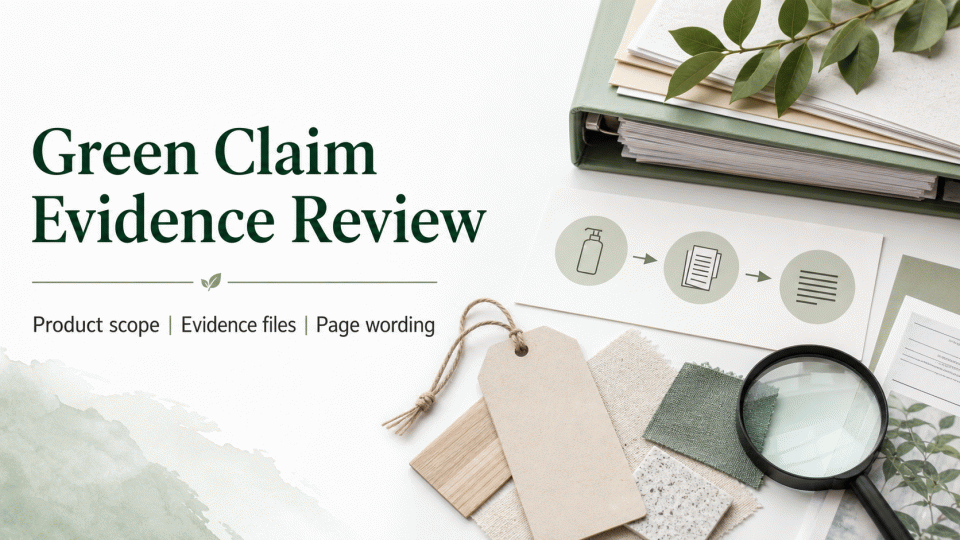
A green claim is not made reliable by adding words such as “eco-friendly” to a product page or attaching a certificate. The team should first define the product, attribute, market, and evidence behind the statement. If a third-party label is used, its owner’s scope, authorisation, and current rules must also be checked. This is a documentation reference, not legal advice, platform approval, or a certification result.
1. Define what the claim covers
Identify the product at a reviewable level: brand, model or SKU, version, materials or formula, packaging, production location, and sales market. Then turn the claim into one testable proposition, such as a recycled-material, packaging, or product attribute statement. Do not use “green product” to combine several different attributes, or mix a factory management system with an input-material property and a finished-product claim.
Build a claim register with one claim per row: SKU scope, evidence owner, file version, source, coverage, limitations, and review date. A sentence without corresponding evidence should not be published. If a file covers only part of a range, the page wording should be limited to the same range.
2. Separate the three types of requirement
Environmental claim: a voluntary statement about an environmental aspect of a product or package. Review its clarity, specificity, support, comparison, and boundaries.
Certification or label: a scheme with its own rules. The process may cover the applicant, product scope, supply chain, testing, audit, certificate, or label licence. Use the scheme owner’s current rules and public records; a supplier screenshot, old logo, or certificate title is not enough.
Mandatory law: market-specific requirements for products, chemicals, packaging, labelling, or producer responsibility. Keep their applicability record separate from voluntary-label evidence. Completing a voluntary label does not establish compliance with every mandatory rule.
3. Build the evidence file
Scope files: specifications, model or variant list, BOM or material list, formula, packaging composition, photographs, label artwork, and version history where relevant.
Attribute evidence: input or recycled-content records, calculation basis, mass-balance or transaction records, energy or emissions data, life-cycle work, or other original records that match the claim. State the boundary, assumptions, and exclusions.
Third-party records: application or audit records, test reports, certificates, label authorisation, and public verification results. Check the legal entity, product or site scope, version, issuing body, and current status. Do not alter a mark or substitute the seller’s name for the certificate holder.
Traceability: purchase orders, invoices, batches, production and transport records, and the relationship between upstream and downstream entities. Retention, transaction certificates, and audit-file requirements vary by scheme; use the current rule instead of applying one fixed period.
4. Reduce ambiguity in page wording
Prefer a specific attribute and scope, for example: “The outer packaging for this model uses supplier-declared recycled paper; the supporting file and version are recorded internally,” only where the facts are documented. Avoid unqualified or absolute language such as “100% green,” “eco-friendly with no impact,” or “sustainably certified.” Do not turn “submitted for review” into “certified,” “compliant,” or “approved by the platform.” Comparative, reduction, and recyclability claims should identify the baseline, calculation boundary, disposal conditions, and market.
The European Commission describes reliable green claims as clear, comparable, and verifiable, while distinguishing current policy from legislative proposals. The U.S. FTC Green Guides likewise emphasise competent and reliable scientific evidence for environmental marketing. These sources do not replace a product- and market-specific review.
5. Pre-publication checklist
Confirm that the claim matches the SKU; material and packaging boundaries agree; evidence identifies its source and responsible entity; scheme names, marks, and permissions follow the applicable rules; necessary qualifiers are visible; Chinese and English describe the same scope; legal review records the market and rule version; and changes to materials, suppliers, formulas, packaging, or page copy trigger a reassessment.
Keep separate records for evidence collection, claim drafting, and label use. 绿色方舟(深圳)认证有限公司 can help organise a project-specific file set by product, market, and evidence scope, but this article makes no certification, compliance, or platform-outcome promise for an unreviewed product.
Sources: European Commission: Green claims; U.S. FTC: Green Guides. These links provide public policy context; applicability still depends on the target market and product facts.