A textile page may refer to organic fibres, recycled content, chemical testing, chain of custody and buyer-specific requirements at the same time. These evidence paths answer different questions and cover different objects. Start with the actual product and supply-chain step, then decide which standard or test is relevant. A certificate should not be presented as proof that every mandatory requirement in every market has been met.
1. Define the smallest unit in the matrix
Use a SKU or style, fibre composition and accessories, production or transaction step, and target market as the working row. Cotton, recycled polyester, blended fabric, dyeing and finishing, and finished apparel may need different evidence. A document held by the same brand or factory does not automatically cover every SKU. Save the BOM, fibre content, colour and finishing details, accessory list, production site and supplier name before mapping a standard.
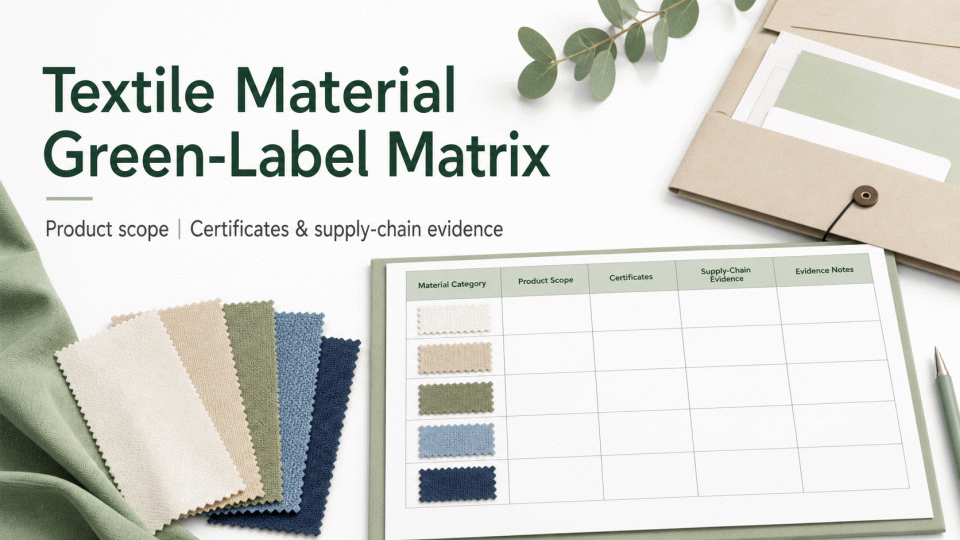
At minimum, keep separate columns for material or product scope, certificate or test type, certificate holder or applicant, supply-chain records, and permitted page wording. Add a “to verify” column for an unconfirmed certificate number, Scope Certificate, Transaction Certificate, laboratory report or current status.
2. What the main evidence paths address
Organic fibre and processing: GOTS addresses certified organic fibre inputs and subsequent spinning, knitting, weaving, processing, manufacturing and trading stages within its scope. Check the certified entity, product and processing categories, and relevant transaction records. It is not a universal chemical-safety test and does not automatically replace a market’s legal labelling rules.
Recycled or organic material and chain of custody: GRS, RCS and OCS do not answer exactly the same question. Their material-content, processing, supply-chain and claim conditions must be mapped separately. A supplier’s verbal statement or one factory certificate is not enough to support a product-level claim.
Harmful-substance testing: OEKO-TEX STANDARD 100 uses product classes based on the intended use of textile articles and accessories and evaluates harmful substances against the applicable requirements. Record the product class, covered components and certificate status; do not turn it into a claim that every law is satisfied or that a product is absolutely harmless.
Buyer or platform requirements: Brands, retailers and platforms may request supplier questionnaires, audits or specific file formats. Keep these as a separate requirement with the requesting party and market recorded. They are not the same layer as a national or regional legal obligation.
3. Link each record to the product row
The first group is product identity: style number, fibre composition, BOM, accessories, colour and process description. The second is standards evidence: Scope Certificates, Transaction Certificates, product certificates or laboratory reports. The third is supply-chain evidence: purchase orders, invoices, batch or quantity links, processing and transport records, and supplier declarations where relevant. The fourth is page and label evidence: the material name used, certification reference, label artwork, selling entity and target-market language.
Check the holder, product or processing scope, certificate number, status information, supply-chain node and document version. If a record does not cover an accessory, blend, processing step or transaction batch, state the limitation instead of using a complete-looking file set to fill the gap.
4. Claim boundaries and a release check
A bounded statement may say that a specified material or processing step for a specified product is supported by identified records, when the product, holder and scope match. Avoid claims such as “the entire supply chain is green,” “approved for all compliance reviews,” or “valid in every country.” Terms such as “recycled,” “organic,” “tested” and “made to a named standard” must each be tied to the relevant certificate, transaction record, test scope and claim rules.
Before publishing, ask: What object does the record cover? Which processing or transaction step is included? Which market and language does the statement address? Has a voluntary standard been written as mandatory market access, a test result expanded into a general product-safety conclusion, or a supplier record expanded to the whole brand? If any answer is unclear, mark the item “to verify” rather than widening the wording.
5. Maintain the matrix, not just a certificate
Recheck the certificate scope and page wording when the fibre composition, supplier, processing site, accessory, label or target market changes. Confirm status, version and applicability against the current record of the issuing scheme or laboratory. Do not add a universal validity period, renewal lead time or inevitable platform consequence without a source.
The matrix can be maintained jointly by procurement, product, quality and content owners: procurement confirms supply-chain files, quality confirms test and certificate scope, product tracks SKU changes, and content uses only evidence-supported wording. 绿色方舟(深圳)认证有限公司 can help organise a checklist for a defined product, market and document set; applicability remains subject to the relevant standard, issuing body, laboratory and official market requirements.
Sources: Global Organic Textile Standard (GOTS), Textile Exchange Standards, and OEKO-TEX STANDARD 100. Standards, certificate status and market requirements can change; check the applicable official material before use.