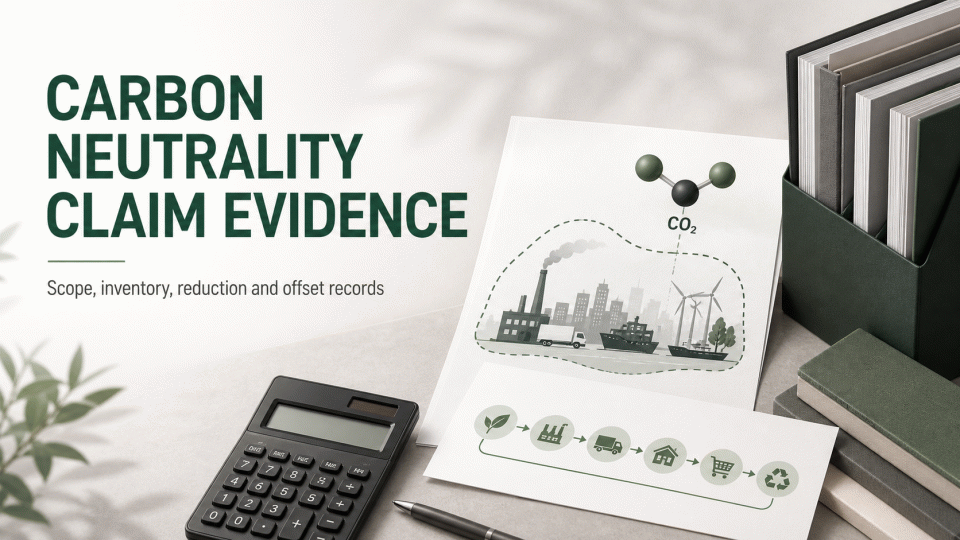
“Carbon neutrality” is not a standalone certificate name that can be detached from the product, organisation or service being described. Start by defining the claim subject, boundary, method and reporting period. Then link emissions data, reduction measures and any removal or offset records to that defined scope. This page is an evidence-organisation reference for cross-border brands and supply-chain teams; it does not confirm that any product is certified or entitled to use a particular environmental claim.
1. Define the claim subject and boundary
Record whether the claim concerns a specific product or SKU, a service, a facility or organisation, or an activity. Add the market, model or variant, reporting period, functional unit, and included and excluded lifecycle stages. Do not hide the treatment of raw materials, manufacturing, transport, storage, use or end of life behind a generic “industry practice” statement. Give a reason for every exclusion and identify any data gap.
If a page uses “low carbon”, “carbon footprint”, “carbon neutral” or “net zero”, create separate terminology entries and define the metric and evidence for each. An organisational inventory from a supplier, recycled content in one material batch or a single carbon-credit purchase should not be rewritten as an environmental result for the whole product or brand.
2. Build an inventory that leads back to source records
Use an applicable method such as the GHG Protocol Product Life Cycle Accounting and Reporting Standard as an index for the methodology, system boundary, functional unit, activity data, emission factors, allocation rules, assumptions and uncertainty notes. Product records should be traceable to the model or SKU, bill of materials, production sites, energy data and transport records. An organisational claim requires a separate record of organisational boundaries, emission sources and the reporting period.
Create an index linking each data point to its source document, calculation file and reviewer. Keep dates, units, versions and provenance for utility, fuel, logistics, purchasing, output and waste records. Label supplier estimates with their estimation method instead of presenting them as measurements. For secondary factors or defaults, record the source, geography and reason for selection.
3. Keep reduction, removal and offset records distinct
A reduction record should identify the measure, location, implementation dates, baseline or comparison basis, before-and-after data, and emissions that remain outside the measure. A planned equipment upgrade is not an achieved reduction, and a supplier efficiency statement is not a substitute for product life-cycle data.
If a claim involves removals or offsets, separately record the project name, project or credit identifier, quantity and unit, issuance or retirement status, ownership, vintage or applicable period, programme standard and public registry information. Link the record to the emissions boundary it is intended to cover. The existence of such records does not automatically make “carbon neutral” acceptable wording; some markets apply tighter limits to claims based on compensation outside the product value chain.
4. Review the page claim by claim
Copy every sentence from the product page, packaging, advertising and customer replies into a claims register. Add five fields: claim text, claim subject, metric or comparison basis, supporting file, and applicable market or expiry trigger. “Checked” or “traceable” is not a substitute for a document identifier and scope. The wording should also make clear whether it refers to a product, organisation, project or activity.
EU consumer-transition rules address the scope of environmental claims, generic green wording and the risk of misleading claims based on offsets outside the value chain. The application date, national transposition and enforcement details still need to be checked for the relevant market. Do not turn an unlinked file into a generic statement such as “EU compliant”, “officially recognised” or “approved”.
5. Assign owners and define maintenance triggers
The brand or claim owner confirms the claim subject, page version and market. Factories and suppliers provide source records for energy, output, materials and transport. The accounting owner controls methods, factors, calculations and assumptions. A verifier or review body, where applicable, covers only the agreed scope. A platform, importer or buyer should receive records that match its request and scope. Every file needs an owner, version, date, coverage and next review trigger.
Reassess the claim when the formulation, bill of materials, factory, supplier, route, packaging, functional unit, method, offset project status or market changes. If the boundary is incomplete, data cannot be traced, the evidence names a different entity, or the page wording exceeds the evidence, pause that sentence, record the issue, and decide whether to add data or narrow the wording.
Sources: ISO 14068-1:2023; GHG Protocol Product Life Cycle Accounting and Reporting Standard; Directive (EU) 2024/825. Check the latest primary text and applicable requirements for the claim subject, product boundary and sales market before use.