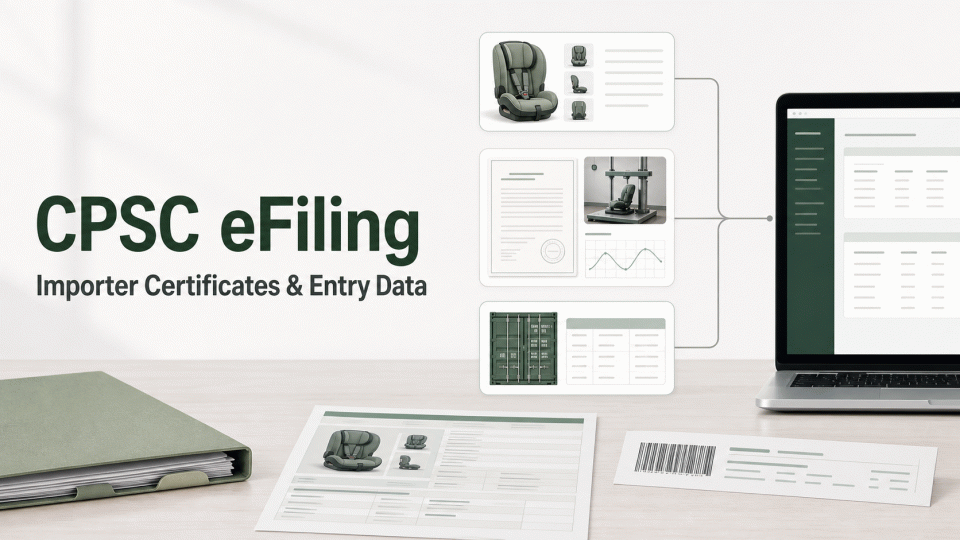
CPSC eFiling changes how certificate data is transmitted to U.S. Customs and Border Protection (CBP). It does not replace applicable testing, certification, or product-scope analysis. For an imported consumer product subject to a CPSC rule, ban, standard, or regulation, keep product identity, the applicable rule, supporting testing, certificate fields, and entry data in one traceable record.
1. Who should review eFiling
CPSC states that, beginning July 8, 2026, most imported consumer products subject to certification requirements must have certificate data electronically submitted through CBP’s Partner Government Agency (PGA) Message Set. Requirements for products imported into a Foreign Trade Zone (FTZ) and later entered for consumption or warehousing begin January 8, 2027. The import eFiling process concerns regulated finished consumer products; products manufactured domestically are not sent through this import eFiling process, although certificate-content requirements still apply. Product names alone are not enough to determine scope.
For eFiling, the Importer of Record (IOR) is generally the importer authorized to make entry. In some arrangements, an authorized customs broker may identify the owner, purchaser, or consignee that authorized the entry and has the product knowledge needed for certification. Write down who makes entry, who controls the product records, and who is responsible for the certificate.
2. Fields that must align
- Product identity: manufacturer, brand or model, lot information, and other identifiers that connect the certificate to the imported goods.
- Applicable rules: the CPSC rules, bans, standards, or regulations actually supporting the certificate; do not merge requirements from unrelated markets.
- Testing basis: the laboratories and most recent testing dates supporting the certificate. Component-part testing must be retained when it supports the finished-product certification.
- Testing exclusions: when an applicable testing exclusion is relied upon, record its code or basis in the certificate and Product Registry. “Not tested” is not automatically “testing not required.”
- Responsible parties: manufacturers, importers, laboratories, and contacts listed as trade parties should match the real transaction and records.
- Entry data: reconcile HTS classification, quantity, entry description, port, and certificate data with the same reviewer. CPSC’s published HTS list is guidance, not a complete scope list.
3. Build one evidence chain per product
Use the sequence “SKU/model — applicable rule — test files — certificate — entry filing — page and label version.” If the specification, material, or intended age changes, first assess whether the rule or testing basis changes; then decide whether the certificate and Product Registry record need revision. Do not use an older report with a similar supplier name when the model, component, or responsible entity is different.
| Record | Primary owner | Update trigger |
|---|---|---|
| Specification, model, materials | Brand/manufacturer | Redesign, material, or factory change |
| Test report and rule citation | Manufacturer/importer | Rule, product, or component change |
| Certificate and Product Registry | Certifying responsible party | Entity, model, or testing-basis change |
| HTS and PGA Message Set | IOR/broker | Each shipment or entry-data change |
4. Pre-submission review
- Check CPSC scope against the specific model and product version; do not use “children’s product” or “general consumer product” as a substitute for rule analysis.
- Confirm that every certificate statement has a traceable testing or exclusion basis, including relied-upon component testing.
- Reconcile the responsible entity, laboratory, contact, product description, and version across the certificate and entry documents.
- Reconcile Product Registry data with the broker’s HTS, quantity, description, and certificate data. Keep the scope analysis when HTS is used only as an aid.
- Keep the CPSC source page, product file, test report, certificate version, and filing record together for later explanation and maintenance.
Avoid these shortcuts: “eFiling creates a new testing program,” “a listed item will necessarily clear,” or “one old certificate covers every SKU.” A bounded statement is: eFiling electronically transmits data from an applicable certificate; the certificate still needs a real rule and testing/exclusion basis, and product and entry decisions remain shipment- and product-specific.
5. Official references and boundaries
Start with CPSC’s eFiling overview, importer resources, FAQ, and certificate update guidance. CPSC product categories, rules, HTS codes, and testing exclusions are not universally interchangeable. If the product, entry route, or responsible party is unusual, obtain product-specific confirmation before filing.
绿色方舟(深圳)认证有限公司 can help organize the product–rule–evidence–entry-data map, but this article does not promise certification, release, or any regulatory outcome for a particular SKU.