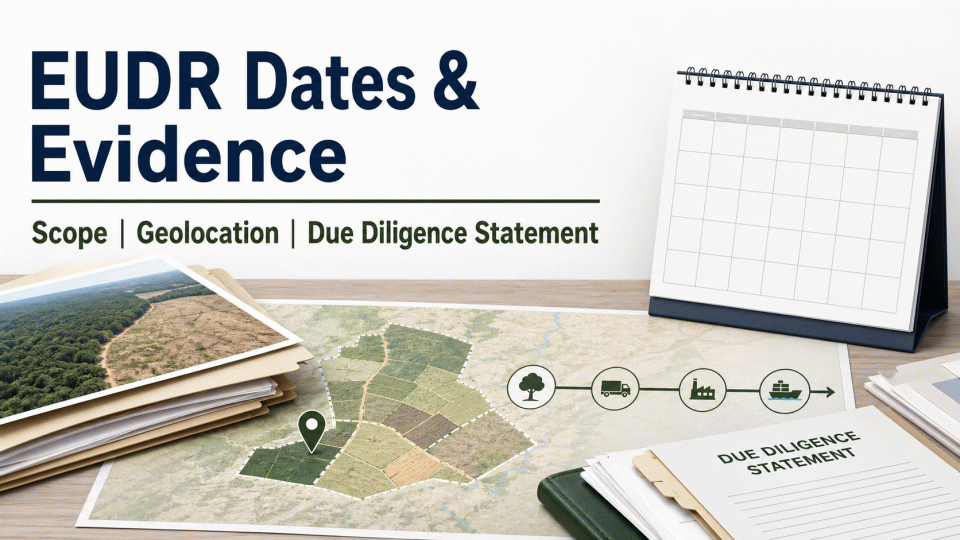
The EU Deforestation Regulation (EUDR), Regulation (EU) 2023/1115, is not a universal certificate or a date-only checklist. For commodities and derived products that fall within Annex I, businesses should first determine product scope and trading role, then assemble information on origin, geolocation, production time, legality and the applicable due diligence statement. This reference reflects European Commission material available on 28 August 2026; applicability still depends on the product, transaction path and current legal text.
1. Confirm whether the product is in scope
Start with Annex I rather than a generic description such as “green,” “wood-based” or a supplier’s verbal assurance. The relevant commodities include cattle, cocoa, coffee, oil palm, rubber, soya and wood, together with specified derived products. Put product description, material composition, quantity, transaction direction and the relevant HS code in the same scope record. A product is not automatically subject to EUDR simply because it contains a particular material.
Map the trading role as well: who first places the relevant product on the EU market, who exports from the EU, who is a downstream operator or trader, and who is only a supplier. Information, submission, retention and reference-number duties can differ by role. A supplier file is not a substitute for the company’s own role analysis.
2. Separate application dates from file status
The European Commission’s current implementation page identifies 30 December 2026 as the main application date for large and medium operators, and 30 June 2027 for most micro and small operators. Micro and small operators already covered by the EU Timber Regulation have an application date of 30 December 2026. Earlier dates from superseded explainers should not be copied into customer materials, and a platform’s internal timetable should not be presented as the legal application date.
Maintain a register covering legal-text version, operator size, commodity scope, trading role, application date and current evidence status. Changes to dates, country-risk classification, system requirements or the supply chain should trigger a review. Before an applicable date, describe the work as preparation and verification—not as an achieved regulatory outcome.
3. Organize evidence around four information groups
Product and quantity: trade name, product type, relevant commodity or product list, quantity and applicable HS code. SKU, batch, invoice and transport records should reconcile.
Production location and time: country of production, relevant regional detail where needed, geolocation of the production plots or establishments, and the production date or time range. Mixed origins should not be reduced to one generic place; cattle-related products require attention to the establishments where cattle were kept.
Legality and deforestation-free evidence: collect information supporting legality in the country of production and the required deforestation-free condition, then perform risk assessment and any needed risk mitigation. Certification or third-party material can be complementary only when its scope and content fit the assessment; it is not automatically a DDS.
Statement and chain references: before placing relevant products on the market or exporting, submit a due diligence statement or simplified declaration where applicable, and retain the relevant reference numbers, verification numbers, upstream references and transaction records. Downstream businesses should collect and pass on the references required for their role rather than assuming every actor has the same filing duty.
4. Use an evidence matrix for human review
A practical matrix can link product or SKU, material origin, country, plot or establishment, production time, supplier, invoice or transport record, geolocation file, risk assessment, mitigation record, DDS reference and page claim. Mark each field as available, pending, not applicable or needs confirmation, and retain document version, collection date, owner and review basis.
Geolocation data should point back to the actual production location, not merely a factory or head-office address. If product name, quantity, country, coordinates and transaction records conflict, pause the page-level conclusion and return to the source records. The Commission explains that due diligence is not a fixed tick-box form; the process must cover information collection, risk assessment and risk mitigation.
5. Keep website and customer wording bounded
It is reasonable to say that EUDR files are being checked by product scope and supply-chain records, or that page wording is being mapped to batch records and DDS references. Do not write “EUDR certified,” “approved deforestation-free compliance,” “customs clearance guaranteed” or “the platform will not delist” without specific evidence, applicability analysis and current readback. EUDR does not provide one universal certificate that replaces due diligence.
Services from 绿色方舟(深圳)认证有限公司 should distinguish document organization, scope analysis, evidence-consistency review and the client’s own statutory filing responsibilities. They should not be described as regulatory approval or an outcome guarantee. Recheck the page when the law, Annex I, the implementation system or the underlying business records change.
Official reference points
1. European Commission Green Forum: Understand Due Diligence — scope, geolocation, DDS information and risk steps.
2. European Commission Green Forum: Traceability and geolocation — application dates, traceability and geolocation.
3. European Commission: FAQ on EUDR Implementation — implementation questions and updates.
4. EUR-Lex: Regulation (EU) 2023/1115 — legal text, Annex I and due-diligence provisions.