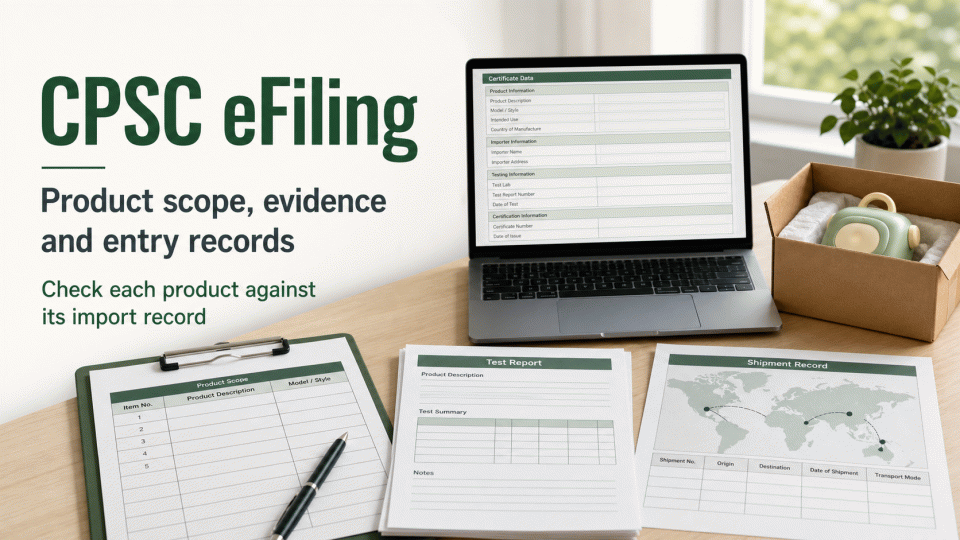
This reference page is for importers, manufacturers, private labelers, and brands moving consumer products into the United States. CPSC eFiling is not a “clearance certificate.” It transmits certificate data for regulated imported consumer products through CBP’s Partner Government Agency (PGA) Message Set, so product identity, certification, testing, and entry records need to remain connected.
Start with scope: product, rule, route, and date
As of this page’s review date, CPSC lists July 8, 2026 as the effective date for most regulated consumer products subject to CPSC certification requirements. Products entered from a Foreign Trade Zone for consumption or warehousing follow January 8, 2027. Domestic manufacturers must meet updated certificate-content requirements, while the import eFiling requirement does not apply to domestic manufacturing itself.
Use the sequence “product and rule → certificate requirement → import scenario and date → responsible filer.” A category page, HTS code, or retailer prompt is not by itself a final legal conclusion. CPSC’s HTS guidance covers approximately 600 codes that may contain products subject to mandatory standards or considered high risk, but the agency says the list is not exhaustive.
| Review layer | Evidence to retain | Boundary |
|---|---|---|
| Product identity | Brand, model, SKU, description, intended use, age grading, variants, labels, and packaging | The same product name does not establish the same rule scope; materials and intended users matter |
| Applicable rule | The CPSC rule, ban, or standard relied on, with its source | eFiling does not decide whether a particular SKU requires a certificate |
| Entry record | Importer, IOR, broker, entry, HTS, route, and entry date | The HTS aid is not a complete legal list; each entry still needs review |
| Scenario | General import, FTZ entry/withdrawal, domestic manufacture, and dates | July 8, 2026 and January 8, 2027 are different implementation dates |
Connect the certificate to the underlying evidence
General-use products may involve a General Certificate of Conformity (GCC), while children’s products may involve a Children’s Product Certificate (CPC). The certificate type follows the product and applicable requirements; it is not determined by an eFiling screen alone. Certificate data should identify the product, responsible certifying party, applicable CPSC rules, manufacture information, testing information, and the person maintaining the supporting records. Children’s product testing must be assessed against the product, intended age, materials, and applicable rule.
| Data group | Suggested fields | Source records |
|---|---|---|
| Product | Product ID, brand/model, description, intended use or age, packaging, variants | Specifications, labels, BOM, packaging files, revision history |
| Responsible parties | Manufacturer, importer, private labeler, IOR, and broker role | Invoices, engagement records, entry filing, certificate sign-off |
| Rules | Each CPSC rule or testing requirement relied on | Rule text, CPSC guidance, scope assessment |
| Testing | Test date/place, laboratory, report number, finished-product or component basis | Laboratory reports, component reports, testing-exception support |
| Manufacture and lot | Manufacture date/place and lot or model relationship | Production records, lot registers, supplier confirmations |
| Recordkeeping | Record custodian, access path, document version, change log | Record policy, permissions, repository audit trail |
When certification relies on component testing, retain the component evidence instead of keeping only a finished-product report. If a testing exception is claimed, retain the applicable code, facts, and reasoning. A third party may help prepare records, but the responsible party remains responsible for the certificate’s content.
Assign the work: IOR, broker, and internal owners
CPSC’s broker guidance notes that a broker may assist with entry documentation, may be the IOR in a particular arrangement, or may identify the certifying party through the ACE PGA Message Set. Write down who enters, certifies, stores, and reviews each record rather than assigning every responsibility to a system or broker.
- Product and quality: confirm SKU, revision, materials, age grading, and testing basis.
- Regulatory: confirm scope, certificate type, testing exceptions, and claim boundaries.
- Import and customs: reconcile IOR, entry, HTS, route, FTZ treatment, and date.
- Records owner: maintain certificates, reports, component evidence, submission history, and versions.
Maintain Product Registry and entry records together
CPSC’s Product Registry stores certificate data and supports transmission of a Reference PGA Message Set; it is distinct from CBP ACE. When a product, certificate, test, manufacturing lot, or responsible party changes, assess the product record first, then update the internal register, certificate version, and entry documentation.
For each SKU, retain a traceable chain: SKU/model → applicable rule → GCC/CPC → test and component basis → Product ID → entry/HTS → submission time and response → change record. If fields conflict, stop using the superseded version and identify affected lots or entries before correcting the record. “Received by the system” should not be expanded into a promise of CPSC recognition, customs release, retailer acceptance, or a particular outcome.
Human pre-submission checklist
- Confirm product identity, intended use, age grading, and applicable rule for each SKU, with the reasoning saved.
- Match GCC/CPC fields to current product, manufacturing, rule, and test records.
- Attach component testing, testing exceptions, and report revisions to the relevant product record.
- Reconcile the certifying party, IOR, broker role, and records custodian.
- Compare Product Registry data with the certificate, entry, HTS, and lot register.
- Separate general-import and FTZ scenarios and record their respective dates.
- Keep the pre-submission version, response, change reason, and reviewer; use current CPSC/CBP guidance and professional advice for exceptions.
Scope note and official sources
This page provides a records framework. It does not decide whether a particular SKU is subject to a rule, replace legal or customs advice, or promise certificate issuance, system acceptance, customs release, retailer listing, inspection results, or processing time. Confirm the product, entry arrangement, and current official guidance before filing.