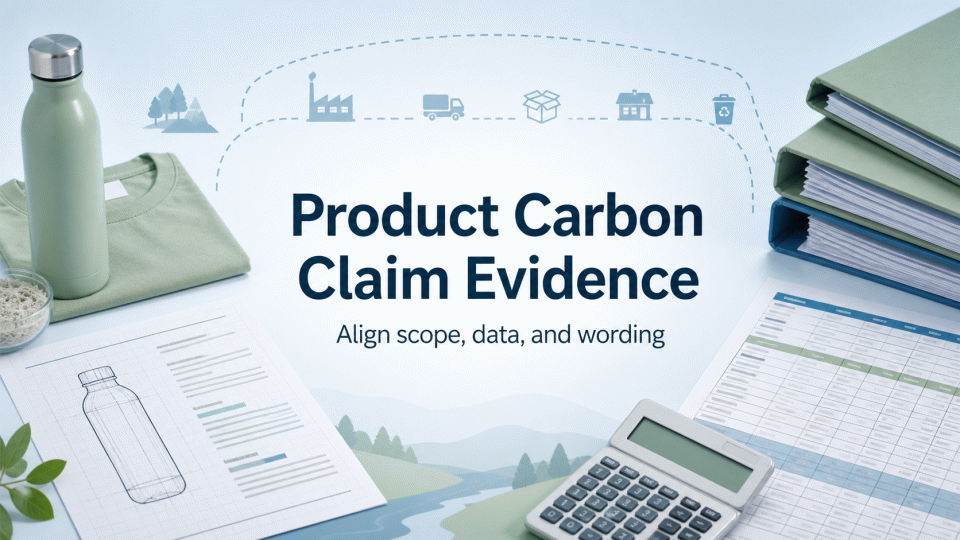
“Carbon neutral” is not a stand-alone certificate that can be detached from a product and its boundary. Before publishing a claim, define the subject, life-cycle coverage, accounting method, and the separate roles of reduction, removal, and offset evidence. This is a documentation reference, not a statement that any product has been certified, verified, or accepted for market access.
1. Define the Claim Subject and Boundary
Before collecting files, create a claim-definition sheet covering the product name, model or SKU, target market, claiming entity, functional unit, reference period, system boundary, and the exact sentence proposed for the page. A product footprint may cover raw materials, manufacturing, transport, use, and end of life, or a clearly disclosed partial life cycle. These scopes must not be presented as interchangeable.
“Product carbon footprint,” “lower-carbon,” and “carbon neutral” are different propositions. The first starts with quantifying emissions and removals within a defined product system. The latter claims may also depend on a baseline, reduction actions, removal or offset records, conditions, and communication rules. If the evidence covers one batch, model, or life-cycle segment, put that limitation directly into the claim.
2. Build the Product Footprint File
Organize a product-and-life-cycle data pack rather than relying on a single supplier statement:
- Product definition: specifications, BOM, material and packaging weights, functional unit, quantity, and change history.
- Activity data: material inputs, factory energy, transport routes and modes, storage or use assumptions, and end-of-life scenarios, each with period, unit, source, and owner.
- Calculation basis: emission-factor sources, GWP version, allocation rules, data-quality assessment, uncertainty, and treatment of missing data.
- Boundary record: included and excluded processes, geography, time period, partial-footprint start and end points, and the reason for the selection.
- Result file: calculation workbook, version control, review notes, sensitivity or uncertainty explanation, and traceable source records.
The GHG Protocol Product Standard helps organizations understand full life-cycle product emissions and identify reduction opportunities. ISO 14067 sets requirements and guidance for quantifying and reporting a product carbon footprint consistently with life-cycle assessment principles. Neither source decides, by itself, whether a marketing phrase is suitable for a particular market.
3. Keep Reduction, Removal, and Offset Evidence Separate
For a reduction measure, retain the before-and-after boundary, implementation record, energy or material data, and comparison basis. For a removal activity, retain the project entity, quantity, date, method, and ownership record. For an offset or compensation arrangement, keep the program standard, project identifier, quantity, issuance or retirement record, claim period, and safeguards against double counting. Purchasing credits should not be rewritten as “the product has no emissions,” and a reduction plan should not be presented as an achieved result.
If the claim relies on external assurance, verification, a label, or a program, record its name, scope, document number, date, claiming entity, and the wording of the conclusion. Match the verified boundary to each page sentence; “verified” does not mean every life-cycle stage or every promotional statement was reviewed.
4. Review Every Customer-Facing Sentence
Maintain a ledger linking each page sentence to its evidence file, applicability boundary, and owner. Check the title, image text, selling points, footnotes, FAQs, and distributor materials for the same product scope and period. Avoid unsupported phrases such as “zero emissions,” “100% offset,” “valid worldwide,” or “officially recognized.” Badges, seals, and institution-like graphics should not replace an evidence explanation.
ISO 14021:2026 applies to self-declared environmental statements on product labels, product literature, advertising, and digital platforms, and sets related documentation and methodology requirements. The European Commission’s green-claims policy page also emphasizes reliable, comparable, and verifiable environmental information. Whether a specific rule applies still depends on the product, market, claim format, and current official requirements.
5. Assign Owners and Triggers
The brand or claiming entity approves the product scope and page wording. Factories and suppliers provide material, energy, and batch-change records. Procurement and logistics own route, quantity, and source documents. The accounting owner controls methods, factors, allocation, and versions. Legal or compliance teams check market requirements and the scope of external assurance. A material, factory, energy mix, package, route, model, claim period, or project change should trigger reassessment instead of silent reuse of an old page.
Suggested order: lock the SKU and exact claim sentence; freeze the boundary and functional unit; complete source data and calculation basis; reconcile reduction, removal, and offset records separately; then trace every page sentence back to a file. 绿色方舟(深圳)认证有限公司 may support documentation organization and boundary review, but this article makes no promise about certification, verification, or a claim outcome for any particular product.
Sources and Limits
- GHG Protocol Product Standard: framework for product life-cycle GHG accounting and reporting.
- ISO 14067:2018: requirements and guidance for quantifying and reporting product carbon footprints.
- ISO 14021:2026: self-declared environmental statements for products and related documentation and methodology requirements.
- European Commission Green Claims: policy background and the objective of verifiable environmental information.
These sources explain methods and communication boundaries; they are not legal advice for a particular product, market, or platform. Preserve source versions, calculation files, and page-review records before publication.