
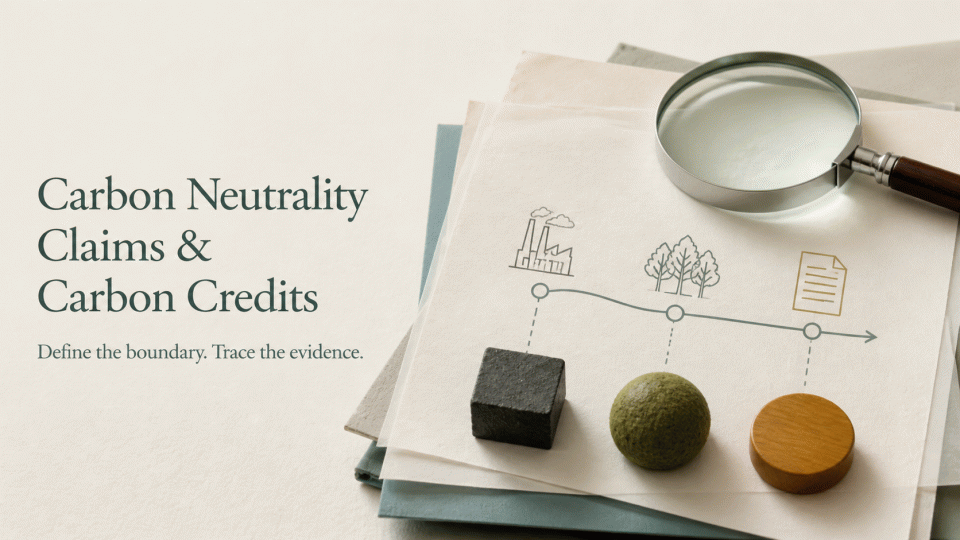
“Carbon neutral,” “carbon offsetting,” and “carbon credits” are not interchangeable labels. Start by defining the claim subject, accounting boundary, base year or reporting period, then keep separate records for reductions, removals, and credit-related actions. Without those fields, a broad environmental statement is difficult to review accurately.
1. Define the claim subject and accounting boundary
Capture four fields: claim subject (one product, a product group, an organisation, or an activity), time boundary (reporting period and base year), life-cycle boundary (which stages from raw materials through disposal are included), and functional unit (such as one product or one service). Product-level accounting does not automatically substitute for an organisation inventory, and an organisation’s credit purchase does not by itself prove the life-cycle impact of a specific SKU.
Keep a version, applicable market, data cut-off date, and owner for each conclusion. Reassess the boundary and data when product specifications, formulations, suppliers, packaging, transport modes, or sales regions change.
2. Make the inventory and calculation traceable
Build a data table covering materials and quantities, manufacturing energy, transport distance and mode, packaging, use-stage assumptions, end-of-life treatment, emission-factor sources, rules for missing data, and the calculation-file version. For supplier data, record the entity, location, period, unit, and supporting reference. “The supplier says it has a footprint” is not a complete evidence record.
The GHG Protocol Product Standard can support a full life-cycle view of product emissions. ISO 14067 or another method accepted in the target market must be checked separately for scope, calculation rules, and verification expectations. Naming a method does not itself establish assurance or permit a “zero emissions” or “carbon neutral” claim.
3. Keep reductions, removals, and credits distinct
A reduction record should connect an operational measure with activity data, a calculation method, and a comparable before-and-after basis. A removal record should describe the removal activity, durability, monitoring, and verification arrangements. A credit or offset record should identify the project or programme, standard and methodology, project period, credit identifier, issuing body, transfer history, retirement or cancellation status, and the relationship to the claim subject and period.
Registry listing, issuance, transfer, and retirement are different events. Their relationship to a claim should be discussed only where the applicable rules allow it, the records can be checked, and double counting or double claiming has been addressed. A project brochure, screenshot, or isolated serial number is not a substitute for complete ownership and retirement evidence.
4. Write each page claim as a checkable sentence
Map every sentence to its evidence, boundary, and owner. A product-footprint statement should identify the functional unit, life-cycle scope, reporting period, and method. A statement about supporting a project should identify the object supported, the project or credit status, and a record that can be checked. A reduction statement should identify its comparison basis, period, and calculation approach. Avoid standalone words such as “green,” “climate friendly,” or “zero carbon” when the subject, scope, and basis cannot be determined.
EU consumer-protection rules on the green transition also address environmental impressions created jointly by words, colours, and images. Page artwork, icons, badges, and headings must not imply official recognition, zero environmental impact, or completed assurance beyond the evidence.
5. Pre-publication records review
① Lock the claim subject, market, reporting period, functional unit, and life-cycle boundary; ② retain source activity data, emission factors, assumptions, calculations, and versions; ③ check that reductions, removals, and credits are not conflated; ④ trace ownership, identifiers, transfers, and retirement status; ⑤ review wording, imagery, and labels sentence by sentence against the evidence; ⑥ assign change triggers and an owner for re-review. If a statement cannot be traced to an underlying record, keep it as an internal item to verify rather than presenting it as a product-level environmental conclusion.
Sources (accessed 28 August 2026): GHG Protocol Product Life Cycle Accounting and Reporting Standard; European Commission Green Claims resources; Directive (EU) 2024/825; European Commission material on the Carbon Removals and Carbon Farming Regulation; and the relevant project registry’s records for projects, issuance, transfer, and retirement. These sources establish a records boundary; the applicable market and programme rules still need to be checked for each claim.