
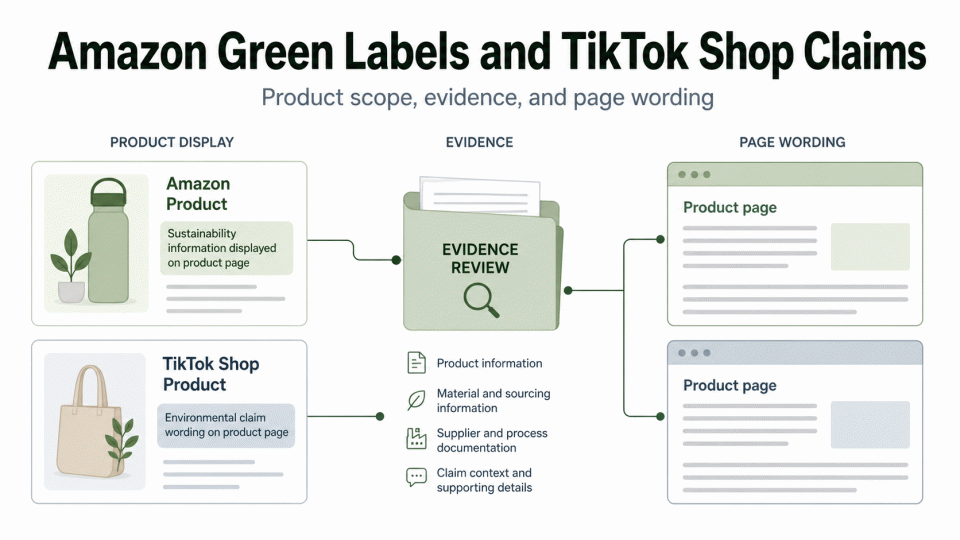
Environmental wording on an Amazon sustainability display or a TikTok Shop product page should not be treated as a generic “green” label detached from the product and its evidence. Start by identifying whether the statement concerns the whole product, a component, or packaging, then map it to certification, testing, assessment, supply-chain records, and the exact page language. Requirements may vary by platform, marketplace, category, account, and program. This is a documentation and wording review framework, not a substitute for current platform rules or legal advice.
1. Separate platform programs, environmental claims, and legal duties
Amazon Business publicly describes Climate Pledge Friendly as a sustainability display associated with third-party certifications and Amazon-owned programs. It does not mean that every product, account, or marketplace is automatically eligible. Check the current program materials and account interface for the specific SKU.
TikTok Shop’s public business rules say that an environmental claim should have a clear basis and identify which part of the advertised product it concerns. Factual claims should be supported by evidence and records should be kept. Platform review, advertising and consumer-protection rules, product safety, and packaging or chemical regulation are separate layers; one sustainability file does not replace the others.
2. Build a claim–evidence–page register for each SKU
Record at least six items: exact claim from the title, bullets, detail page, image text, or video; claim object such as the whole product, component, or packaging, with model, material version, size, and market; specific attribute such as a material feature, reuse design, or defined certification scope; evidence file with number, issuer, holder, scope, version, date, and limitations; applicability boundary covering SKU, production site, batch, market, and claim period; and review record with page version, submission date, findings, and change basis.
Evidence supports only the scope stated in the source file. A supplier certificate does not automatically prove every SKU sold by the listing owner, and packaging evidence does not automatically support a whole-product environmental conclusion.
3. Match documents by function, not by filename
Entity records identify who sells, imports, or makes the statement. Specifications, BOMs, formulations, labels, and packaging artwork identify the claim object. Tests or assessments support a defined performance, composition, or attribute. Purchase, batch, invoice, and production records connect materials or products through the supply chain. A business license does not prove a product attribute, and a generic certificate does not prove every model.
When using a certification or label name, check the scheme’s product scope, holder, status, mark-use conditions, and public verification route. Do not add “certified,” “officially approved,” or “platform approved” when the status has not been verified. Describe a platform badge only as shown or confirmed by the current platform or program.
4. Conduct three manual wording reviews
Scope: confirm who or what each sentence describes, including product, component, packaging, and market. Basis: link every sentence to a specific file, scope, and date; delete or qualify wording that cannot be linked. Meaning: avoid unqualified “green,” “eco-friendly,” “zero impact,” or “fully sustainable” wording, and avoid images or phrases implying approval by a platform, regulator, or certifier.
If you use a specific statement such as “contains recycled material,” identify the relevant material or proportion and keep it consistent with the evidence. If the evidence supports only a limited attribute, retain that qualifier in the title, image, and body.
5. Submission checklist and maintenance boundary
□ Account, marketplace, category, and SKU are identified; □ product, component, packaging, and company-level claims are separated; □ every page statement has evidence or a clear factual source; □ entity, model, material, batch, and market scope align; □ certificate or label status and use conditions are checked; □ images, video, and detail-page wording do not imply more than the text evidence supports; □ the submitted version and review record are saved; □ uncertain platform or regulatory points are checked against the current official source.
GreenArk (Shenzhen) Certification Co., Ltd. can assist with mapping products, evidence, and page wording. Whether a platform accepts a document or a claim is suitable for a market remains subject to the platform’s current rules, the certification body’s documents, and applicable law.
Sources
Amazon Business: Sustainability; TikTok Shop US: Business Campaign Terms and Conditions; U.S. FTC: Green Guides. Accessed 28 August 2026.


