When a customer, platform team or internal reviewer asks why an environmental statement is used for a product, the most useful response is not a generic certificate image. It is a traceable record that identifies the claim object, the covered SKU, the supporting file, the wording shown on the page and the owner of future updates.
Amazon Climate Pledge Friendly (CPF) is a consumer-facing product discovery program. Its recognition may rely on qualifying third-party certifications or Amazon programs. Whether a product is recognized and what information is displayed depends on the current Amazon program pages, account interface and marketplace. This guide does not treat document preparation as an Amazon decision and does not replace import, product-safety or other legal requirements.
1. Define the audience and the claim scope
Before replying, record four fields: product name and ASIN/SKU, marketplace, claim or program name, and the page location involved. Do not turn “the package uses a particular material,” “the product holds a certification,” and “CPF information appears on the page” into one conclusion.
If the statement concerns packaging only, identify the packaging composition, covered component and evidence boundary. If it concerns the product itself, connect the model, formulation or material, production site and applicable variant. A supplier file may cover a factory, a material batch or a finished product; the record should say which one.
Also identify what the requester needs: an additional file, an explanation of page wording, a version check or a current platform-status check. Each question needs its own evidence; a generic “compliance pack” is not a substitute for scope review.
2. Link the product, package and files in one index
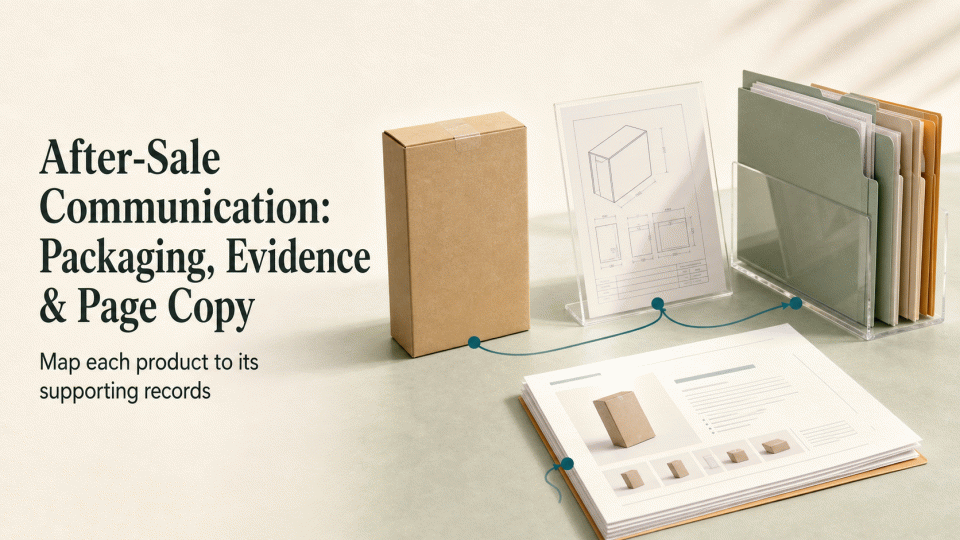
Create a minimum evidence index for each SKU instead of forwarding a supplier folder as-is. Useful columns include SKU/ASIN, product and packaging version, claim object, material or attribute, file name and number, issuing party, coverage, source link, page location, last reviewer and change note.
Packaging records may include a structure drawing, material list, supplier specification, purchasing or batch record, packaging-version photographs and applicable disposal or recycling information. Connect them to a page statement only when they support that specific statement. Do not infer a broad environmental benefit automatically from words such as “recyclable,” “recycled material” or “reduced packaging.”
Certification or program records should preserve the original source, holder or claimant, product/material scope and version. The relevant certification body controls the name, scope and mark-use rules. The existence of a file does not authorize extending its coverage to every product or package.
Page records should preserve the title, bullets, detail-page environmental statements, image text and submission history for the relevant ASIN/SKU. The wording should match the evidence object and boundary. Where needed, use qualifiers such as “the package includes…” or “this statement applies only to…”.
3. Write replies that another reviewer can check
A reviewable response can follow this sequence: question, fact, basis, boundary and next action.
First, quote the actual page, SKU or file in question rather than broadening the request. Then state the product and packaging version and the fields checked. List the file name, number, issuing party and original source. Explain what the file covers, what it does not cover and whether Amazon or a certification body still needs to confirm something. Finish with the missing file, page field or status check that remains.
Avoid statements such as “already approved,” “will not be delisted,” “customs will not detain it,” or “the whole range is covered” unless the exact authority and evidence directly support that wording. Do not turn internal document organization into an Amazon review outcome. Describe platform status with the marketplace, account context, lookup time and location of the relevant record.
4. Bring environmental wording back to a specific attribute
The U.S. FTC Green Guides explain that broad terms such as “green” or “eco-friendly” can be difficult for consumers to interpret without specific, clear and substantiated qualifications. Product and packaging claims should identify their object and retain reliable evidence for the stated benefit.
For a page review, ask sentence by sentence: Is this about the product, package or a component? Is it a material fact, a design feature, a certification scope or a platform label? Can the reader see the necessary qualification near the statement? Does the file cover the same SKU, version and marketplace? If one answer is unclear, narrow the wording or restore the source before discussing another submission.
5. Maintain the record after a change
When packaging materials, suppliers, production sites, formulations, models, page images or claim wording change, reassess the mapping. Record the old and new versions, affected ASINs/SKUs, affected files and page locations, statements requiring reconfirmation, the owner and the evidence of completion.
Do not assume one universal validity period for every certificate, report or program record. Check the issuing body, scheme, program page and marketplace requirement that actually applies. If the source does not specify a period, mark it for confirmation rather than inventing one.
GreenArk (Shenzhen) Certification Co., Ltd. may use this index as an internal review framework when organizing client materials. The final page and after-sale reply should still follow the client’s actual product, original files, target-market requirements and Amazon’s current program rules.
6. Five checks before sending
□ The product, package, component and ASIN/SKU are identified. □ Each environmental statement has a supporting file and original source. □ The file holder, scope, version and page object match. □ Marketplace or program status is recorded separately from legal duties. □ The reply states verified facts, open questions and the next action without an outcome promise.
Sources: Amazon Ads: Climate Pledge Friendly Creative Guidelines; Amazon Sustainability: Products and services; U.S. FTC: Green Guides. Program, certification and marketplace requirements may change; check the current official pages before use.