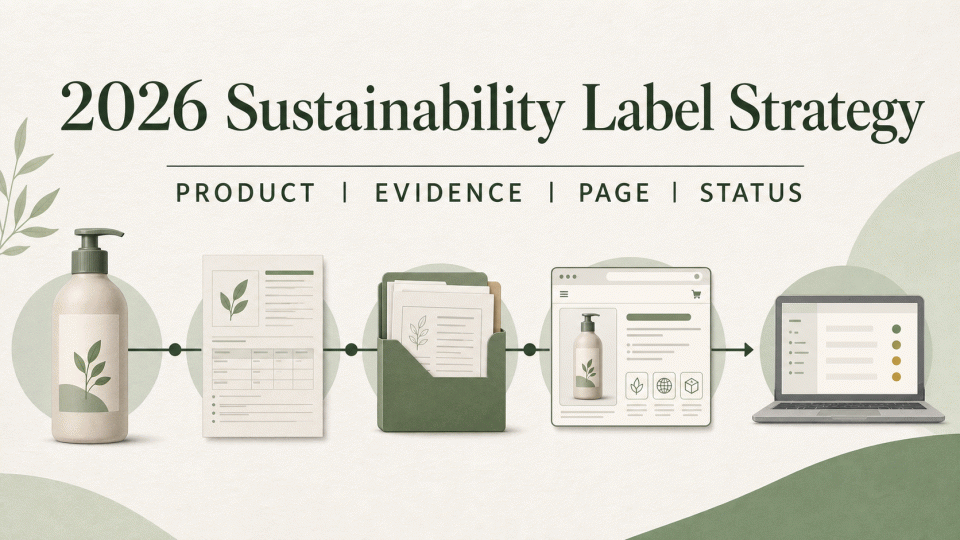
A sustainability label is not a universal conclusion that covers every product or market. Using product-level programmes such as Amazon Climate Pledge Friendly (CPF) as a reference, this page sets out a records-based review: identify the product and relevant programme, then keep the environmental attribute, certificate or programme record, page wording and current platform status as separate fields. It is a documentation reference, not a determination that any SKU is certified, enrolled or accepted by a platform.
1. Define the review object
Create one record for each SKU or variation: product name, model or ASIN, materials and formula, packaging attributes, store or marketplace, page version, responsible entity and review date. State which attribute is being checked, such as recycled content, organic content, packaging efficiency, carbon impact or a supply-chain attribute. Different attributes may have different standards, certificate holders and evidence boundaries.
Do not treat “label strategy” as a single outcome column. A more useful unit is “specific product × specific attribute × specific evidence × specific page version × specific platform status”, with reasons recorded for items that are not applicable, incomplete or due for another review.
2. Separate certification and programme paths
Amazon’s published materials describe CPF as a way to help customers discover products with particular sustainability features through qualifying third-party certifications and Amazon-developed programmes. Record the certification or programme name, standard version, certificate or programme reference, holder, covered products, market, issuance or update information, and the specific attribute supported by the record.
A third-party certification, an Amazon programme and a company’s voluntary environmental statement are different layers. Check the certificate scope, the product-page attribute and the platform’s displayed status independently. Do not turn a certification name into a broader claim such as “fully sustainable”, “all products are green-labelled” or “platform approved”.
3. Build an evidence index
Product and entity: SKU, model or ASIN, brand–manufacturer relationship, responsible entity, product specification, BOM or formula, and packaging dimensions and materials.
Attribute and certification: certificate or programme record, standard and version, holder, covered product or facility, scope limits, reference number, issuing body’s public lookup record and document version.
Page and change control: environmental wording in the main image, title, bullets, A+ or detail page, page screenshot or version, submission record, and review history after a formula, package, supplier, production site, certificate scope or page change.
Each file proves only the matter it covers. A supplier statement does not automatically establish the brand entity, product scope or platform status; a certificate does not automatically replace mandatory market requirements, private customer standards or other regulatory records.
4. Keep page wording separate from platform status
Page copy should point to a verifiable product attribute and evidence scope, for example by identifying the certificate reference and the product range it covers. For CPF-related wording, use the relevant expression only when the current product status shown by Amazon and the supporting scope are consistent. Amazon’s advertising guidance also requires every product shown in a CPF creative to have the relevant product status; a single qualified product cannot support generic brand advertising.
“Documents submitted”, “under review”, “covered by a certificate” and “currently displaying a platform label” describe different facts. Include a review date and page version, and avoid converting preparation into approval, acceptance, guaranteed display, guaranteed traffic or universal product coverage.
5. Maintenance checks for 2026
Recheck the product–evidence relationship whenever the product, formula, packaging, supplier, production site, certification scope or page content changes. Do not assume one universal certificate validity period or platform processing time; record the next review item from the relevant certifier, programme rules, contract or account notice. For cross-market sales, maintain a separate mandatory-market register rather than combining it with CPF or another voluntary programme.
Five manual checks before publication: 1) Are the product, variation and attribute specific? 2) Do the certificate or programme records cover the product and entity? 3) Are reference numbers, versions and lookup evidence traceable? 4) Does the page say only what the evidence supports? 5) Are platform status, mandatory rules and customer requirements recorded separately, without an outcome promise?
Sources: Amazon Ads, “Climate Pledge Friendly (CPF): Creative Guidelines”; Amazon Selling Partners, “The Sustainability Solutions Hub”; and Amazon Sustainability, “Products you can trust: helping customers shop with the planet in mind” (28 January 2026). Check the applicable official programme page and current account records for the specific scope and status. 绿色方舟(深圳)认证有限公司 provides this page as a documentation reference only; it does not replace the judgment of a certifier, platform or competent authority.