
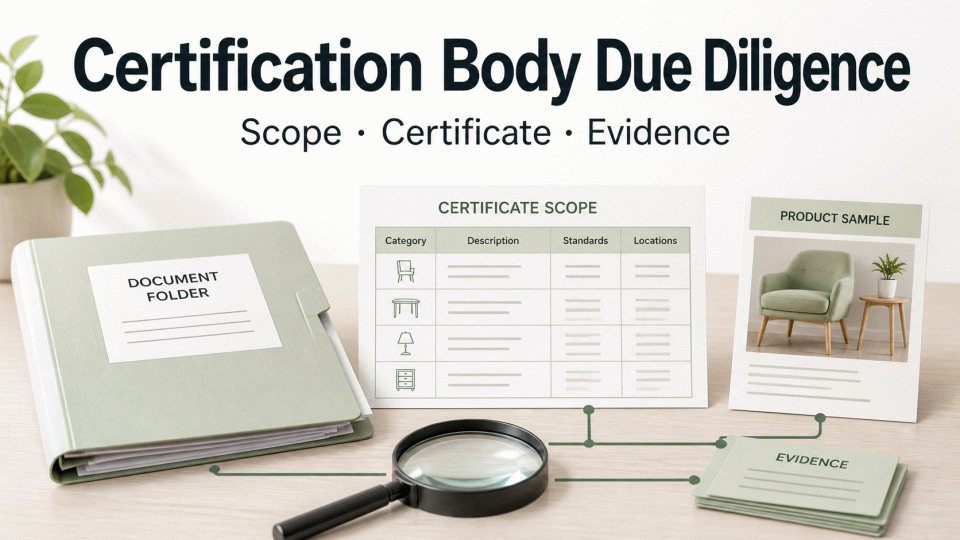
When selecting a certification body or reviewing an environmental claim, the key question is not whether the organization sounds authoritative. It is whether the certification object, scheme or standard, competence scope, certificate status, and product evidence all connect. This page offers a due-diligence framework. It does not represent a certification, platform decision, or outcome for any organization or product.
ISO explains that product, process, and service certification should be understood within a defined certification scheme. The scheme sets the object, requirements, sampling where relevant, evaluation and decision process, mark controls, and surveillance activities. ISO/IEC 17065:2012 remains the published edition listed by ISO, while the ISO page also records ongoing revision work. Record the date checked and consult the current official text when citing the standard.
1. Define the due-diligence object
Before contacting a body, create a product–market–claim table. Record the SKU or model, material or formulation, production site, sales markets, importer or page-responsible entity, intended standard or scheme, and the environmental attribute you plan to communicate. Keep brand-level, factory-level, product-level, and transaction-level evidence in separate fields.
For product certification, check whether the scheme defines the product category, technical requirements, sampling, and evaluation method. For testing, check the laboratory scope, sample identity, method version, and report client. For an environmental claim, separately confirm the claim rule, accounting boundary, data period, and review method. The appropriate route depends on the current rule, scheme, and customer or platform requirement.
2. Review the certification body
Identity and decision roles: record the body's legal name, registration location, certificate issuer, public contact details, and the people responsible for evaluation, technical review, and the certification decision. Do not judge competence from a sales presentation alone.
Accreditation scope: obtain the accreditation certificate or the accreditation body's public scope. Compare the product category, standard or scheme, geography, and issuing entity. ISO/CASCO also notes that product certification must be considered in the context of a certification scheme, including evaluation, decision, and surveillance arrangements.
Impartiality and conflicts: ask how consultancy, testing, auditing, evaluation, and certification decisions are separated. Keep the applicable impartiality policy, complaint and appeal rules, and rules for suspension, withdrawal, or change. Being able to provide a service does not by itself establish independence for a certification decision.
Public verification: record the official lookup page, certificate number, certified entity, scope, status, and lookup date. IAF CertSearch supports searches for some accredited management-system certifications issued under the relevant IAF signatory arrangements; it is not a universal database for every product scheme. Check the applicable accreditation body and scheme record.
3. Align certificates, reports, and claims
Put certificates, reports, and page copy in one evidence matrix. Check the legal entity or authorization, product model and variants, key materials or formulation, factory or production site, standard and version, evaluation method, issue date, status or conditions, mark-use rules, limitations, and exclusions. If a field cannot be mapped, pause the proposed wording and ask the issuer for clarification.
For a test report, check the laboratory, accreditation scope, sample description or image, client, method, results, deviations, and signatures. ISO/IEC 17025 concerns laboratory competence; whether a report meets a market or platform rule still requires a separate, rule-specific assessment. “ISO/IEC 17025” is not a substitute for checking the actual requirement.
Environmental attributes also need a defined object and boundary. “Contains recycled material,” “recyclable,” and “product carbon footprint” may require different evidence, such as content or chain-of-custody records, material and recovery information, or calculation methods and source data. Do not turn a factory management-system certificate into a product-performance claim, or extend a supplier's general statement to the current SKU without evidence.
4. Build the file and review the page
Body file: legal identity, accreditation certificate and scope, certification scheme, official lookup route, complaint and appeal rules, impartiality policy, and mark-use rules.
Product file: model and variants, specification, BOM or formulation, factory and suppliers, packaging and labels, sample records, sales markets, and responsible entity.
Evidence file: certificates, reports, transaction or content records, calculations, source data, versions, signatures, lookup links or screenshots, and review dates. Use a consistent identifier connecting each SKU, document, and claim sentence.
Page review: read the title, bullets, A+ content, packaging, and advertising line by line. Check that “eligible to apply” or “under review” has not become “certified,” and that limitations have not disappeared. Save the page version and approver after each change.
5. Common errors and responsibility boundaries
“The body is accredited, so it can certify everything” confuses scope. “The report carries a stamp, so a platform must accept it” replaces a rule with an assumption. “Another model from the same brand is certified, so this SKU can use the same claim” confuses the certification object. “The certificate is in our folder, so its status is unchanged” ignores suspension, withdrawal, amendments, and scheme updates. Each issue should be checked against the relevant official record, issuer, and current use rule.
When 绿色方舟(深圳)认证有限公司 assists with documentation, clients should retain original files, lookup records, and version-change notes, with product, supply-chain, legal/compliance, and page-operations owners confirming the final wording. We can help build a checklist and evidence map, but we do not replace the issuing body's certification decision or promise a platform display, review, or sales outcome.
Sources
- ISO/IEC 17065:2012 — Requirements for bodies certifying products, processes and services (publication and revision status).
- ISO/CASCO — Certification bodies for products, processes and services (elements of a certification scheme).
- ISO — Conformity assessment (basic definitions for certification and conformity statements).
- IAF — CertSearch and accredited certification information (scope depends on the relevant database and accreditation record).
- ILAC (laboratory accreditation and mutual-recognition information; apply the target-market rule separately).


