For: Brands, manufacturers, importers and e-commerce teams placing batteries, battery-powered products or light means of transport batteries on the EU market.
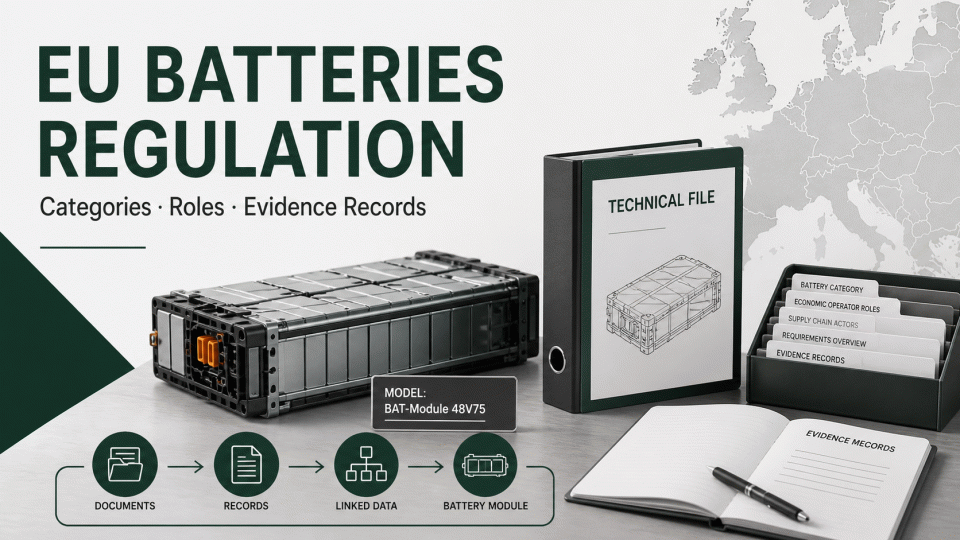
Core point: Regulation (EU) 2023/1542 addresses battery sustainability, safety, labelling, marking, information, producer responsibility, waste-battery collection and reporting. Start with the battery category, product relationship and economic-operator role, then map the applicable requirements to the model, label, technical file and producer-responsibility records.
Boundary: This is a recordkeeping framework, not a product-specific compliance conclusion. It does not replace the current official text, Member State authority guidance, producer-responsibility arrangements or platform requirements. Check the applicable consolidated text and later delegated or implementing measures against the product facts.
1. Define the battery object and market scenario
The Regulation covers batteries and waste batteries and distinguishes portable, starting-lighting-ignition, light means of transport, electric-vehicle and industrial batteries, among other categories. Record separately whether the battery is built into a product, sold on its own, supplied as a replacement, or used in a vehicle or equipment. A brand name or product title is not enough to determine the category.
Use a minimum review unit: chemistry, rated energy or capacity, model and variants, removability or replaceability, host product, Member States, placing-on-the-market entity and supply-chain version. Specific exclusions, including certain military or space equipment, and the limited nuclear-installation exception must be checked against the scope provisions rather than inferred from an electronics label.
2. Split the requirements into six evidence lines
- Roles and entities: Record the manufacturer, importer, distributor, authorised representative where relevant, and producer-responsibility role, with names, addresses and the basis for the role assessment.
- Product and category: Keep the model, category, use, rated parameters, component relationship, variants and change history aligned with the technical file and listing.
- Safety and technical file: Organise risk assessment, design and manufacturing information, test or calculation evidence, declaration documents and instructions as required by the applicable provisions.
- Labels, marks and information: Version the battery, packaging, product-page and instruction artwork; check capacity information, sorting or recycling information and target-market language requirements.
- Supply chain and changes: Link the battery supplier, key materials, batch, purchase, production, transport and replacement model records. A cell, chemistry, factory or enclosure change should trigger review.
- Waste batteries and producer responsibility: By Member State and battery type, retain registration or reporting records, collection and treatment arrangements and their supporting basis. One national registration should not be treated as an EU-wide substitute.
3. Build a model–provision–file–page matrix
| Review object | Record at minimum | Do not infer automatically |
|---|---|---|
| Battery category | Use, structure, parameters, host product and version | Same brand or appearance means the same category |
| Economic operator | Manufacturer, importer, distributor and producer role | A supplier name replaces the placing-on-the-market entity |
| Label and page | Artwork, instructions, language, parameters and claim version | A test report supports every environmental or safety statement |
| Waste-battery duty | Member State scope, registration/reporting, collection and treatment | An arrangement in one country covers all Member States |
4. Give the cross-border team an owner flow
For a consumer-electronics SKU with a removable battery, the product manager confirms the battery model and host-product relationship; engineering or quality organises technical and safety evidence; procurement controls supplier and change records; the brand or importer confirms the placing-on-the-market role; operations uses only the checked model, parameter and label versions; finance or legal retains the Member State producer-responsibility arrangement. A change to the model, selling entity, target country or page claim reopens the matrix.
- Check first: SKU/model, host-product relationship, Member States, placing-on-the-market entity and current legal version.
- Then file: technical records, declaration documents, labels/instructions, supplier records and waste-battery responsibility evidence.
- Release the page last: use only parameters and claims traceable to the same model and evidence version, and retain the published version and reviewer.
5. Common mistakes and challenge questions
Mistake 1: Treating a CE mark, transport document, platform file or supplier test report as the complete Batteries Regulation record. Their purposes, responsible parties and scopes may differ and must be mapped separately.
Mistake 2: Updating packaging artwork without updating instructions, page parameters and internal model records. A visible version cannot stand in for an aligned technical file.
Mistake 3: Turning “recycled content”, “recyclable” or “low carbon” into a legal conclusion. Environmental wording needs its own evidence, scope and legal review; it is not automatically authorised by a battery document.
Ask before submission: Which battery model does this file cover? Which role does each party hold for placing the product on the EU market? Can every page parameter or environmental statement be traced to the same evidence version? If not, pause at evidence review rather than describing the product as compliant or guaranteed to pass.
6. Official materials and use boundary
Starting points: EUR-Lex Regulation (EU) 2023/1542 consolidated text and the European Commission Batteries page. The consolidated text is a documentation aid; formal decisions should also check the Official Journal and later amendments, delegated acts and implementing acts.
绿色方舟(深圳)认证有限公司 can help organise the links between the product, responsible parties, technical file, page versions and Member State responsibility records. The applicable scope, reporting duties and wording still depend on the SKU facts, market role, destination Member States and current official requirements.