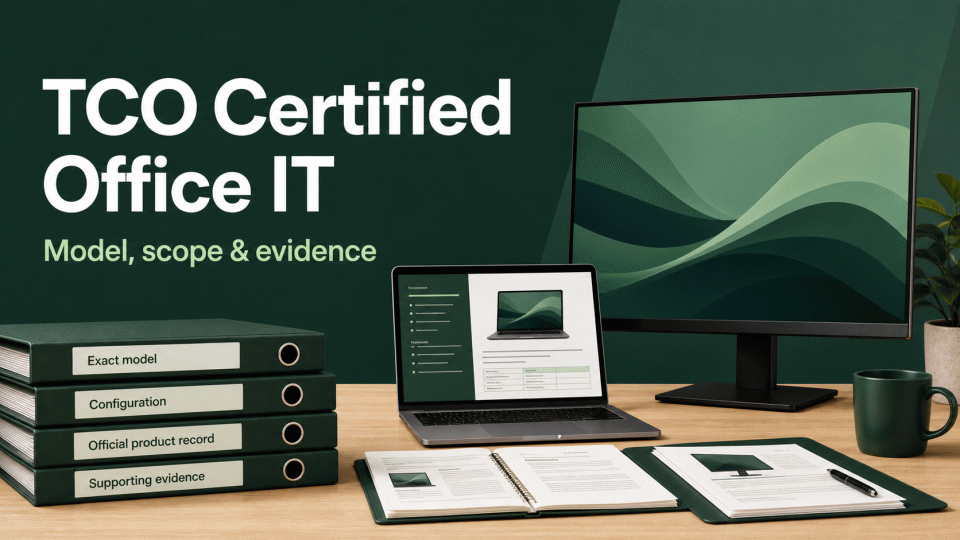
TCO Certified is an IT-product sustainability certification scheme. For an office-device brand or seller, the useful starting point is to confirm the exact product category, model and configuration, then map each customer-facing statement to evidence that actually covers that product.
What TCO Certified does—and does not—show
TCO Certified addresses product criteria across areas such as climate, substances, circularity and supply chain. It is not a blanket statement that a company is “green,” that every market-access requirement has been met, or that a marketplace will automatically accept a listing.
Separate claims about energy use, recycled content, recyclability, restricted substances or social responsibility need their own scope and support. A TCO record should not be used as a substitute for evidence required by another scheme or rule.
A model-level review path
- Record the brand, full model, configuration differences, sales region and listing SKU.
- Search the official TCO Certified Product Finder by category, brand or model. Preserve the search date, product record, certification date and any displayed expiration information.
- Check the applicable product-category criteria and edition. Confirm whether the record covers the complete product, a defined configuration or another limited object.
- Reassess the mapping when the model, configuration, supplier, market or marketing claim changes.
Evidence fields worth keeping
| Field | Review question |
|---|---|
| Product identity | Do brand, model, configuration, SKU, version and market match? |
| Certification record | What category, record, certification date and expiration information are shown? |
| Supporting files | Which criteria edition, verification material and applicant/product relationship are documented? |
| Page sentence | What specific attribute does the sentence claim, and does it exceed the certification scope? |
Keep the page wording qualified
A page may accurately identify the model, applicable TCO Certified category and traceable record. It should not turn that record into claims such as “zero environmental impact,” “guaranteed energy savings,” “all regulations met” or “guaranteed marketplace acceptance.” The FTC Green Guides note that third-party certification does not by itself substantiate every express or implied advertising claim; the basis of a certification should be clear, and separate environmental claims need their own support.
If the page also mentions ENERGY STAR, EPEAT, RoHS, REACH or supplier information, maintain a separate product scope and evidence map for each one. Do not use a TCO record as evidence for a different program.
Four checks before publication
- Make sure the model and configuration match across the listing, packaging, manual and internal register.
- Keep official records, criteria editions and source files traceable; do not convert an unverified field into a definite conclusion.
- Separate certification scope, product attributes, company commitments and marketplace or buyer requirements.
- Have a market-aware reviewer read every sentence and retain the version, date and reason for each change.
绿色方舟(深圳)认证有限公司 can help organize a review table by product, model, evidence file and page sentence. The applicable criteria, official record and the company’s actual documentation remain the basis for any final conclusion.
Sources
- TCO Certified Product Finder: model and category search and displayed certification information.
- TCO Certified Generation 10 General, Edition 2: scope, criteria and independent verification context.
- FTC Environmental Claims: Summary of the Green Guides: evidence and certification/seal boundaries for environmental marketing.