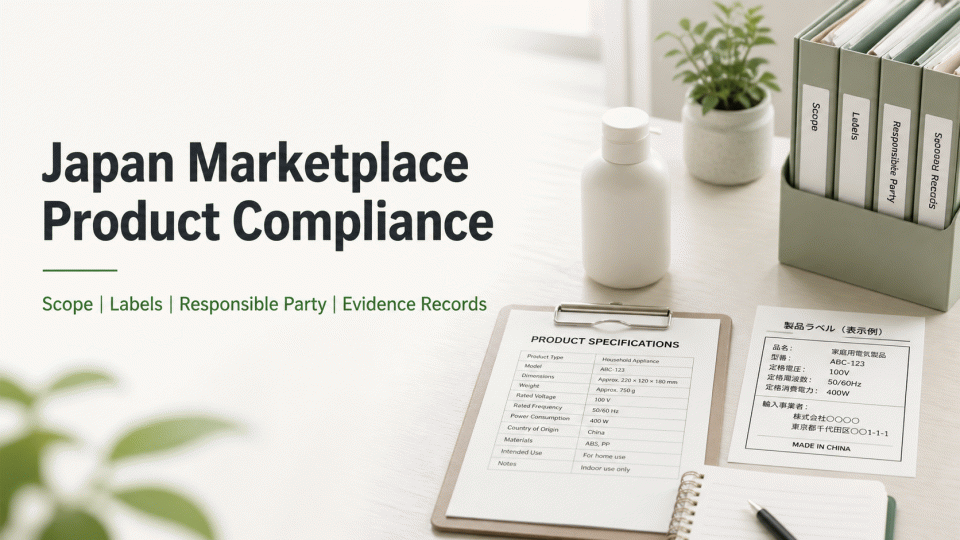
Who this is for: Brand, procurement and operations teams preparing to sell consumer products, household appliances, battery products or wireless products through Japanese e-commerce channels.
Bottom line: “Japan marketplace compliance” is not one universal document list. Fix the product use, construction, ratings, selling entity, import arrangement and page claims first, then review the applicable rules, labels, technical files and current platform prompts separately. This guide organizes an evidence review; it does not replace Japanese law, regulator guidance, platform requirements or product-specific professional advice.
1. Fix the product and selling scenario
Use one master-record line for one SKU, model and selling scenario. Record the product name, intended use, main materials, rated voltage and frequency, power or capacity, battery and wireless features, package contents, target user and Japanese sales channel. Do not infer the applicable law from a product name or HS code alone; retain product photos, construction drawings, nameplate images and supplier confirmations when relevant.
Also identify who is responsible for manufacture, import, sale, labelling, customer support and incident handling. An overseas seller, overseas manufacturer, Japanese importer, platform and brand owner may have different roles. Do not collapse supplier, storefront and responsible-party fields into one name.
2. Route the review by product characteristics
1) Electrical products: check the Electrical Appliances and Materials Safety Act
Japan’s Ministry of Economy, Trade and Industry (METI) explains that the Electrical Appliances and Materials Safety Act covers designated electrical appliances and materials and distinguishes specified from non-specified products. Confirm the product category, technical requirements, importer or notifying supplier and current official list for the actual model. Do not treat CE, UKCA, FCC or a supplier declaration as a Japanese PSE conclusion.
Record the classification basis, technical-standard version, required self-inspection records, type or conformity-assessment evidence, label artwork and import or notification party. The conditions for using the PSE mark and any sale restrictions must be checked against METI’s current statutory process; the mark is not a universal licence for every product.
2) Specified consumer products: check the Consumer Product Safety Act
Baby and infant products, portable laser products, riding helmets and other items may fall within specified-product rules under Japan’s Consumer Product Safety Act. Review METI’s current product list, technical requirements, notification or inspection procedures and marking rules. Confirm whether the actual product is in scope and whether warnings and responsible-party details match. Do not mix PSC with PSE or infer statutory completion from a marketplace listing.
3) Household products: review quality labelling separately
Japan’s Consumer Affairs Agency explains that the Household Goods Quality Labeling Act prescribes required items and methods for designated household goods, including certain textile products, synthetic-resin products, electrical machinery and miscellaneous industrial goods. If the product is a designated item, prepare the required Japanese material, size, use, caution or other statements under the relevant product rule. Quality labelling and product-safety marks are separate evidence layers; one test report is not a substitute for both.
4) Wireless, food-contact and chemicals: treat them as separate branches
Products with Wi-Fi, Bluetooth, cellular or other radio functions should be checked separately against Japan’s Radio Act and applicable Ministry of Internal Affairs and Communications requirements. Food-contact, cosmetics, children’s products and chemical-containing products may involve different authorities, methods, labels or filings. Add a branch to the SKU evidence file only after the product characteristics match an official scope; do not treat EU REACH, US FDA or another market’s file as an automatic Japanese substitute.
3. Build a requirement–evidence–page map
| Field | Record | Review question |
|---|---|---|
| Product scope | Model, version, use, materials, ratings and accessories | Does the file cover the configuration sold now? |
| Responsible party | Manufacturer, importer, brand, seller and authorization links | Do names, addresses and roles match? |
| Rules and evidence | Official source, provision, report/declaration number, version and date | Can the conclusion be traced to the product and source? |
| Labels and pages | Japanese labels, warnings, manual, specifications and page claims | Does the page stay within the evidence? |
Version control should let the team trace a model, label or page claim back to the relevant report, photo, technical file and responsible party. Keep complete reports, issuing body, sample description and standard. If the product, supplier, power unit or packaging changes, reassess whether the old evidence still covers it.
4. Pre-listing page and label review
- Match the SKU, model, colour/capacity, ratings and package contents against the photos, specification and tested sample.
- Confirm that Japanese labels, manuals and warnings contain the fields required by the applicable rule; keep an item as “to confirm” rather than filling it with an assumption.
- Place PSE, PSC, radio marks or other claims only where the corresponding basis exists; do not copy another market’s mark onto the Japanese page.
- Review the Amazon title, bullets, A+ content, image text and physical package as one claim set, removing absolute claims such as “complies with all laws” or “ready for sale” when the evidence does not support them.
- Save the page version, reviewer, date and open items. Record current platform prompts separately from statutory requirements.
5. Four common mistakes
- Treating “Japan marketplace” as one law. Scope depends on product characteristics, use and selling arrangement.
- Applying supplier files directly to a storefront SKU. Check model, version, responsible party, sample and configuration, not just the file title.
- Treating overseas marks as Japanese conclusions. Systems may have different objects, duties and procedures and must be reviewed separately.
- Treating a listing as proof of compliance. Listing status does not replace legal analysis, label review or evidence retention.
6. Sources and working boundary
Use METI’s Electrical Appliances and Materials Safety Act / PSE page, METI’s Product Safety page and the Consumer Affairs Agency’s Household Goods Quality Labeling Act page for the current entry points, scope and materials. The primary law, regulator guidance and product-specific classification take priority over secondary checklists.
Boundary: This guide organizes Japanese marketplace product records and page-claim review. It does not promise listing, sale, clearance, certification, platform acceptance or any fixed outcome. Follow the current documents from the relevant Japanese authority, platform and verified product evidence. Prepared by 绿色方舟(深圳)认证有限公司.