
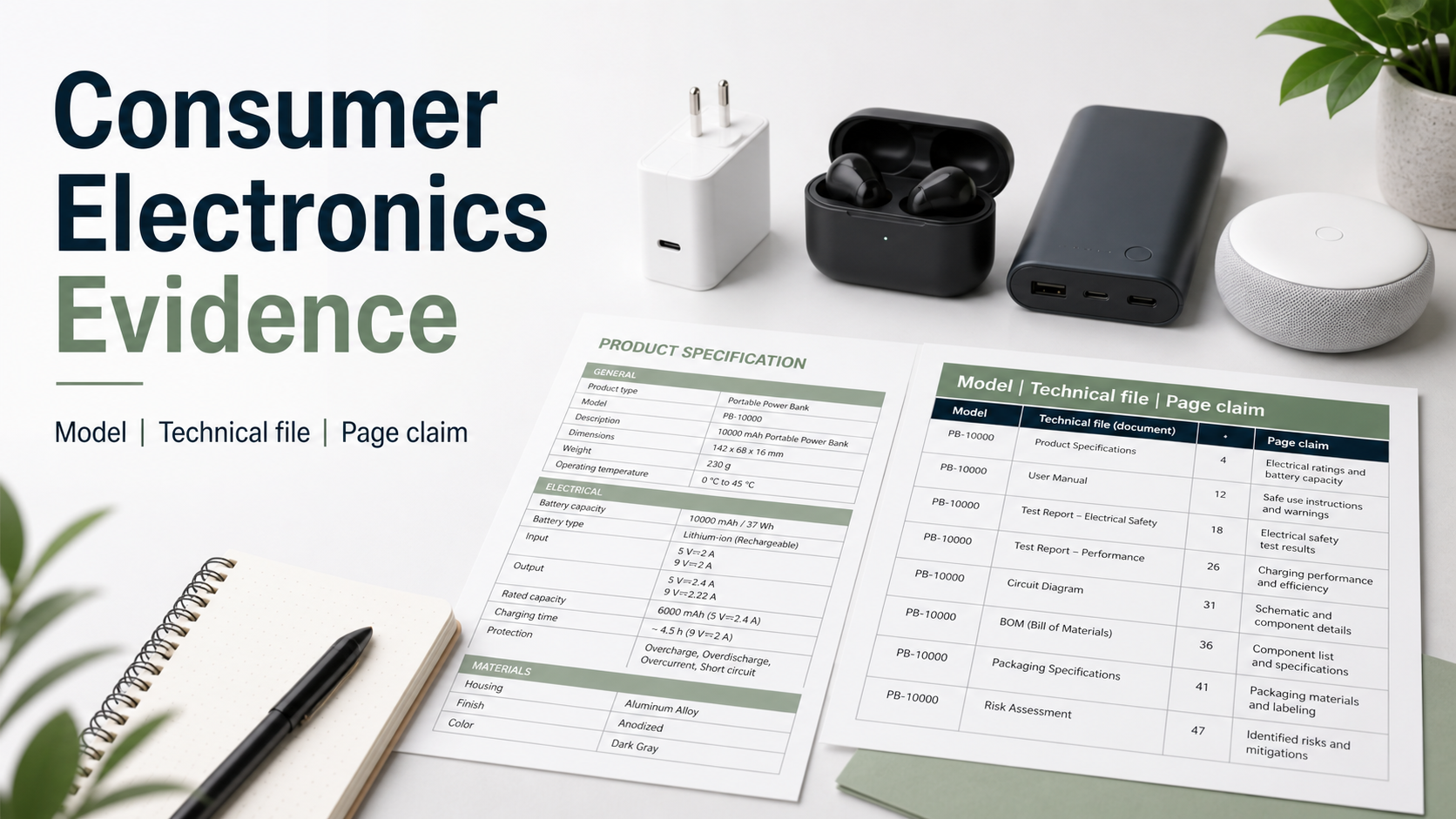
A consumer-electronics evidence review should not begin with a generic “green certificate”. It should connect one model, one sales market, the applicable requirements, the technical file and each proposed page sentence in a traceable record. This is a review framework, not legal advice, a certification decision or a platform outcome.
A charger, earbud set, power bank and connected device under the same brand may raise different questions about safety, radio, batteries, chemicals, waste or environmental claims. Do not reuse another product’s report or wording until the product design, functions and destination market have been confirmed.
1. Fix one product record first
For each model or SKU, record the brand, manufacturer, responsible entity, model, variation, rated inputs and outputs, radio functions, battery information, packaging version and target market. An ASIN or parent listing helps identify catalogue relationships; it does not replace the model, technical specification or applicability analysis.
If one document covers several variations, confirm whether the appearance, critical components, firmware, power, battery and marking remain within its scope. A colour or packaging change may or may not affect applicability, but it should not be assumed to be identical without review.
2. Separate requirements from evidence types
Specifications, BOMs, risk assessments, instructions, labels and test reports explain what the product is and how it was assessed. Declarations, certification records or registrations may support a responsibility arrangement in a specific market. Packaging, recycling, battery and environmental-claim records should be reviewed under their own regimes. Evidence for one area does not automatically prove another.
For example, CE-related files, radio testing, RoHS material records, WEEE or battery producer-responsibility records may serve different purposes. Record the issuer, product scope, standard or regulation, method, date, version and limitations for each file; do not rely on a filename or screenshot alone.
3. Build a model–file–page map
| Record layer | Manual check | Do not infer |
|---|---|---|
| Product identity | Model, variation, key parameters, batch and market | Automatic coverage of other products under the brand |
| Technical file | Issuer, scope, method, version, date and limitations | The report itself proves market access everywhere |
| Page claim | Sentence-level match to the product and evidence | An unconditional “green”, “safe” or platform-label conclusion |
Use one row for each ASIN or SKU. Preserve the proposed wording from the title, bullets, description, attributes and image text, and link each sentence to its evidence, market and open question. When the model, entity, version or scope does not match, mark it for review rather than filling the gap with a supplier assurance.
4. Keep page wording proportionate to the evidence
A page may describe a product feature supported by the file, such as a model parameter, material detail or defined test scope. It should not turn one test into “fully compliant”, turn a supplier document into the seller’s or brand’s certification, or turn document preparation into a promise of platform approval, customs clearance, reinstatement or a fixed timeline.
Before using a certification name, mark or environmental wording, check the destination-market rules, the scheme owner’s claims policy and the platform’s current guidance separately. 绿色方舟(深圳)认证有限公司 may help organise the product, document and page-claim map, but it does not replace a decision by a certification body, platform or regulator.
5. Manual checks before submission
- Confirm that the model, variation, batch and listed product are the same object.
- Check the issuer, scope, version, date and limitations of every file.
- Review safety, radio, battery, chemicals, waste and environmental-claim requirements separately for the target market.
- Read the title, bullets, description, attributes and image text sentence by sentence, removing wording the files do not support.
- Record verified, pending and not-applicable items separately, with the source link and review date.
Source boundary: public European Commission information on CE marking and product rules, RoHS and WEEE texts in EUR-Lex, producer-responsibility guidance from the relevant market authorities, and current seller requirements from the applicable platform. Rules, standards and platform workflows can change; return to the official source and the specific product record before use.