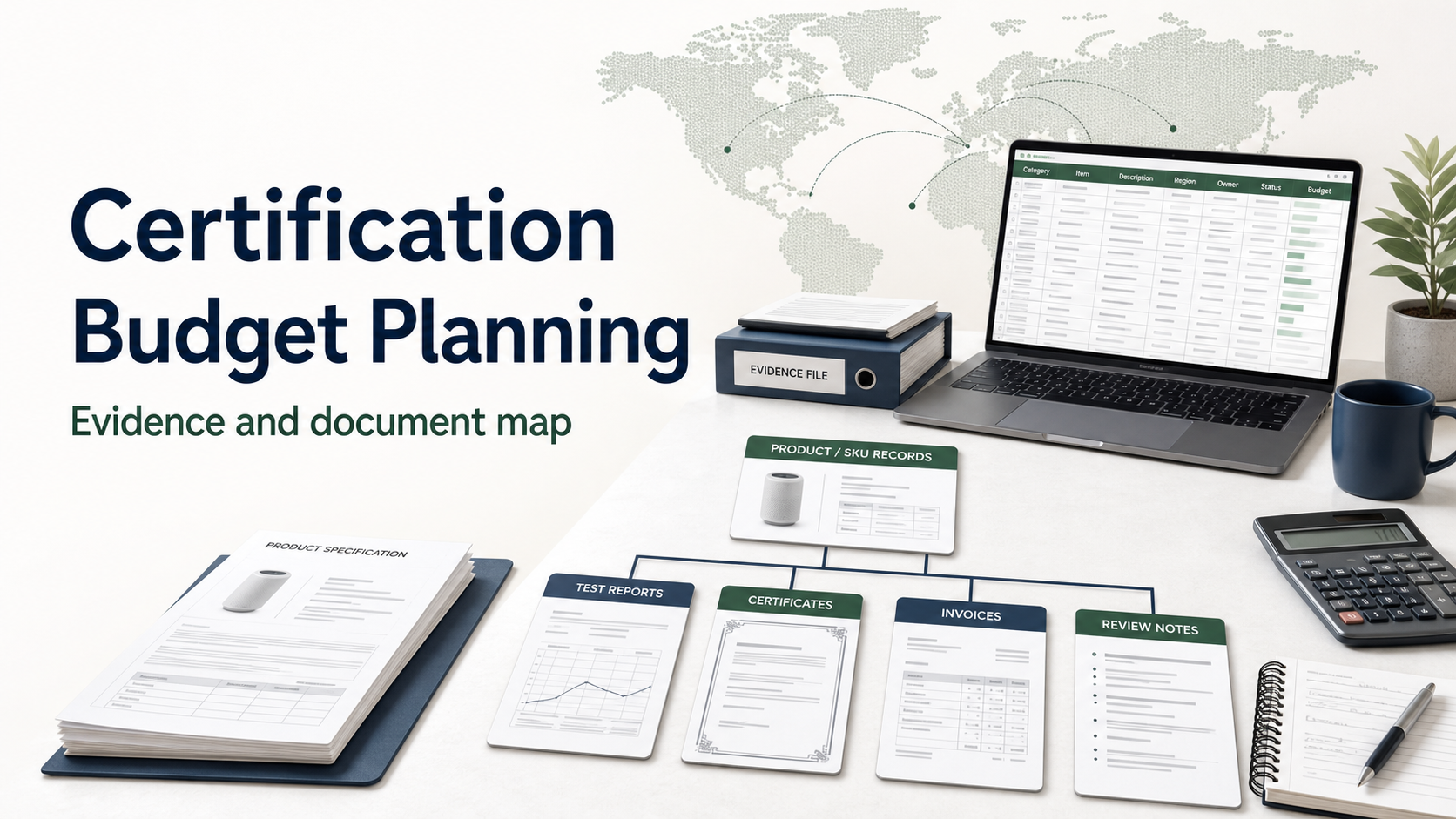
A certification or compliance budget should begin with the product, destination market, responsible entity, and evidence scope—not with the assumption that one certificate solves every requirement. This reference page maps testing, assessment, file preparation, and maintenance. The applicable regulation, authority, platform rule, or scheme document remains the controlling source.
1. Define the budgeting unit
Build a product-and-market register: product name, model or SKU, materials and formulation, critical components, packaging, destination country or region, importer or seller entity, and the account or legal entity responsible for submission. A shared brand or factory does not make evidence interchangeable across products or markets.
Separate requirements into legal requirements, platform or channel requirements, and customer or brand-owner requirements. Their decision-makers, evidence formats, and update processes may differ, so keep them as separate budget lines.
2. Split the budget into four workstreams
Entity and responsibility files: registration details, brand authorization, manufacturer and importer information, responsibility assignments, account records, and declarations requiring a specified signatory.
Technical and labeling files: specifications, BOMs, critical-part or material information, risk assessments, instructions, warnings, packaging, and label artwork. Record translation, layout review, sample confirmation, and version control separately.
Testing, assessment, and audit: confirm methods, samples, laboratory or assessment body, report format, and supplementary documents from the applicable scheme. Check the model, sample, method, parameter range, and submission scope rather than estimating by report length.
Supply-chain and transaction evidence: purchase records, invoices, batch or order references, transport documents, material declarations, and transaction certificates where the specific scheme requires them. Link each record to the relevant product or batch.
3. Adjust the budget for evidence gaps
For each SKU, maintain the relationship between requirement, evidence, owner, and status. Check the legal entity, model, material, factory, market, signatory, and date against the current product. If a supplier file does not match, mark it for review instead of treating a generic document as product evidence.
Classify gaps as unavailable, unclear in scope, outdated or version-unclear, or inconsistent with the product. They may require additional testing, issuer clarification, reassessment, or a document update. A generic “certification fee” line hides those different tasks.
Label each estimate with its assumptions: sample count, translation needs, on-site assessment, possible supplementary testing, and file-preparation scope. Until a formal quotation or scheme document is available, keep the amount as an estimate rather than a fixed price or promised outcome.
4. Review and maintain the budget sheet
Before submission, ask product, supply-chain, and compliance owners to review their fields. The product owner confirms the model and change history; supply chain confirms transaction and batch relationships; compliance confirms the applicable requirement, source, and page wording. For platform submission, also check the current interface and help documentation.
A material, factory, packaging, label, or market change can change the evidence scope. Keep a version number, file path, review date, and open actions. The review interval should follow the relevant certificate, scheme, regulation, or platform rule rather than a universal deadline.
5. Sources and wording boundaries
Ground the document map in the destination market’s regulation and official annexes, public requirements from the responsible authority or scheme owner, current platform help documentation, and formal quotations or reports from the relevant body. Secondary articles may help locate an issue, but they do not replace checking the original text, scope, and version.
A page may explain which evidence to review and how to structure a budget. It should not promise certification, platform acceptance, customs release, or completion by a particular date. Greenark (Shenzhen) Certification Co., Ltd. can help organize the review path; the project still depends on the product information, target market, and formal requirements.