A sustainability statement is not created by adding “green” or “eco-friendly” to a page. Each public sentence should connect to a defined product scope, comparison basis, document, and owner. This page is a documentation framework; it is not a certification, legal opinion, or market-entry conclusion.
1. Turn the brand story into reviewable claims
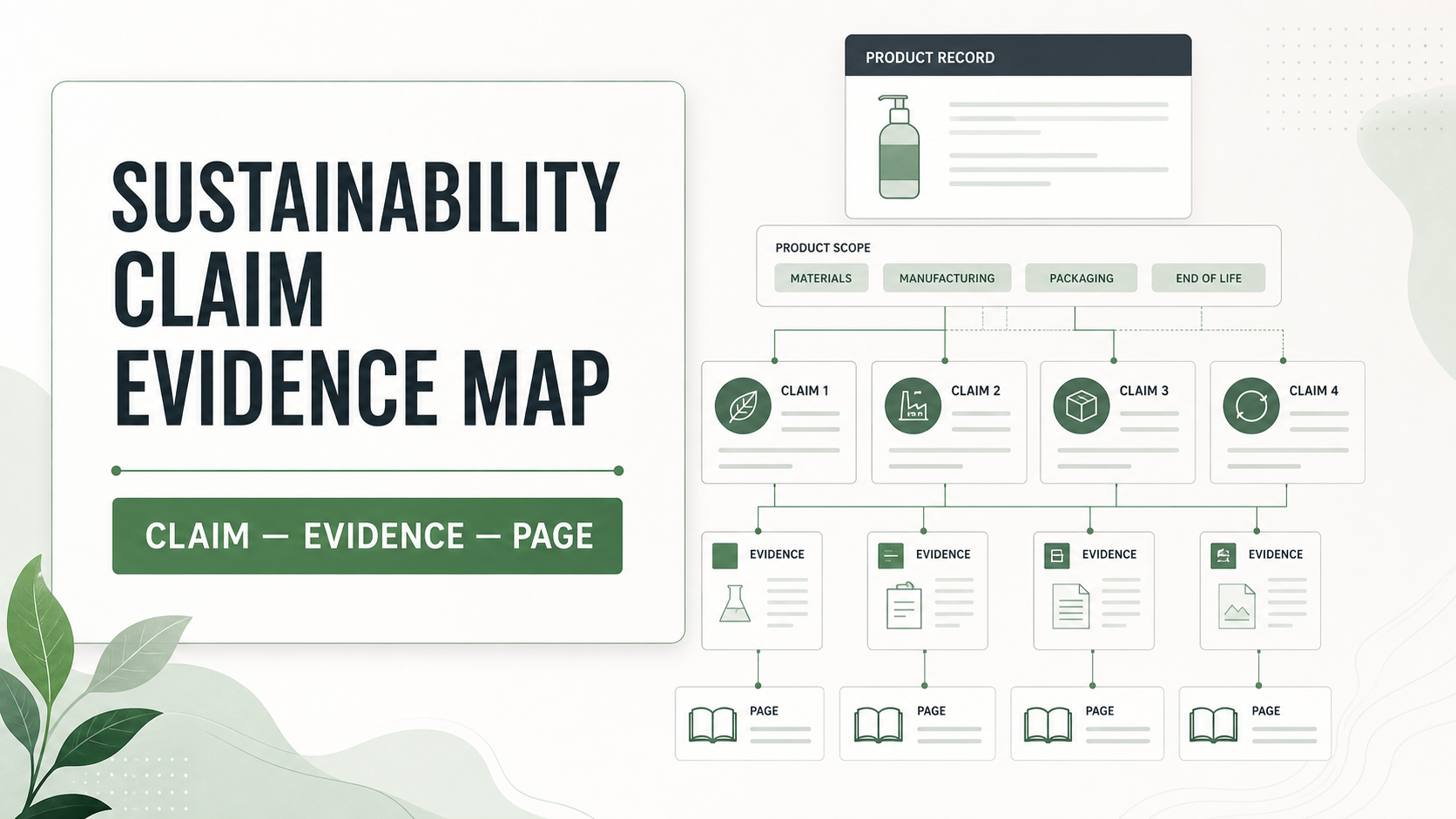
List each proposed sentence separately, such as “contains recycled material,” “from a certified supply chain,” or “recyclable packaging.” Do not compress several different meanings into an unqualified “sustainable product” statement. For every claim, record the object (product, packaging, or company), scope (model, batch, material, or supply-chain stage), comparison basis, market, evidence owner, and page location.
Where a claim depends on a calculation, test, certification, or supplier data, retain the method, source data, version, and limitations. A supplier document for another product or legal entity does not automatically substantiate the current SKU’s page wording.
2. Build a claim–evidence–page register
At minimum, record the exact claim and language version; product model, materials, and packaging scope; evidence type and file number; issuer or data source; applicable standard, scheme, or calculation method; covered date or batch; market and limitations; page, label, or catalogue location; reviewer; and version date.
Entity and scope: Check the relationship among the brand owner, manufacturer, importer, certificate holder, and page operator. For certificates, transaction files, and supplier declarations, record exactly who and what they cover and which supply-chain stage they describe.
Technical and test evidence: Retain specifications, BOMs, material declarations, test reports, and sampling information. Identify components, colours, packaging, or models that are not covered. Review laboratory competence, method, and date against the target market and product category; do not assume one universal validity period.
Supply-chain and transaction evidence: Link purchase orders, invoices, transport records, chain-of-custody or content-balance records to the relevant batch. If a claim covers only a supplier, facility, material, or transaction, do not expand it into a brand-wide claim.
3. Keep page wording within the evidence
Prefer specific, limited language that explains what is covered and which record supports it. Keep certificate names, mark-use rules, calculation boundaries, and necessary qualifiers visible to the reader. Terms such as “recyclable,” “low carbon,” “non-toxic,” and “sustainable” may imply a broad benefit; state the specific meaning and evidence scope.
The U.S. FTC Green Guides stress that environmental marketing claims should be substantiated and caution against broad, unqualified environmental benefit claims. The European Commission likewise frames evidence, verifiability, and clear communication as important parts of the green-claims discussion. These sources provide a review framework, not a substitute for market-specific legal assessment.
4. Manual pre-publication review
Review each sentence: Does the claim match the evidence object? Is the certificate or report issued for the current entity and model? Can the data, method, and version be traced? Are qualifiers retained? Do the Chinese and English versions express the same scope? Could an image, icon, or label suggest a wider result? Are linked records still accessible? Delete unsupported wording, narrow its scope, or label it as an item requiring verification.
For a green-claims evidence system, 绿色方舟(深圳)认证有限公司 recommends keeping the evidence register, page capture, approval record, and change reason within one version chain. Reassess coverage when the product, material, supplier, market, or page changes. This article does not promise certification, platform approval, customs clearance, sales, or regulatory outcomes.
Sources
European Commission: Green claims; U.S. FTC: Green Guides; ISO 14021:2026. Each claim still needs a product-, evidence-, and market-specific review.