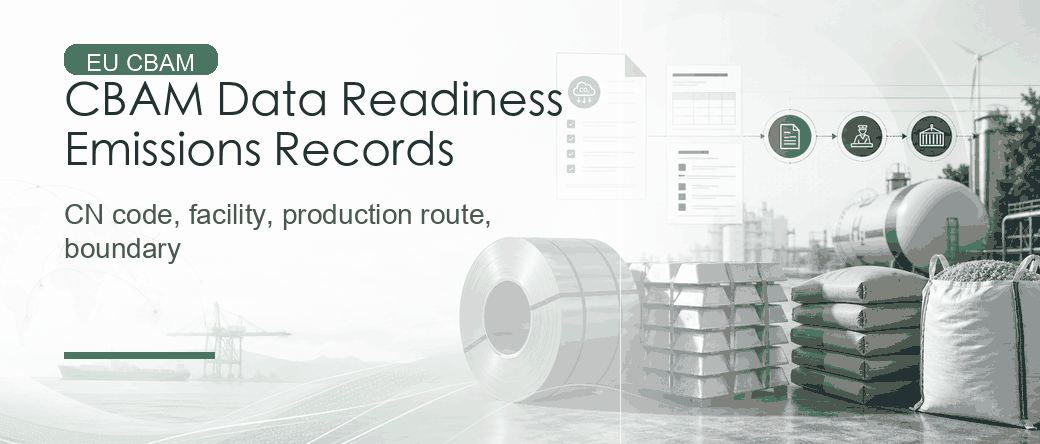
CBAM preparation starts with scope and accountability. First confirm whether the imported goods fall within CBAM, then connect the importer, the non-EU production installation and the supporting records. This page is a practical filing framework; it does not replace a declarant’s or competent authority’s case-specific assessment.
1. Confirm the goods and the accountable parties
For each product, record the CN code, description, quantity, country of origin and production installation, and compare them with Annex I of the CBAM Regulation and the Commission’s sector guidance. The main sectors currently covered are cement, iron and steel, aluminium, fertilisers, electricity and hydrogen. Scope cannot be inferred from a brand name, a factory name or a “green product” label.
Keep separate fields for the EU importer or indirect customs representative, declarant, non-EU installation, installation operator, exporter and supplier. A non-EU manufacturer will commonly provide installation and emissions information; the authorised CBAM declarant in the EU handles the relevant registry, declaration and certificate obligations. The actual allocation of work depends on the transaction and authorisation arrangements.
2. Build an emissions data pack for each product
A traceable product or production-route record should cover at least:
- CN code, product description, unit, import quantity and linked invoice or customs records;
- installation name, address, operator, production process and reporting period;
- direct emissions and, where applicable, indirect emissions, system boundary, activity data, emission factors and calculation method;
- fuel, electricity, input-material and output records, with source, version, owner and change history;
- the basis for using actual or default values, plus verification or supporting notes where applicable.
Do not treat a supplier’s generic environmental statement as CBAM emissions data. Each figure should trace back to an installation, process, period and source record. If default values are used, record their source and limits; do not present them as measured plant data.
3. Hand the data into the declaration workflow
A non-EU installation can organise its emissions information using the Commission’s guidance for installation operators, then match it line by line to the importer’s goods schedule. A useful handover register contains: goods, installation, production route, emissions record, supporting file, owner, version and gap. Preserve the split and aggregation logic when products, installations or routes are combined.
The CBAM Registry supports authorisations, reporting and emissions-data submissions. The definitive regime applies from 2026. The Commission states that importers of CBAM goods, or their indirect customs representatives, above the applicable single mass-based threshold must apply for authorised CBAM declarant status. Check the current legislation and competent-authority guidance for the applicable threshold, reporting period, certificates and exemptions.
4. Manual pre-submission checklist
- Do the CN code, goods description, quantity and invoice reconcile?
- Are the importer, indirect representative, manufacturer and installation kept distinct?
- Can the reporting period, process boundary, unit and precision of each figure be explained?
- Are actual values, default values, verification status and supporting files labelled?
- Does every gap have an owner, basis and next document, rather than a blanket “compliant” label?
- Do the website, quotation and customer messages avoid presenting preparation as an approval, exemption or filing outcome?
5. Sources and boundaries
This page is based on the European Commission pages for the CBAM definitive regime, CBAM Registry, CBAM verification and CBAM legislation and guidance, together with Regulation (EU) 2023/956 on EUR-Lex. Rules, default values, sector coverage and system procedures may change; check the Commission, EUR-Lex and the relevant national competent authority before a formal filing. 绿色方舟(深圳)认证有限公司 may help map products, installations and evidence, but it does not replace the declarant’s legal responsibility or make advance promises about scope decisions or filing outcomes.