
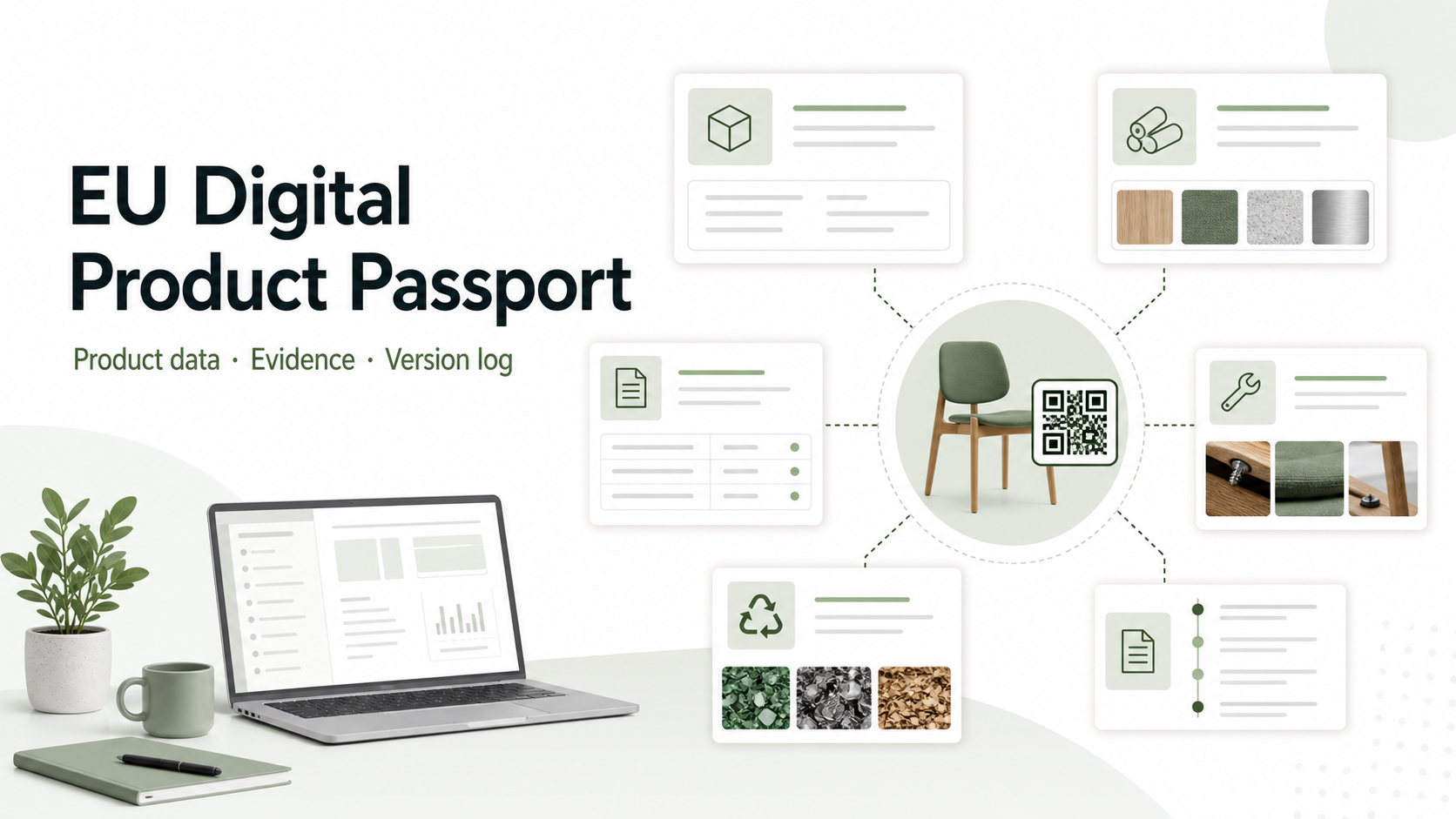
A Digital Product Passport (DPP) is not a stand-alone certificate that can be separated from the product and its regulatory scope. For an organisation preparing products for the EU market, a practical starting point is a traceable register linking product identity, applicable requirements, evidence files, data versions and access rights. This page uses the DPP provisions of the Ecodesign for Sustainable Products Regulation (ESPR), Regulation (EU) 2024/1781, as a framework. The applicable delegated act for the relevant product group remains decisive for the required fields.
1. Separate ESPR, DPP and product-group rules
ESPR provides a framework under which ecodesign and information requirements can be set for product groups. The DPP is the digital mechanism for making that information available. Article 9 links market-placement requirements to the applicable delegated act and the requirements in Articles 10 and 11. It is therefore inaccurate to turn the existence of the ESPR framework into a claim that every product already has one identical DPP obligation.
Start with a scope register: product group, model or SKU, intended Member States, economic-operator role, applicable delegated act, required data level (model, batch or item), and open questions. Customer, marketplace and other regulatory records may be linked as related workstreams, but should not be presented as DPP fields without checking their legal basis.
2. Five core data groups for a DPP register
1. Product identity: model, batch or item level, relationships between variants, a persistent unique product identifier, and the intended location of the data carrier on the product, packaging or accompanying documents. The applicable delegated act determines the final level and placement.
2. Materials and performance: record only attributes supported by technical documentation, tests, calculations or supply-chain records, such as composition, durability, reparability, recyclability or recycled content. Store the method, unit, sample/model coverage and version with each value.
3. Actors and facilities: manufacturers, importers, distributors, repairers, refurbishers and recyclers, together with relevant facilities. Where unique operator or facility identifiers are used, record their source, ownership and change history; do not substitute a supplier name for a legal-entity assessment.
4. Evidence index: create a field–file–product-scope–version–owner–review-date record for each data field. Technical files, test reports, material declarations and repair or recycling records should each state their coverage. A document does not cover every SKU merely because its title looks relevant.
5. Access and maintenance: record which data are available to consumers, business partners, repairers, recyclers, market-surveillance or customs actors, and which are restricted. Keep historical versions, update reasons, correction or withdrawal records and the backup location. DPP data must be accurate, complete and up to date, while the technical design is intended to support open standards and interoperability.
3. Turn the product information sheet into an evidence chain
Use one master record per model and split each requirement into an evidence card: field, value, unit, source file, file version, covered product, responsible actor, data level, date and reviewer. Do not fill gaps with “certified”, “compliant” or verbal supplier statements. Mark them as missing evidence or an applicability question until verified.
Environmental, durability and repairability wording on product pages, packaging and manuals should point back to the same register. State the object, scope and basis of each claim; do not expand a material percentage, repair feature or recycling instruction into an unconditional environmental outcome for the whole product. DPP records may cross-reference CE, EPR, customs, marketplace or third-party certification files, but those workstreams have different purposes and responsibility boundaries.
4. Human pre-publication checklist
Check that the product identifier resolves consistently to the model, batch or item; the data carrier and link follow the applicable requirement; every key field has a locatable source file; test or calculation methods cover the current product; actors, facilities and supply-chain records match; access rights are role-based; product pages, labels, manuals and DPP data use the same version; and every change has an owner, reason and backup record.
5. Boundaries and official sources
This page is a preparation reference, not a substitute for product-specific legal analysis, technical-file assessment or an applicable delegated act. Articles 9–12 of ESPR address DPP availability, data accuracy, identifiers, access, interoperability and backup; the detailed data, carrier, responsibility level and access rights still need to be checked against the relevant product-group rules.
Official sources: Regulation (EU) 2024/1781 (EUR-Lex); European Commission: New law to make products on the EU market more sustainable.
For organisation-specific preparation, 绿色方舟(深圳)认证有限公司 can review the product, market, responsible entity and evidence scope item by item. This page does not promise certification, market access or a completion date.