
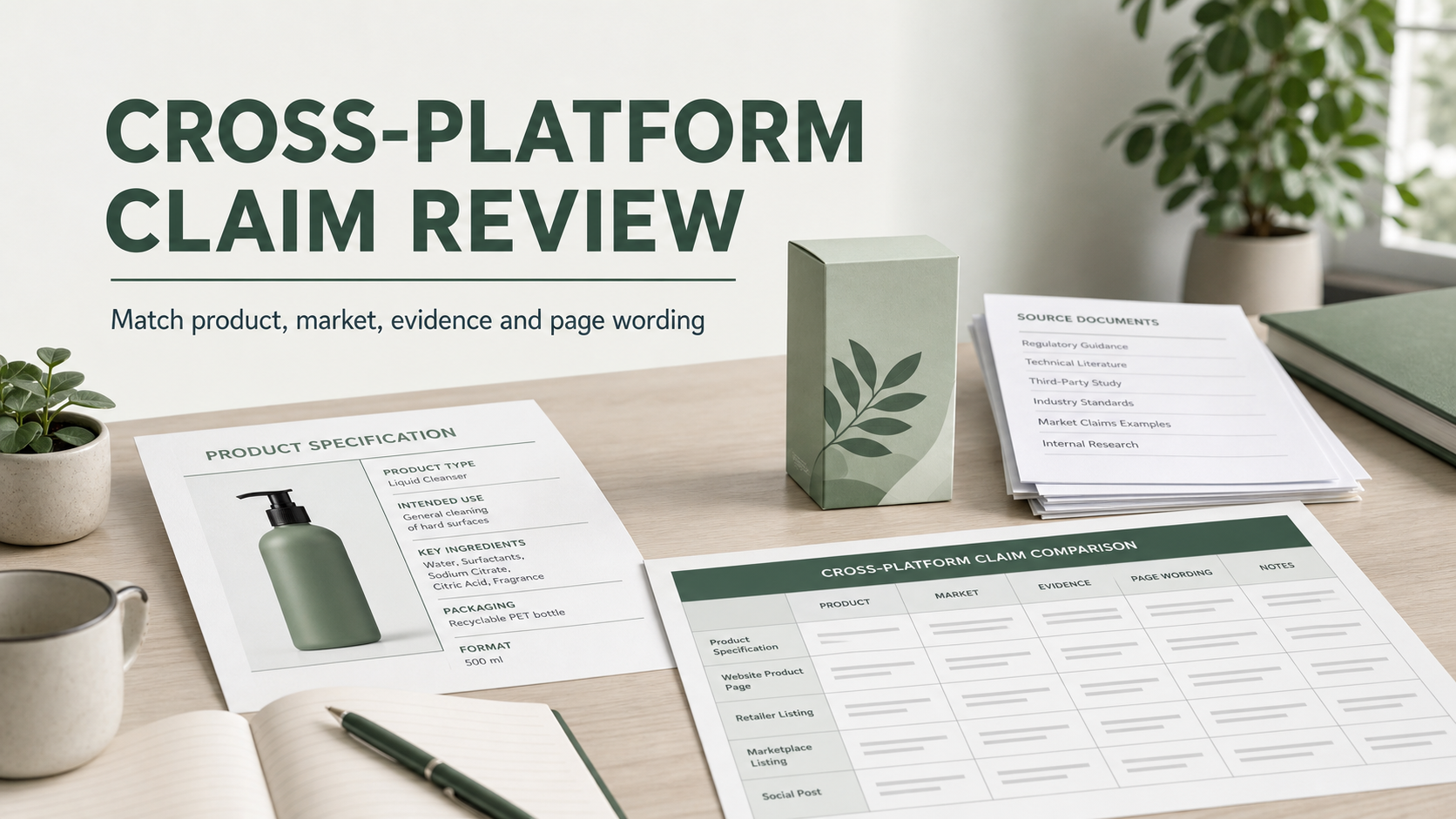
A sustainability statement used on a company website, a retailer page and a marketplace listing cannot be treated as substantiated everywhere merely because one supplier file exists. A practical review maps the claim, product, market, evidence source and page wording in one controlled record, with version history.
1. Define the claim object
Break down terms such as recyclable, recycled content, reusable or lower-carbon into a testable object. Does the statement concern the product, packaging, one material, or a production, distribution or use stage? Record the model, formula or BOM, packaging composition, page location and target market. Avoid replacing a specific proposition with broad language such as green or environmentally friendly.
If a claim covers only one component, material or life-cycle stage, state that limitation near the claim. If a certification name or seal is used, check authorization, certificate holder, covered products and mark rules. A supplier certificate or report supports only the entity, product, dates and scope stated in it; it does not automatically cover every brand SKU.
2. Build a claim–evidence–page register
Use one row per claim and retain: SKU or model; exact wording; target market; claim object and limitation; evidence filename, version, date and issuing party; original source or public lookup route; page location; owner; review decision and missing items.
Product records: specification, BOM, material or formulation details, packaging artwork, use and disposal information.
Supply-chain records: purchase and batch records, supplier declarations, and transaction or chain-of-custody documents only where the relevant scheme applies.
Testing and calculations: report, sampling scope, method, laboratory information, assumptions and source data.
Page records: archived wording or version captures for the website, retailer page, marketplace listing and advertising assets.
3. Review each market and channel separately
Website copy, marketplace submissions, import or product-law files and a buyer questionnaire serve different purposes. Identify the formal source, then check whether it covers the current product, entity, market and date. A platform request is not automatically a statutory duty, and a regulatory document does not necessarily satisfy a platform field.
For the United States, the FTC Guides for the Use of Environmental Marketing Claims help explain the truthfulness and substantiation principles for environmental marketing. For the European Union, use the current legal text, national implementation and product-specific rules. Laws, guidance and platform requirements change, so record the source date and version instead of inventing one universal validity period.
4. Check the page expression
Check whether the words state the object, scope and conditions; whether images, icons, packaging and headings imply a broader benefit; whether evidence traces to the current SKU, entity and version; and whether all languages and channels preserve the same factual limit. Pause absolute or outcome wording such as 100%, zero impact, fully sustainable or guaranteed approval and return to the evidence review.
A revision should cover the H1, summary, body, image text, structured fields and source links together. Keep the previous version, reason for change, reviewer and effective date so the page history remains explainable.
5. Minimum pre-submission checklist
□ Claim object matches the SKU, packaging or material; □ entity, date, scope and version are traceable; □ test or calculation method fits the proposition; □ a limited attribute is not written as a whole-product conclusion; □ Chinese, English and channel assets do not expand the claim; □ sources, files and lookup dates are archived; □ triggers for rechecking regulatory or platform changes are recorded.
绿色方舟(深圳)认证有限公司 can help structure records and clarify claim boundaries. Whether a product meets a law, platform rule or buyer standard remains dependent on the applicable scheme, product facts and current evidence.
Sources and limits
This page is a record-keeping framework, not legal advice and not a substitute for a platform decision, certification-body conclusion or customs determination. Sources reviewed: the U.S. Federal Trade Commission, Guides for the Use of Environmental Marketing Claims (16 CFR Part 260) and Environmental Claims Summary; current environmental-claim and consumer-protection texts on EUR-Lex. Review date: 31 August 2026.


